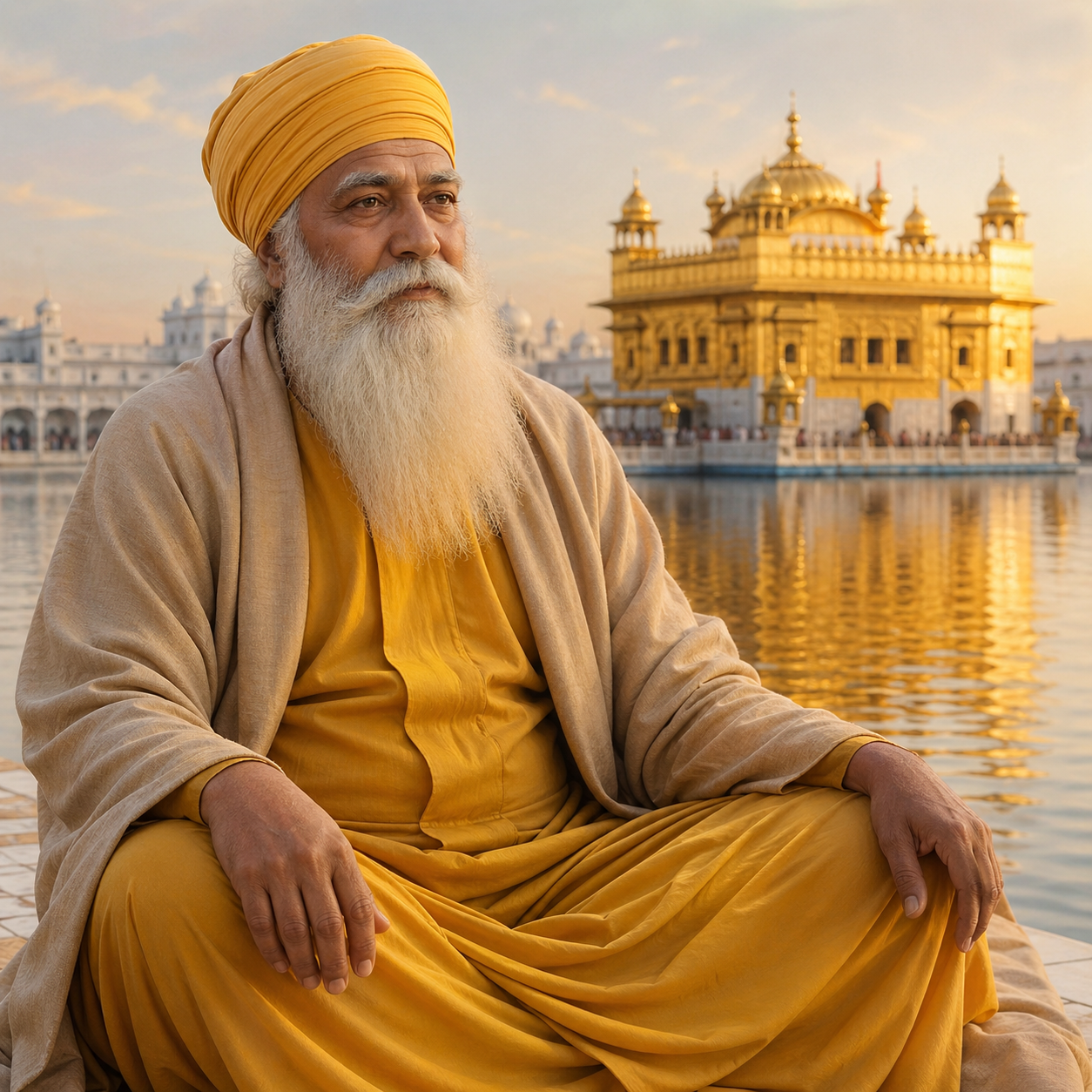
Guru Nanak — "The greatest wealth is contentment. And a really comfortable chair."
The greatest wealth is contentment. And a really comfortable chair.
The greatest wealth is contentment. And a really comfortable chair.
Click any product to generate a realistic preview. Up to 3 at a time.
* Initial load can take up to 90 seconds — revising the preview in another color is nearly instant.
"The body is the field, the mind is the farmer, good deeds are the seeds, and God's Name is the water. Cultivate it well, O peasant, and you shall reap salvation."
"The world is a house of clay, O Nanak, and the soul is a guest."
"The Lord Himself is the enjoyer, and He Himself is the enjoyed."
"The five thieves (lust, anger, greed, attachment, ego) plunder the house of the body."
"He who has no faith in himself can never have faith in God. Or in his ability to assemble IKEA furniture."
Founder of Sikhism and the first of the Ten Sikh Gurus, whose teachings of one universal God and rejection of caste shaped Punjab. Closely associated with Kabir (mystical poet whose verses appear in the Sikh Guru Granth Sahib). For an intellectual contrast, see Brahmanical orthodoxy, the Hindu caste-and-ritual establishment of his era — Sikhism was founded as a deliberate alternative to both Hindu ritual hierarchy and Islamic exclusivism — Nanak's universalism was a structural rejection of caste and priestly mediation.
Found in 1 providers: grok
1 source checked
Contentment — not money, status, or possessions — is the highest form of wealth. The joke twist adds a chair, grounding lofty philosophy in everyday comfort-seeking. Together they suggest true happiness blends inner peace with small physical pleasures. Stop chasing big wins; sometimes the richest life is simply wanting less, while also acknowledging that a genuinely comfortable chair does, in fact, improve everything.
Guru Nanak's core teaching of Santokh (contentment) explicitly rejected materialism and caste-based wealth hierarchies. He left a comfortable government job at age 30 to wander thousands of miles with almost nothing, embodying the principle himself. The comedic chair aside gently pokes at the gap between spiritual aspiration and human comfort-seeking — a tension Nanak's own itinerant, very-much-sitting-on-the-ground life navigated constantly.
In 15th–16th century Punjab, Mughal invasions, Hindu-Muslim sectarian conflict, and rigid caste hierarchies created enormous social instability. Most people owned almost nothing; a cushioned seat was a luxury reserved for rulers and elites. Nanak's radical message — that contentment outweighs accumulation — directly challenged ruling-class wealth ideology and gave ordinary laborers and low-caste communities a framework for dignity without requiring material gain.
AI-generated insights based on extensive research and information for context. Factual errors? Email [email protected].
Your cart is empty