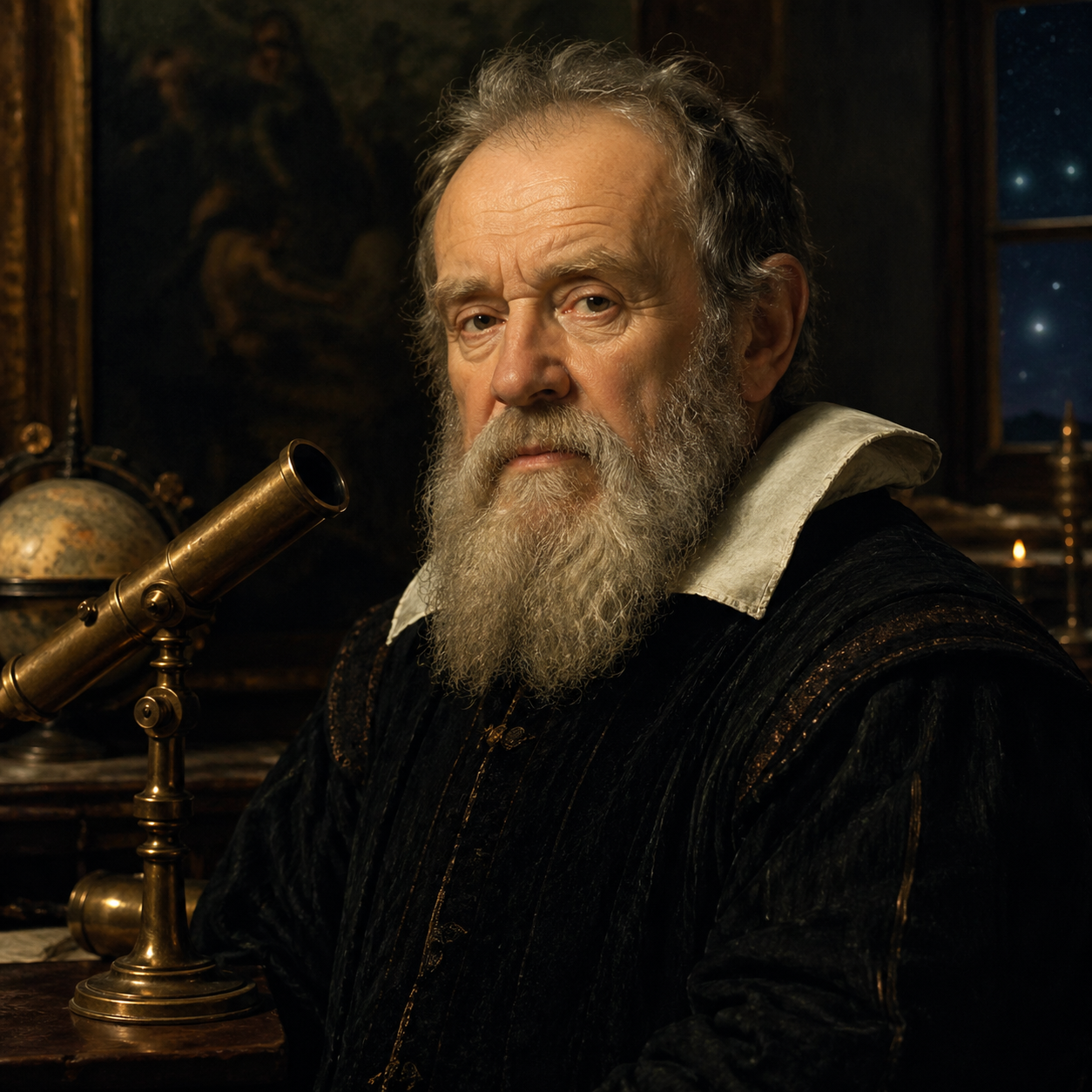
Galileo Galilei — "The greatest wisdom is to know oneself."
The greatest wisdom is to know oneself.
The greatest wisdom is to know oneself.
Click any product to generate a realistic preview. Up to 3 at a time.
* Initial load can take up to 90 seconds — revising the preview in another color is nearly instant.
"Nature is relentless and unchangeable, and it is indifferent as to whether its hidden reasons and actions are understandable to man or not."
"The deeper I go into the sciences, the more I am convinced that the world is the work of an all-wise Creator."
"To understand the universe, you must understand the language in which it's written. And that language is mathematics."
"Facts which at first seem improbable will, even on scant explanation, drop the cloak which has hidden them and stand forth in naked and simple beauty."
"I am about to take leave of this earth, and I can say that I have seen more wonders than any man before me."
Often attributed, but this is a much older Socratic maxim. Unlikely to be a unique Galileo quote.
Date: Uncertain
WisdomFound in 1 providers: grok
1 source checked
True wisdom begins with honest self-examination — understanding your own limitations, biases, and capabilities before claiming to understand the world. It means recognizing what you actually know versus what you merely assume, and having the intellectual humility to distinguish between the two. Self-knowledge is the foundation that makes all other learning reliable and genuine.
Galileo built his entire scientific career on rigorous honesty about what observation actually reveals versus inherited assumption. He challenged Aristotelian cosmology not through ego but through careful self-correcting method. His willingness to admit uncertainty — while standing firm on empirical evidence — defined his conflict with the Church and his revolutionary approach to natural philosophy.
The early modern period was dominated by scholastic authority, where received wisdom from ancient texts overrode direct observation. The Renaissance had sparked individualism and humanist inquiry, but most Europeans still deferred to Church doctrine and Aristotle. Knowing oneself — thinking independently rather than accepting inherited truth — was both philosophically radical and, for figures like Galileo, genuinely dangerous.
AI-generated insights based on extensive research and information for context. Factual errors? Email [email protected].
Your cart is empty