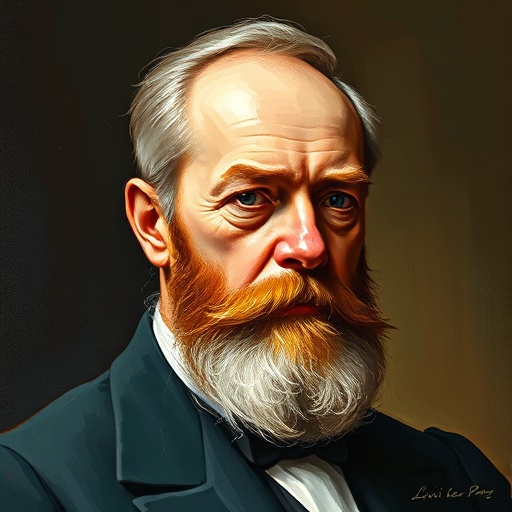
Louis Pasteur — "The Greeks understood the mysterious power of the hidden side of things."
The Greeks understood the mysterious power of the hidden side of things.
The Greeks understood the mysterious power of the hidden side of things.
Click any product to generate a realistic preview. Up to 3 at a time.
* Initial load can take up to 90 seconds — revising the preview in another color is nearly instant.
"Do not let yourself be discouraged by the difficulties of research, and do not be afraid of a little suffering, for it is in this way that the truth will be revealed."
"One must have a certain amount of daring to embark on a scientific career."
"The scientific life is a life of constant battle against error."
"I have no doubt that I shall succeed in my experiments."
"It is by observation and experimentation that we discover the laws of nature."
Found in 1 providers: deepseek
1 source checked
Pasteur is pointing out that the ancient Greeks grasped something profound: invisible or concealed forces often drive visible reality. What we cannot see with our eyes may matter more than what we can. Whether in nature, philosophy, or daily life, surface appearances mislead. True understanding requires looking beyond the obvious to uncover underlying causes, patterns, and influences shaping outcomes we wrongly credit to chance.
This perfectly captures Pasteur's scientific breakthroughs. He proved that invisible microorganisms—germs too small to see—caused disease, fermentation, and spoilage, overturning centuries of belief in spontaneous generation. His germ theory and pasteurization rested entirely on acknowledging a hidden biological world. Quoting the Greeks reveals Pasteur as a cultured scientist who saw his microbial discoveries as confirming ancient intuitions about unseen forces governing visible phenomena.
Pasteur worked in 19th-century France during a revolution in science. Microscopes had improved dramatically, germ theory was controversial, and diseases like cholera, rabies, and anthrax devastated populations without clear cause. Classical education still shaped European intellectuals, so invoking Greek wisdom carried authority. His era bridged ancient philosophy and modern empiricism, making appeals to hidden causes both rhetorically powerful and scientifically timely as laboratories began revealing nature's invisible machinery.
AI-generated insights based on extensive research and information for context. Factual errors? Email [email protected].
Your cart is empty