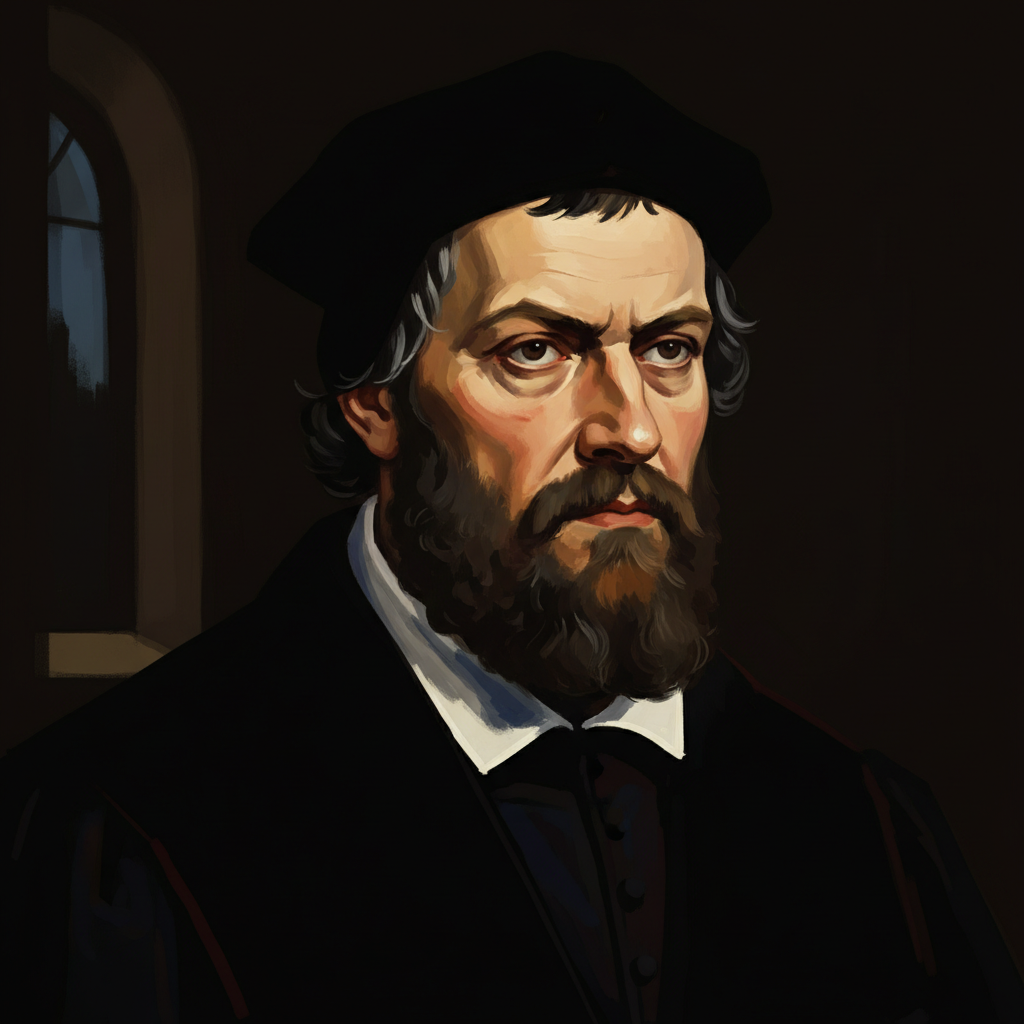
Martin Luther — "The hair on my head is a fine work of art, but it is not necessary for salvation…"
The hair on my head is a fine work of art, but it is not necessary for salvation.
The hair on my head is a fine work of art, but it is not necessary for salvation.
Click any product to generate a realistic preview. Up to 3 at a time.
* Initial load can take up to 90 seconds — revising the preview in another color is nearly instant.
"I frankly confess that even if it were possible I should not wish to have free choice given to me, or to have anything left in my own hands by which I might strive for salvation."
"The book of Esther I toss into the Elbe. I am such an enemy to the book of Esther that I wish it did not exist, for it Judaizes too much and has in it a great deal of heathenish foolishness."
"We are saved by faith alone, but the faith that saves is never alone."
"The world is like a drunken peasant. If you lift him into the saddle on one side, he will fall off on the other."
"Therefore, dear Lords, help here, save here, release here, stab, smite, strangle here, whoever can. And if you die in it, blessed are you; for you die in obedience to God's Word and command (Rom. 13) …"
German theologian whose 95 Theses (1517) launched the Protestant Reformation and broke the Catholic Church's monopoly on Western Christianity. Closely associated with Philipp Melanchthon (Lutheran systematizer) and John Calvin (later Reformer who built on Luther's break). For an intellectual contrast, see Pope Leo X, Renaissance pope (1513-1521) — Leo X's indulgence sales triggered Luther's break and Leo excommunicated him in 1521 — Luther's entire Reformation is structured as a direct answer to the indulgence-funded Vatican Leo represented.
Found in 1 providers: grok
1 source checked
Luther distinguishes between things that are pleasant or impressive and things that actually matter for being right with God. Beautiful hair, fine art, ceremonies, and outward appearances can all have value, but none of them determine whether a person is saved. He is drawing a sharp line between what looks good and what is spiritually essential, insisting that ultimate worth lies elsewhere.
Luther built his entire theology around salvation by faith alone, not by works, rituals, indulgences, or outward observances. As a former Augustinian monk who agonized over his own worthiness, he came to reject the medieval Catholic system that tied salvation to priestly acts and physical practices. This quip captures his blunt humor and his core conviction: external things, however admirable, are spiritually nonessential compared to grace through faith.
In early sixteenth century Europe, the Catholic Church taught that salvation flowed through sacraments, indulgences, pilgrimages, monastic vows, and clerical authority. Tonsures, vestments, relics, and ceremonies were treated as spiritually significant. Luther's 1517 Ninety-Five Theses ignited the Reformation by attacking these external mediators of grace, splitting Western Christianity. His insistence that outward forms were nonessential undermined Rome's authority and reshaped European religion, politics, and culture.
AI-generated insights based on extensive research and information for context. Factual errors? Email [email protected].
Your cart is empty