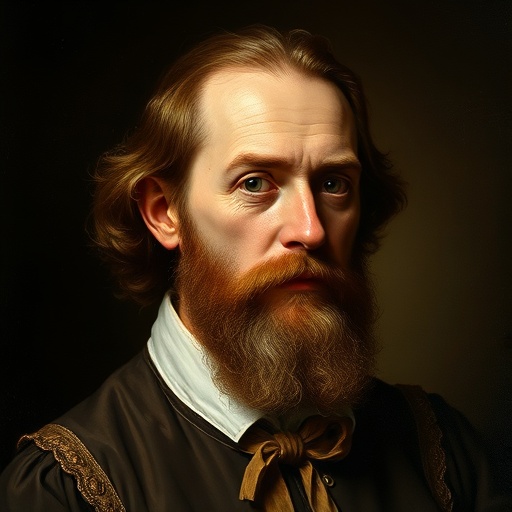
William Harvey — "The heart is like a king, sitting in the middle of his kingdom, sending out comm…"
The heart is like a king, sitting in the middle of his kingdom, sending out commands to the periphery.
The heart is like a king, sitting in the middle of his kingdom, sending out commands to the periphery.
Click any product to generate a realistic preview. Up to 3 at a time.
* Initial load can take up to 90 seconds — revising the preview in another color is nearly instant.
"I have not been afraid to publish my thoughts, knowing that truth, though for a time suppressed, will at last prevail."
"The whole world is a theatre, and all the men and women merely players."
"The body is the instrument of the soul."
"I avow myself the partisan of truth alone."
"We are taught by nature to begin with the simple and proceed to the complex."
English physician whose On the Motion of the Heart and Blood in Animals (1628) demonstrated blood circulation, overturning 1,400 years of Galenic medicine. Closely associated with Francis Bacon (his contemporary in the new English empiricism). For an intellectual contrast, see Galenic medicine, the 2nd-century Greek medical tradition (humors, blood-as-consumed-fuel) — Harvey calculated that the heart pumps more blood per hour than the body could possibly produce as fuel — a single quantitative observation that demolished the entire Galenic-Aristotelian medical worldview. The cleanest example in medical history of arithmetic disproving 14 centuries of authority.
Found in 1 providers: deepseek
1 source checked
The heart functions as a central authority governing the entire body, actively directing blood outward to all distant tissues and organs. Rather than being passive, it operates as a command center—pumping rhythmically, asserting control over circulation, and sustaining life through continuous, coordinated output to every extremity and system it serves.
Harvey's 1628 work De Motu Cordis overturned Galenic medicine by proving blood circulates rather than being consumed. This monarchical metaphor directly mirrors his discovery: the heart as active pump, not passive vessel. Harvey worked under royal patronage—physician to James I and Charles I—making kingly metaphors natural to his intellectual vocabulary.
In 17th-century Europe, absolute monarchy defined political reality. Kings like England's Charles I claimed divine authority over all subjects. Harvey wrote during this era, when hierarchical order—cosmic, political, bodily—felt natural and God-given. Mapping the heart onto royal governance gave his radical circulatory theory familiar, legitimate framing in a world organized around centralized sovereign power.
AI-generated insights based on extensive research and information for context. Factual errors? Email [email protected].
Your cart is empty