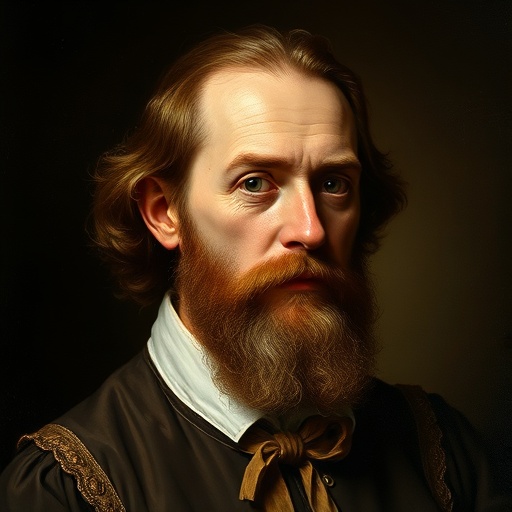
William Harvey — "The heart is the beginning of life, and the source of all motion."
The heart is the beginning of life, and the source of all motion.
The heart is the beginning of life, and the source of all motion.
Click any product to generate a realistic preview. Up to 3 at a time.
* Initial load can take up to 90 seconds — revising the preview in another color is nearly instant.
"It is not the strongest of the species that survives, nor the most intelligent, but the one most responsive to change."
"The blood is the life."
"The body is the instrument of the soul."
"The greatest happiness is to be able to understand the works of God."
"I confess that I have been led to embrace this opinion by a careful consideration of the structure and use of the valves in the veins."
English physician whose On the Motion of the Heart and Blood in Animals (1628) demonstrated blood circulation, overturning 1,400 years of Galenic medicine. Closely associated with Francis Bacon (his contemporary in the new English empiricism). For an intellectual contrast, see Galenic medicine, the 2nd-century Greek medical tradition (humors, blood-as-consumed-fuel) — Harvey calculated that the heart pumps more blood per hour than the body could possibly produce as fuel — a single quantitative observation that demolished the entire Galenic-Aristotelian medical worldview. The cleanest example in medical history of arithmetic disproving 14 centuries of authority.
A statement on the heart's fundamental role in physiology.
Date: 1628 (from 'De Motu Cordis')
Love & RelationshipsFound in 1 providers: gemini
1 source checked
The heart is the central engine of the body — not merely a pump, but the origin point of all biological activity and movement. Without its rhythmic contractions, nothing else in the body functions. Life itself begins and ends with the heart's motion, making it the fundamental source of every physiological process that sustains a living creature.
Harvey spent decades dissecting animals and observing beating hearts to prove blood circulates continuously rather than being consumed. His 1628 masterwork 'De Motu Cordis' placed the heart at the center of his revolutionary circulatory model, overturning Galen's 1,400-year-old static blood theory. This quote is the philosophical core of his life's scientific mission.
In the early 1600s, Galenic medicine still dominated European universities, teaching that the liver produced blood which organs simply absorbed. Harvey's assertion elevated the heart from a passive organ to the body's sovereign engine during a period of intense anatomical investigation sparked by Vesalius, making his claim both scientifically radical and professionally dangerous.
AI-generated insights based on extensive research and information for context. Factual errors? Email [email protected].
Your cart is empty