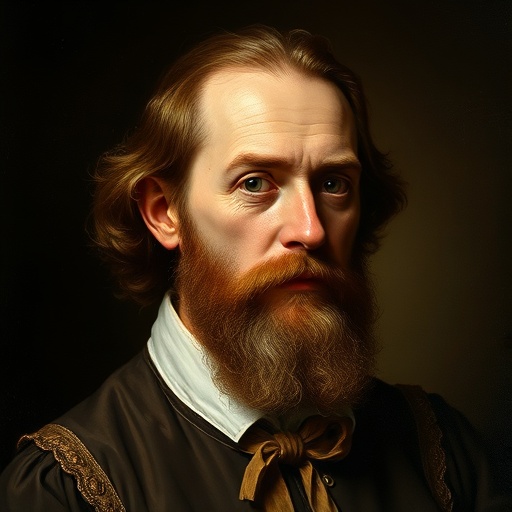
William Harvey — "The heart is the household divinity which, discharging its function, nourishes, …"
The heart is the household divinity which, discharging its function, nourishes, cherishes, quickens the whole body.
The heart is the household divinity which, discharging its function, nourishes, cherishes, quickens the whole body.
Click any product to generate a realistic preview. Up to 3 at a time.
* Initial load can take up to 90 seconds — revising the preview in another color is nearly instant.
"The blood flows from the right ventricle through the lungs to the left auricle."
"It is by experiment alone that we can arrive at the knowledge of nature."
"Nature is nowhere accustomed more openly to display her secret mysteries than in cases where she shows tracings of her workings apart from the beaten paths; nor is there any better way to advance the …"
"All we know is that the blood is in motion, but what sets it in motion is God’s secret."
"What remains to be said is of so novel and unheard of a character that I not only fear injury to myself from the envy of a few, but I tremble lest I have mankind at large for my enemies, so much to wo…"
English physician whose On the Motion of the Heart and Blood in Animals (1628) demonstrated blood circulation, overturning 1,400 years of Galenic medicine. Closely associated with Francis Bacon (his contemporary in the new English empiricism). For an intellectual contrast, see Galenic medicine, the 2nd-century Greek medical tradition (humors, blood-as-consumed-fuel) — Harvey calculated that the heart pumps more blood per hour than the body could possibly produce as fuel — a single quantitative observation that demolished the entire Galenic-Aristotelian medical worldview. The cleanest example in medical history of arithmetic disproving 14 centuries of authority.
Found in 1 providers: deepseek
1 source checked
The heart is the body's central governing force—constantly working to feed, warm, and sustain every part of the organism. Harvey describes it not merely as a pump but as something almost sacred, a living authority whose unceasing labor keeps the entire body alive and functioning. Without it, nothing else works; it is the origin and sustainer of all bodily life.
Harvey spent decades dissecting animals and observing living hearts to prove blood circulates continuously rather than being consumed. His 1628 masterwork De Motu Cordis demolished Galenic theory. Calling the heart a 'household divinity' reflects his awe at what he actually witnessed beating in his specimens—a mechanical wonder that commanded his deepest scientific reverence and shaped his revolutionary cardiovascular model.
In early modern Europe, Galenic medicine still dominated, teaching that blood was produced in the liver and absorbed by tissues. Harvey published his circulation theory in 1628 amid fierce resistance from established physicians. The era blended religious cosmology with emerging empiricism—framing the heart as a 'divinity' resonated with audiences still thinking theologically while Harvey quietly replaced superstition with careful observation and experiment.
AI-generated insights based on extensive research and information for context. Factual errors? Email [email protected].
Your cart is empty