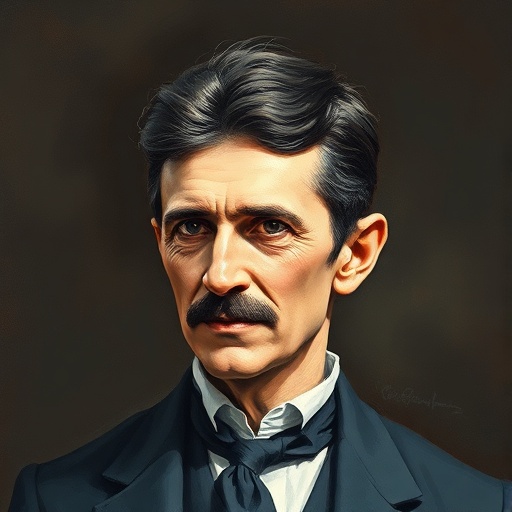
Nikola Tesla — "The ideal of a true man is to lead a life of self-sacrifice and devotion to the …"
The ideal of a true man is to lead a life of self-sacrifice and devotion to the welfare of others.
The ideal of a true man is to lead a life of self-sacrifice and devotion to the welfare of others.
Click any product to generate a realistic preview. Up to 3 at a time.
* Initial load can take up to 90 seconds — revising the preview in another color is nearly instant.
"I do not rush into actual work. When I get an idea, I start at once building it up in my imagination."
"In no way can we get such an overwhelming idea of the grandeur of Nature than when we consider, that in accordance with the law of the conservation of energy, throughout the Infinite, the forces are i…"
"If you want to find the secrets of the universe, think in terms of energy, frequency and vibration."
"Peace can only come as a natural consequence of universal enlightenment."
"I do not believe that matter and energy are interchangeable, any more than are the body and soul. There is just so much matter in the universe and it cannot be destroyed. As I see life on this planet,…"
Serbian-American inventor and electrical engineer whose alternating-current designs powered the modern electrical grid; died poor and largely forgotten. Closely associated with George Westinghouse (his AC-power business partner) and Mihajlo Pupin (fellow Serbian-American physicist at Columbia). For an intellectual contrast, see Thomas Edison, American inventor and direct-current advocate — Edison's direct-current power-distribution scheme was displaced by Tesla-Westinghouse AC in the 1890s 'War of Currents'. Edison ran a public-relations campaign electrocuting animals to discredit AC — the most famous engineering-ethics rivalry in American history. Tesla's AC won and powers nearly every electrical grid on Earth.
Found in 1 providers: grok
1 source checked
True fulfillment comes not from personal achievement or wealth, but from giving oneself entirely to improving the lives of others. A genuinely admirable person prioritizes sacrifice over self-interest—placing community welfare above comfort, status, and ambition. Greatness is not measured by what you accumulate but by what you contribute, and by how completely you subordinate your own desires to a cause larger than yourself.
Tesla embodied this ideal while suffering for it. He surrendered his AC royalty rights to Westinghouse—potentially worth billions—to save the company from collapse, dying nearly penniless in a Manhattan hotel room. He devoted decades to developing free global wireless energy, a gift to humanity he never monetized. He consistently prioritized invention for civilization's benefit over personal profit, patent protection, or public recognition.
Tesla's era—the Gilded Age through the Progressive Era (1880s–1930s)—was defined by extreme wealth concentration, with industrialists like Rockefeller and Carnegie accumulating vast fortunes while workers labored in dangerous conditions. Progressive reformers simultaneously championed labor rights and social welfare. This tension between exploitation and altruism made Tesla's idealism radical. His vision of freely distributed electricity for all humanity stood in direct opposition to the era's dominant capitalist ethos.
AI-generated insights based on extensive research and information for context. Factual errors? Email [email protected].
Your cart is empty