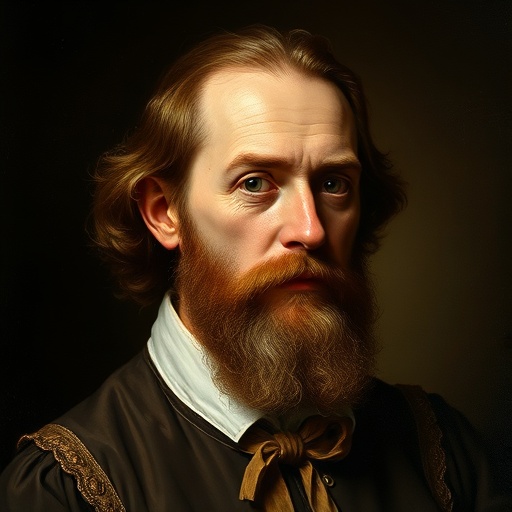
William Harvey — "The knowledge of man is the knowledge of God."
The knowledge of man is the knowledge of God.
The knowledge of man is the knowledge of God.
Click any product to generate a realistic preview. Up to 3 at a time.
* Initial load can take up to 90 seconds — revising the preview in another color is nearly instant.
"I have often wondered, and indeed not a little, at the great difference of opinion among anatomists and physicians in the matter of the pulse and the motion of the heart."
"The circulation of the blood is a new doctrine, and I doubt not but it will meet with its opponents."
"The senses are the primary source of all knowledge."
"The blood in the arteries is of a more florid colour than that in the veins."
"Very many maintain that all we know is still infinitely less than all that still remains unknown; nor do philosophers pin their faith to others' precepts in such wise that they lose their liberty, and…"
English physician whose On the Motion of the Heart and Blood in Animals (1628) demonstrated blood circulation, overturning 1,400 years of Galenic medicine. Closely associated with Francis Bacon (his contemporary in the new English empiricism). For an intellectual contrast, see Galenic medicine, the 2nd-century Greek medical tradition (humors, blood-as-consumed-fuel) — Harvey calculated that the heart pumps more blood per hour than the body could possibly produce as fuel — a single quantitative observation that demolished the entire Galenic-Aristotelian medical worldview. The cleanest example in medical history of arithmetic disproving 14 centuries of authority.
A philosophical and theological statement connecting human understanding with divine knowledge.
Date: Uncertain (attributed)
BiblicalFound in 1 providers: gemini
1 source checked
The quote asserts that understanding human nature — the body, its workings, its design — is equivalent to comprehending divine wisdom. By studying what God created, we access God's own logic and intention. It positions empirical investigation of the human body as a sacred act, closing the gap between scientific inquiry and theological knowledge. To know humanity deeply is to know the mind of its maker.
Harvey spent decades meticulously observing the human heart and blood's movement, ultimately proving circulation through dissection and quantitative experiment. For him, anatomy wasn't merely mechanical — it was revelatory. His relentless dedication to uncovering the body's hidden mechanisms reflects this conviction that mastering human physiology meant decoding a divine blueprint, lending spiritual weight to his revolutionary challenge of centuries-old Galenic tradition.
The early 17th century saw fierce tension between emerging empirical science and Church doctrine. The Scientific Revolution was dismantling ancient authorities like Galen and Aristotle. Thinkers like Harvey needed theological framing to legitimize radical discoveries — casting anatomy as reading God's design made dissection spiritually acceptable rather than sacrilegious, in an era when challenging entrenched medical canon risked profound professional and religious censure.
AI-generated insights based on extensive research and information for context. Factual errors? Email [email protected].
Your cart is empty