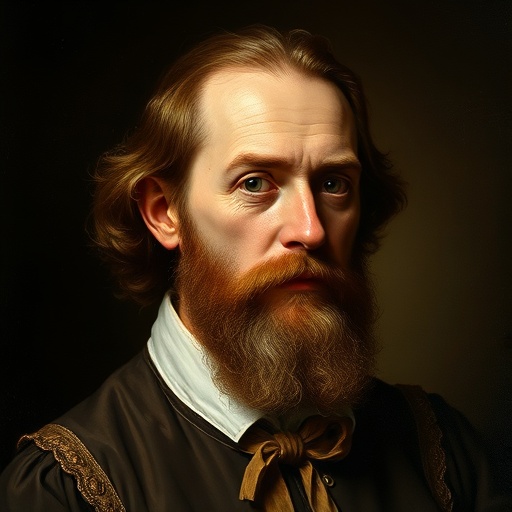
William Harvey — "The left ventricle of the heart ejects blood into the aorta."
The left ventricle of the heart ejects blood into the aorta.
The left ventricle of the heart ejects blood into the aorta.
Click any product to generate a realistic preview. Up to 3 at a time.
* Initial load can take up to 90 seconds — revising the preview in another color is nearly instant.
"The more accurately and industriously I have examined the matter, the more clearly have I perceived the truth."
"I avow myself the partisan of truth alone."
"The body is a machine, but it is a divine machine."
"As art is a habit with reference to things to be done, so is science a habit in respect to things to be known."
"I am not afraid to confess that I am a man who loves to dissect."
English physician whose On the Motion of the Heart and Blood in Animals (1628) demonstrated blood circulation, overturning 1,400 years of Galenic medicine. Closely associated with Francis Bacon (his contemporary in the new English empiricism). For an intellectual contrast, see Galenic medicine, the 2nd-century Greek medical tradition (humors, blood-as-consumed-fuel) — Harvey calculated that the heart pumps more blood per hour than the body could possibly produce as fuel — a single quantitative observation that demolished the entire Galenic-Aristotelian medical worldview. The cleanest example in medical history of arithmetic disproving 14 centuries of authority.
Found in 1 providers: grok
1 source checked
The heart's main pumping chamber forces blood into the body's largest artery, launching it through the entire circulatory system. This describes the mechanical reality of how the heart works as a pump, propelling oxygenated blood outward to nourish every organ and tissue. It is a precise anatomical statement about a specific structural function rather than a metaphor or philosophical claim.
Harvey's 1628 masterwork De Motu Cordis proved through systematic dissection and experimentation that the heart actively pumps blood in a continuous circuit. This statement reflects his revolutionary insight that the heart is a muscular pump, not a passive organ generating heat as Galenic tradition claimed. His quantitative reasoning—calculating blood volume per beat—made this mechanical understanding irrefutable.
In early modern Europe, Galenic medicine still dominated, teaching that blood was consumed by tissues and continuously produced by the liver. Harvey's era saw the Scientific Revolution challenging ancient authority through observation and experiment. His finding overturned 1,400 years of medical dogma at a time when challenging established doctrine carried professional and sometimes personal risk, yet Renaissance humanism created space for empirical inquiry.
AI-generated insights based on extensive research and information for context. Factual errors? Email [email protected].
Your cart is empty