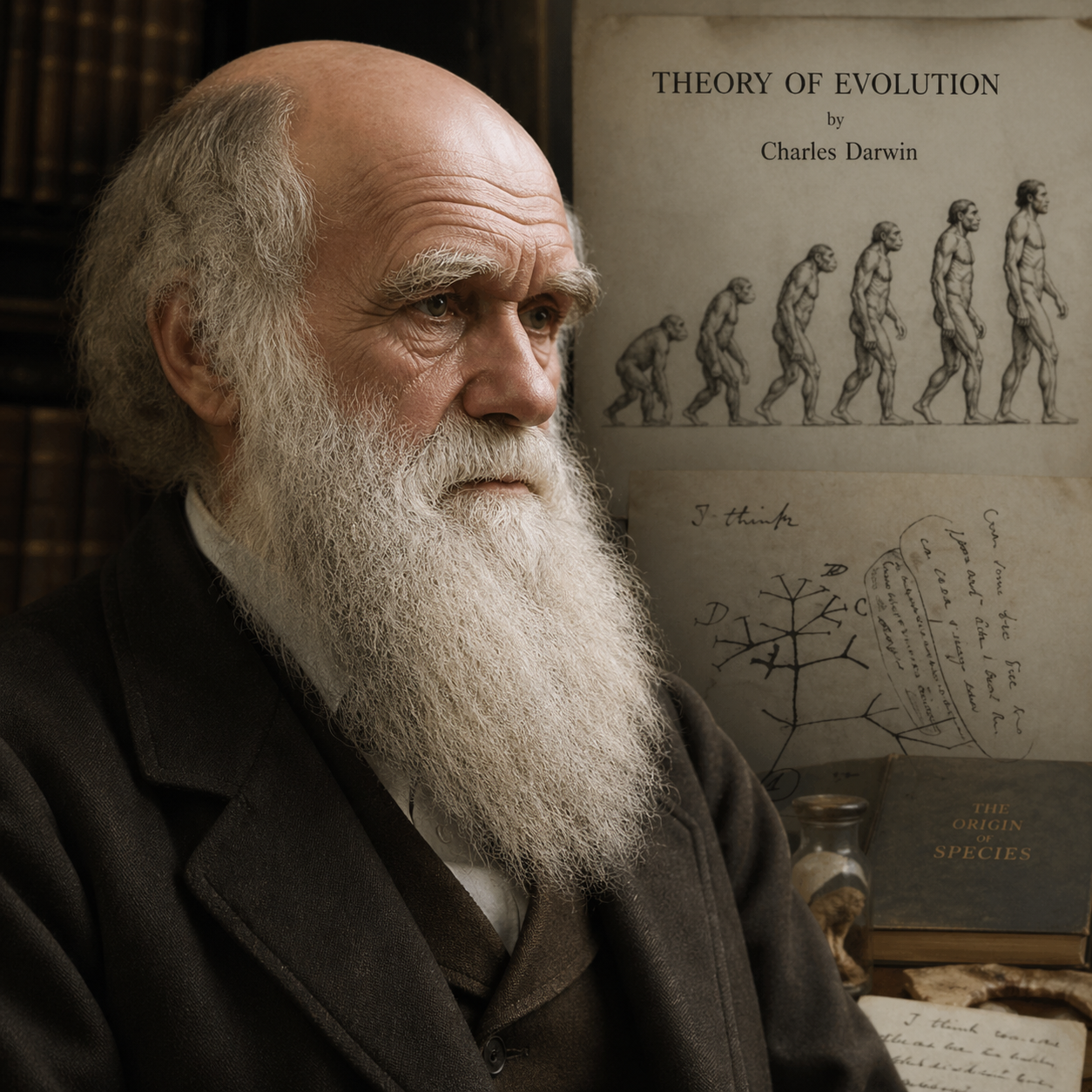
Charles Darwin — "The love for all living creatures is the most noble attribute of man."
The love for all living creatures is the most noble attribute of man.
The love for all living creatures is the most noble attribute of man.
Click any product to generate a realistic preview. Up to 3 at a time.
* Initial load can take up to 90 seconds — revising the preview in another color is nearly instant.
"It is not the strongest of the species that survives, nor the most intelligent that survives. It is the one that is most adaptable to change."
"We are not to be discouraged by the smallness of the means, but to remember that the greatest results are often produced by the accumulation of small effects."
"The very essence of instinct is that it's followed independently of reason."
"The more civilized so-called Caucasian races have beaten the Turkish hollow in the struggle for existence."
"My mind seems to have become a kind of machine for grinding general laws out of large collections of facts, but why this should have caused the atrophy of that part of the brain alone, on which the hi…"
British naturalist whose On the Origin of Species (1859) established evolution by natural selection — the unifying theory of modern biology. Closely associated with Thomas Henry Huxley (his 'bulldog' public defender) and Alfred Russel Wallace (independent co-discoverer of natural selection). For an intellectual contrast, see William Paley, Anglican theologian and Natural Theology author (1743-1805) — Origin of Species is structurally a 400-page reply to Paley — Darwin admired Paley's watchmaker-argument as an undergraduate at Cambridge and then spent 20 years building the empirical machinery to displace him. The cleanest 'design argument vs natural selection' founding rebuttal in science.
The standard scholarly entry points to Charles Darwin's work: Janet Browne (Harvard, history of science) — Charles Darwin: Voyaging (1995) and The Power of Place (2002); Adrian Desmond (UCL, biographer) — Darwin: The Life of a Tormented Evolutionist (1991, with James Moore). These are the works graduate seminars cite when teaching Charles Darwin.
Found in 2 providers: grok,deepseek
2 sources checked
Darwin argues that compassion extending beyond our own species — to animals, insects, and all living things — represents humanity's highest moral quality. Most people naturally limit their care to family, community, or their own kind. The capacity to feel genuine empathy for creatures entirely unlike us, who cannot reciprocate or even understand our concern, is what distinguishes truly noble human character from basic survival instinct and self-interest.
Darwin spent decades documenting thousands of species — beetles, barnacles, earthworms, finches — and was deeply affected by animal suffering he witnessed. He actively opposed vivisection, expressed distress over cruelty to animals in personal letters, and owned beloved pets throughout his life. Crucially, his evolutionary theory placed humans firmly within the animal kingdom rather than above it, making cross-species empathy not just sentiment but a logical extension of shared biological ancestry.
Darwin lived in Victorian Britain (1809–1882), when industrialization drove widespread animal exploitation — overworked horses, factory conditions, rampant vivisection in laboratories. The RSPCA was founded in 1824, and animal welfare debates were intensifying publicly. Meanwhile, dominant religious frameworks maintained humans as divinely separate from animals. Darwin's evolutionary theory directly challenged that separation, making his call for cross-species empathy both scientifically grounded and culturally provocative in an era that routinely treated animals as property.
AI-generated insights based on extensive research and information for context. Factual errors? Email [email protected].
Your cart is empty