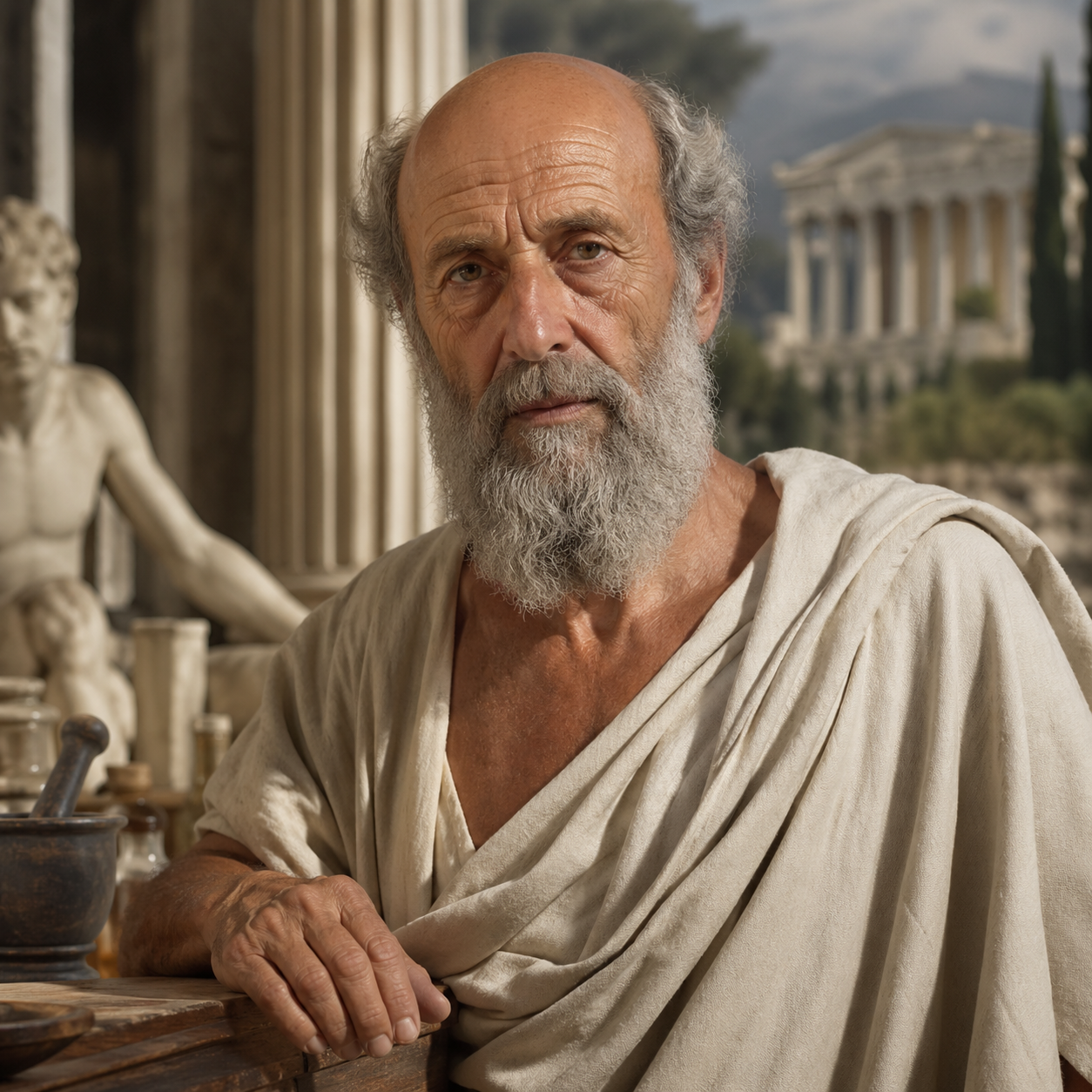
Hippocrates — "The love of wisdom is the mother of all good things."
The love of wisdom is the mother of all good things.
The love of wisdom is the mother of all good things.
Click any product to generate a realistic preview. Up to 3 at a time.
* Initial load can take up to 90 seconds — revising the preview in another color is nearly instant.
"The natural forces within us are the true healers of disease."
"If someone wishes for good health, one must first ask oneself if he is ready to do away with the reasons for his illness. Only then is it possible to help him."
"For extreme diseases, extreme methods of cure, as to restrict them to the knife or fire."
"A wise man should consider that health is the greatest of human blessings, and learn how by his own thought to derive benefit from his illnesses."
"Before you heal someone, ask him if he's willing to give up the things that make him sick."
Found in 1 providers: grok
1 source checked
Pursuing deep understanding and knowledge is the foundation from which all virtuous and beneficial outcomes arise. When people genuinely seek to comprehend how the world works rather than acting on ignorance or assumption, they make better decisions, cause less harm, and create more lasting value. Wisdom is not mere intelligence but disciplined, humble inquiry that guides both thought and action toward what is genuinely good.
Hippocrates built medicine on systematic observation rather than superstition or divine explanation, embodying this principle directly. He demanded physicians study patients carefully, record symptoms honestly, and reason from evidence. His Hippocratic Corpus insists that understanding disease through inquiry protects patients, while ignorance kills them. For him, loving wisdom was not philosophical abstraction but the literal prerequisite for healing effectively and ethically.
In ancient Greece, disease was widely attributed to divine punishment or spiritual imbalance, with temples to Asclepius serving as healing centers. Hippocrates lived during the 5th-4th centuries BCE, when Socratic philosophy was reframing knowledge as earned through rigorous questioning. This tension between supernatural and rational explanations for human suffering made declaring wisdom the source of all good things a culturally bold, even radical, intellectual stance.
AI-generated insights based on extensive research and information for context. Factual errors? Email [email protected].
Your cart is empty