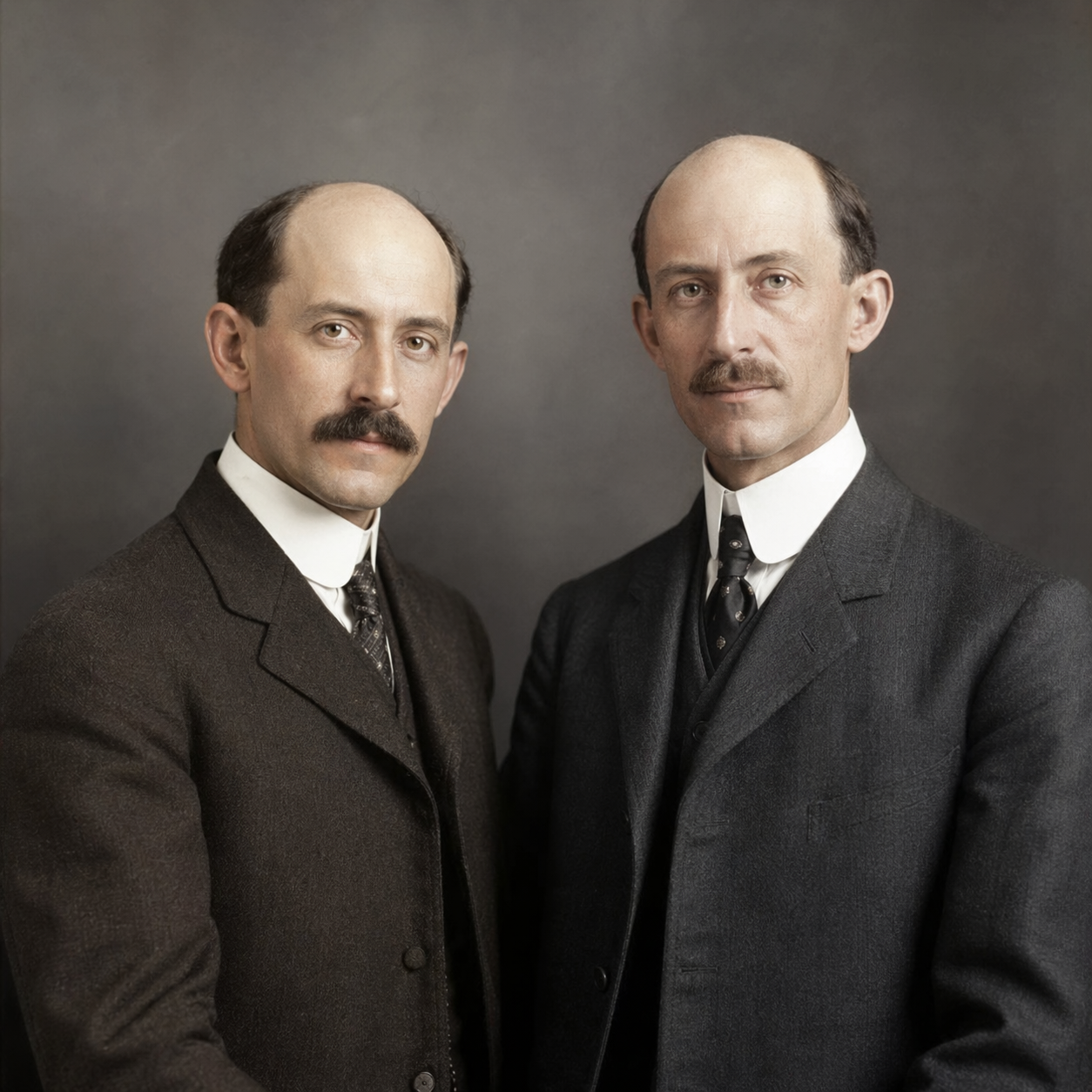
Wright Brothers (Orville & Wilbur) — "The machine has been proven to be a success beyond our most sanguine hopes."
The machine has been proven to be a success beyond our most sanguine hopes.
The machine has been proven to be a success beyond our most sanguine hopes.
Click any product to generate a realistic preview. Up to 3 at a time.
* Initial load can take up to 90 seconds — revising the preview in another color is nearly instant.
"The fact that the machine did not fall apart at the first gust of wind was a great encouragement."
"The difficulties of the problem are so great that few have dared to attack it."
"If birds can glide for long periods of time, then why can't we?"
"No one can appreciate the work and worry it cost us to build our first machine."
"We could not but feel that the time was at hand for man to make a practical flight."
American aviation pioneers who achieved the first sustained powered controlled airplane flight at Kitty Hawk, NC, on December 17, 1903. Closely associated with Octave Chanute (their gliding mentor and aeronautical correspondent). For an intellectual contrast, see Samuel Pierpont Langley, Smithsonian Institution Secretary and government-funded aviation researcher — Langley's Aerodrome crashed twice into the Potomac in October-December 1903 with $50,000 of War Department funding; the Wright Brothers' bicycle-shop empiricism beat Langley's institutional Big Science by 9 days. The most-cited example in engineering history of empirical-tinkerer beating institution-funded credentialism.
Found in 1 providers: grok
1 source checked
The invention has worked even better than we optimistically expected. After testing and refinement, the device performs at a level that surpasses the most hopeful predictions we dared to make. What began as a bold ambition has turned into demonstrated reality, with results exceeding every benchmark we set for ourselves during the development process.
The Wrights spent years as bicycle mechanics methodically solving flight's three-axis control problem, building wind tunnels and gliders at Kitty Hawk before their 1903 Flyer. Their cautious, data-driven temperament makes this restrained celebration characteristic: two self-taught engineers acknowledging that their calculated gamble on powered heavier-than-air flight had paid off, vindicating thousands of glider trials and hand-built engine work in their Dayton workshop.
In the early 1900s, respected scientists and newspapers openly declared powered human flight impossible, and Samuel Langley's government-funded attempts had crashed spectacularly weeks before Kitty Hawk. The era was saturated with industrial optimism, electric lights, automobiles, and telegraphs, yet aviation remained the final frontier of mechanical achievement. The Wrights' quiet announcement challenged entrenched scientific consensus and launched the aerospace century.
AI-generated insights based on extensive research and information for context. Factual errors? Email [email protected].
Your cart is empty