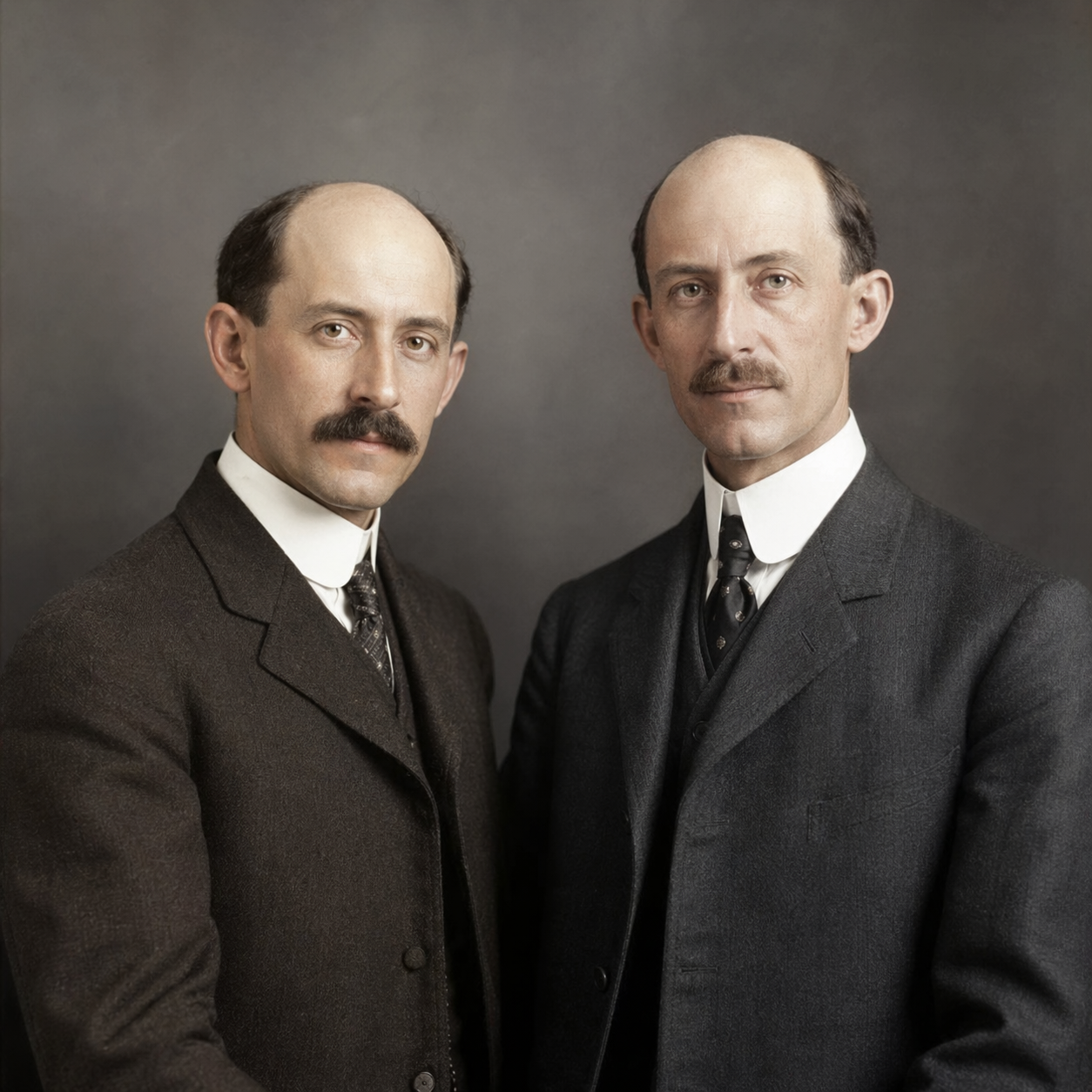
Wright Brothers (Orville & Wilbur) — "The machine has been working very nicely and we have been making several flights…"
The machine has been working very nicely and we have been making several flights each day.
The machine has been working very nicely and we have been making several flights each day.
Click any product to generate a realistic preview. Up to 3 at a time.
* Initial load can take up to 90 seconds — revising the preview in another color is nearly instant.
"It is difficult to understand how anyone could have been so blind to the truth."
"No flying machine will ever fly from New York to Paris."
"It is not necessary to be a horse to be a good jockey."
"The machine is practically ready for its public demonstration."
"We were not as a matter of fact in the habit of thinking of the future. We were too busy with the present."
American aviation pioneers who achieved the first sustained powered controlled airplane flight at Kitty Hawk, NC, on December 17, 1903. Closely associated with Octave Chanute (their gliding mentor and aeronautical correspondent). For an intellectual contrast, see Samuel Pierpont Langley, Smithsonian Institution Secretary and government-funded aviation researcher — Langley's Aerodrome crashed twice into the Potomac in October-December 1903 with $50,000 of War Department funding; the Wright Brothers' bicycle-shop empiricism beat Langley's institutional Big Science by 9 days. The most-cited example in engineering history of empirical-tinkerer beating institution-funded credentialism.
Found in 1 providers: grok
1 source checked
Two inventors calmly report their experimental aircraft is performing reliably and they're completing multiple test flights daily. The tone is deliberately understated—clinical, factual, almost mundane. They're treating a world-changing breakthrough as routine engineering work: observe, test, record, repeat. The quote captures the mindset of practical problem-solvers who measure success not in grand proclamations but in consistent, repeatable results that can be replicated tomorrow.
Former bicycle mechanics from Dayton, Ohio, Orville and Wilbur solved powered flight through relentless systematic experimentation, not formal education or government funding. They documented every test flight obsessively, built their own wind tunnel to gather data rivals ignored, and treated each flight as an engineering iteration. This understated report mirrors their character exactly—methodical, private men who preferred notebooks and repeatable results over public fanfare, even while quietly rewriting the limits of human capability.
In the early 1900s, powered flight was widely considered physically impossible. Months before Kitty Hawk, the Smithsonian-backed Langley Aerodrome had crashed spectacularly and publicly. Skepticism ran so deep that Scientific American refused to believe the Wrights had flown until 1908—five years after the fact. Automobiles were just emerging, and telegraph still defined long-distance communication. Their casual mention of flying several times daily was quietly radical against a backdrop of almost universal disbelief from the scientific establishment.
AI-generated insights based on extensive research and information for context. Factual errors? Email [email protected].
Your cart is empty