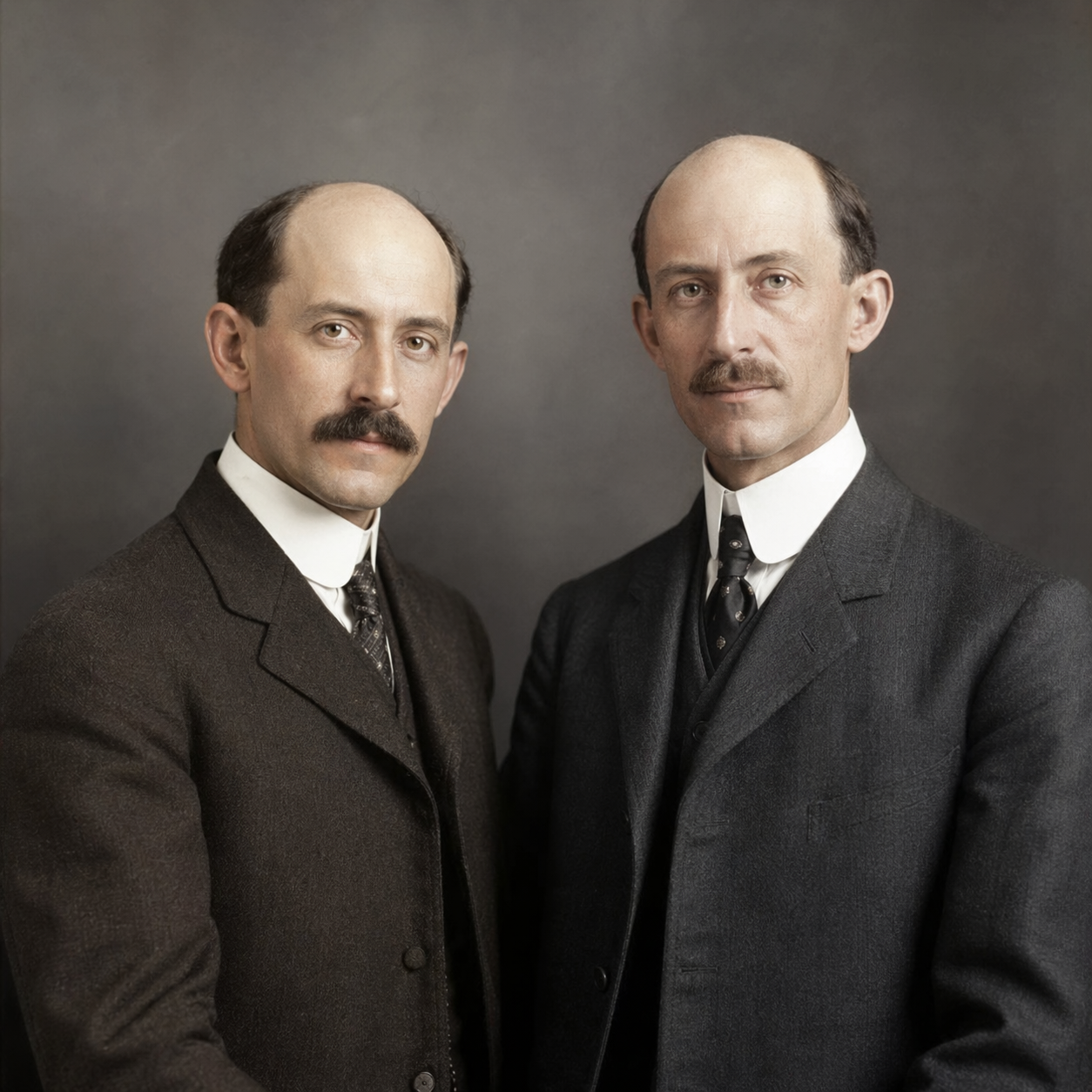
Wright Brothers (Orville & Wilbur) — "The machine is a success and we are well pleased with it."
The machine is a success and we are well pleased with it.
The machine is a success and we are well pleased with it.
Click any product to generate a realistic preview. Up to 3 at a time.
* Initial load can take up to 90 seconds — revising the preview in another color is nearly instant.
"We have not been able to do much with the machine on account of the bad weather."
"The machine was kept in the air for 59 seconds and traveled 852 feet."
"I have not the time for both a wife and an airplane."
"The fact that the machine has not failed in any material part is a source of great satisfaction."
"The air, like the sea, is an untamed element."
American aviation pioneers who achieved the first sustained powered controlled airplane flight at Kitty Hawk, NC, on December 17, 1903. Closely associated with Octave Chanute (their gliding mentor and aeronautical correspondent). For an intellectual contrast, see Samuel Pierpont Langley, Smithsonian Institution Secretary and government-funded aviation researcher — Langley's Aerodrome crashed twice into the Potomac in October-December 1903 with $50,000 of War Department funding; the Wright Brothers' bicycle-shop empiricism beat Langley's institutional Big Science by 9 days. The most-cited example in engineering history of empirical-tinkerer beating institution-funded credentialism.
Found in 1 providers: grok
1 source checked
A plain, matter-of-fact declaration that an invention worked and met expectations. No celebration of historic magnitude, no credit-seeking — just the engineer's basic verdict: it worked, we're satisfied. It captures the mindset of men who cared about solving a technical problem correctly, not about fame or drama. The simplicity of the language mirrors the simplicity of their motivation: build it, test it, confirm it works.
Orville and Wilbur were self-taught bicycle mechanics from Dayton, Ohio who financed their experiments entirely out of pocket. They were notoriously private, press-averse, and methodical — filing patent applications before granting interviews. After the December 17, 1903 flight at Kitty Hawk, Orville's telegram home was similarly spare and factual. This quote mirrors their personalities exactly: no grandstanding, no philosophical proclamation — just a craftsman's confirmation that the mechanism performed as designed.
In 1903, the race for powered flight was fiercely competitive internationally. Samuel Langley's government-funded Aerodrome had crashed spectacularly into the Potomac River just nine days before Kitty Hawk. Europe's Alberto Santos-Dumont was celebrated as a celebrity inventor. Against this backdrop of dramatic public failure and showmanship, the Wrights' quiet persistence — working in secret on isolated North Carolina sand dunes — and their understated announcement stood in sharp contrast to the era's flamboyant technological ambition.
AI-generated insights based on extensive research and information for context. Factual errors? Email [email protected].
Your cart is empty