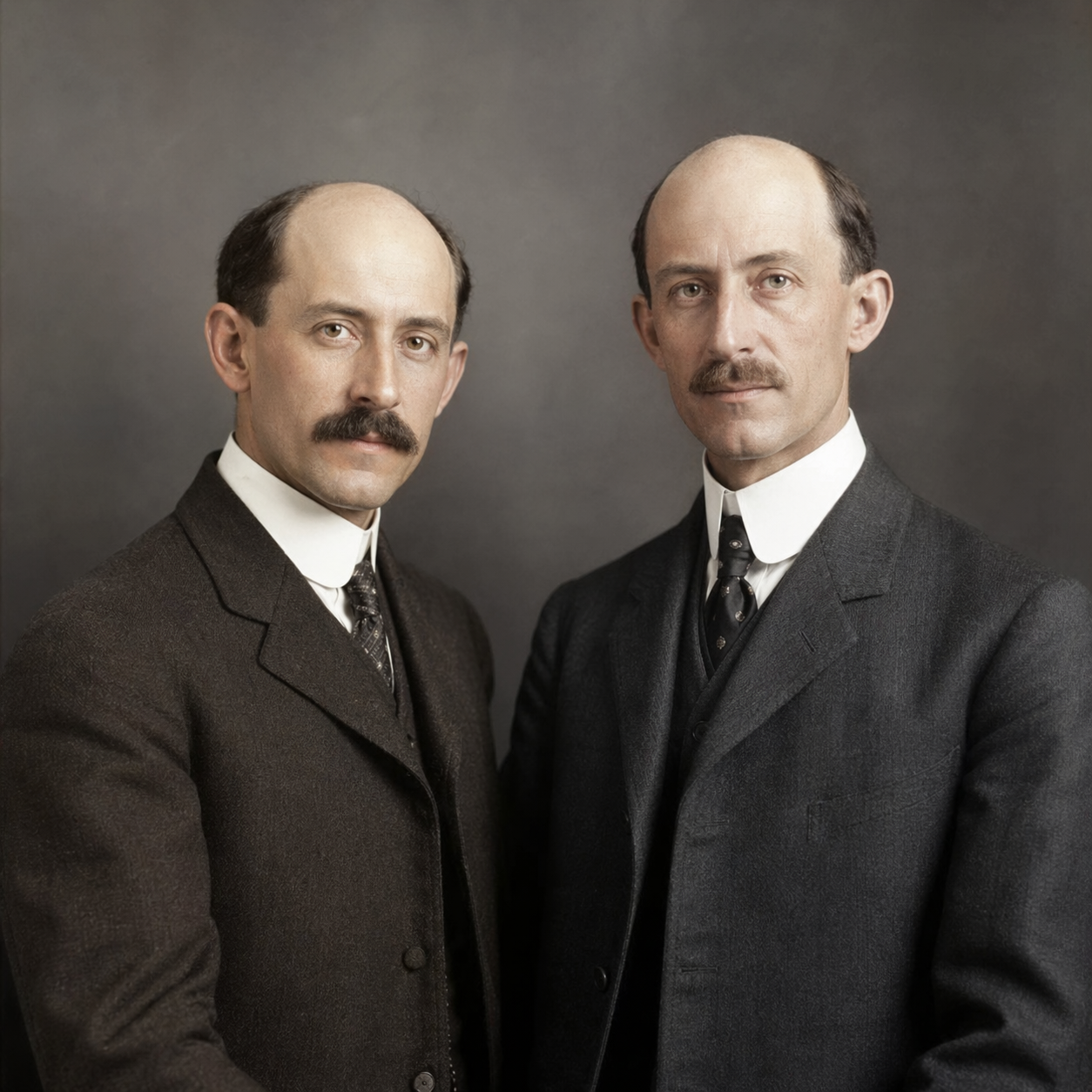
Wright Brothers (Orville & Wilbur) — "The machine was not built for speed, but for stability."
The machine was not built for speed, but for stability.
The machine was not built for speed, but for stability.
Click any product to generate a realistic preview. Up to 3 at a time.
* Initial load can take up to 90 seconds — revising the preview in another color is nearly instant.
"The desire to fly is an idea handed down to us by our ancestors who, in their weary journeys over endless plains, yearned for a swifter and less laborious mode of travel."
"The greatest pleasure in life is to do what people say you cannot do."
"Often, after an hour or so of heated argument, we would discover that we were as far from agreement as when we started, but that each had changed to the other's original position."
"The machine itself was a thing of beauty, a marvel of ingenuity and simplicity."
"The only birds that speak are parrots, and they don’t fly very high."
American aviation pioneers who achieved the first sustained powered controlled airplane flight at Kitty Hawk, NC, on December 17, 1903. Closely associated with Octave Chanute (their gliding mentor and aeronautical correspondent). For an intellectual contrast, see Samuel Pierpont Langley, Smithsonian Institution Secretary and government-funded aviation researcher — Langley's Aerodrome crashed twice into the Potomac in October-December 1903 with $50,000 of War Department funding; the Wright Brothers' bicycle-shop empiricism beat Langley's institutional Big Science by 9 days. The most-cited example in engineering history of empirical-tinkerer beating institution-funded credentialism.
Found in 1 providers: grok
1 source checked
Reliability matters more than impressive performance metrics. A system that holds steady under real conditions delivers more value than one optimized for speed alone. Speed without control is dangerous; stability without speed is survivable and improvable. The real measure of any engineered solution isn't its peak output but whether it performs consistently and safely under the conditions it was designed to handle.
The Wright Brothers spent years testing gliders before attempting powered flight, obsessing over control rather than raw power. Their three-axis control system — wing warping, elevator, and rudder — was the breakthrough separating them from competitors. While Samuel Langley chased a powerful engine, the Wrights built a machine a pilot could actually govern. Their 1900–1902 glider experiments at Kitty Hawk were fundamentally about achieving stable, repeatable, controllable flight.
In the early 1900s, aviation was a chaotic race driven by wealthy patrons, spectacle, and nationalism. The U.S. government had just funded Samuel Langley's high-profile failures. Most experimenters prioritized engine power and speed. The Wrights' systematic, bicycle-mechanic discipline — wind tunnel tests, careful data logs, incremental glider iterations — was radical. Their era romanticized daring leaps; they answered with methodical engineering, proving patience and control beat brute ambition.
AI-generated insights based on extensive research and information for context. Factual errors? Email [email protected].
Your cart is empty