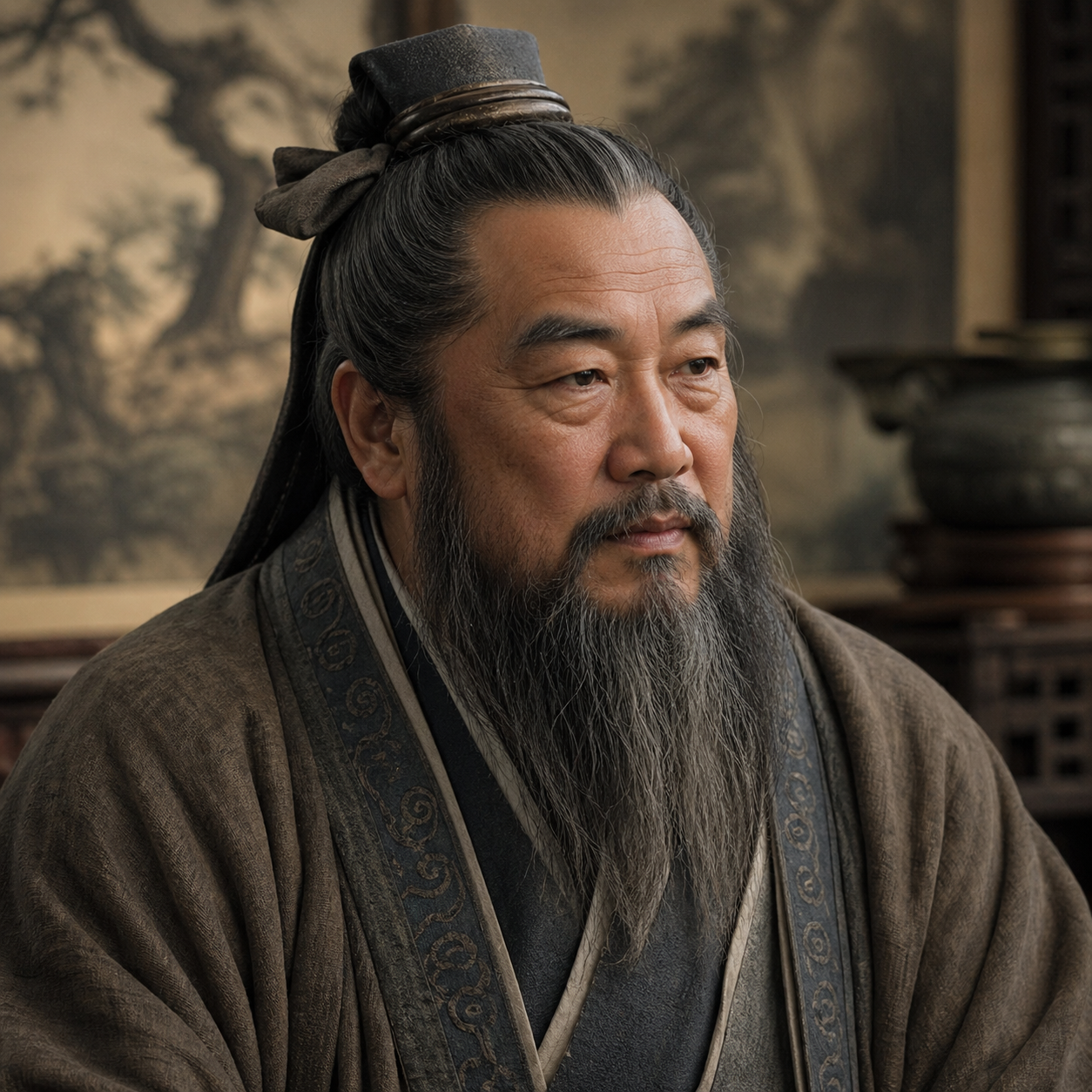
Confucius — "The man who asks a question is a fool for a minute, the man who does not ask is …"
The man who asks a question is a fool for a minute, the man who does not ask is a fool for life.
The man who asks a question is a fool for a minute, the man who does not ask is a fool for life.
Click any product to generate a realistic preview. Up to 3 at a time.
* Initial load can take up to 90 seconds — revising the preview in another color is nearly instant.
"If a man in the morning hear the right way, he may die in the evening hear regret."
"The scholar who cherishes the love of comfort is not fit to be deemed a scholar."
"Everything has beauty, but not everyone sees it."
"The superior man has a dignified ease without pride. The mean man has pride without a dignified ease."
"The Master said, 'What I want to avoid is fixed ideas, obstinacy, narrow-mindedness, and egoism.'"
Chinese philosopher and teacher whose teachings (compiled by his students in the Analects) became the foundational ethical framework of East Asian civilization for 2,500 years. Closely associated with Mencius (his most-influential follower a century later). For an intellectual contrast, see Laozi, near-contemporary Chinese sage and Tao Te Ching author — Confucius systematized social order through ritual and family hierarchy; Laozi's Taoist effortless-action philosophy argued such systems were the disease, not the cure. The two founding poles of Chinese moral philosophy — every East Asian moral tradition since has positioned itself between them.
The standard scholarly entry points to Confucius's work: Philip J. Ivanhoe (Georgetown, Chinese philosophy) — Confucian Moral Self Cultivation (2000); Edward Slingerland (UBC, Asian Studies) — Effortless Action: Wu-wei as Conceptual Metaphor (2003); Tu Weiming (Harvard, Confucian scholar) — Confucian Thought: Selfhood as Creative Transformation (1985). These are the works graduate seminars cite when teaching Confucius.
Found in 1 providers: gemini
1 source checked
Asking a question might make you look ignorant for a moment, but refusing to ask locks in your ignorance forever. The brief embarrassment of admitting you don't know something is a tiny price compared to a lifetime of not understanding. Curiosity and humility are smarter than pride. Swallow the small discomfort of sounding uninformed, because the alternative is never learning the answer at all.
Confucius built his entire teaching method around inquiry and self-examination, famously saying real knowledge begins with admitting what you do not know. He ran an open school, took students from any class, and rewarded those who pressed him with questions. As a traveling advisor who spent decades seeking wisdom from rulers and elders, he modeled the lifelong-learner posture this saying demands.
In sixth-to-fifth-century BCE China, the late Zhou dynasty was collapsing into the Warring States era, and education was largely reserved for aristocrats trained in rigid ritual. Confucius broke that mold by accepting commoner students and treating learning as a moral duty rather than a class privilege. Questioning elders was often considered disrespectful, so his endorsement of asking, even at the cost of momentary embarrassment, was a quietly radical stance.
AI-generated insights based on extensive research and information for context. Factual errors? Email [email protected].
Your cart is empty