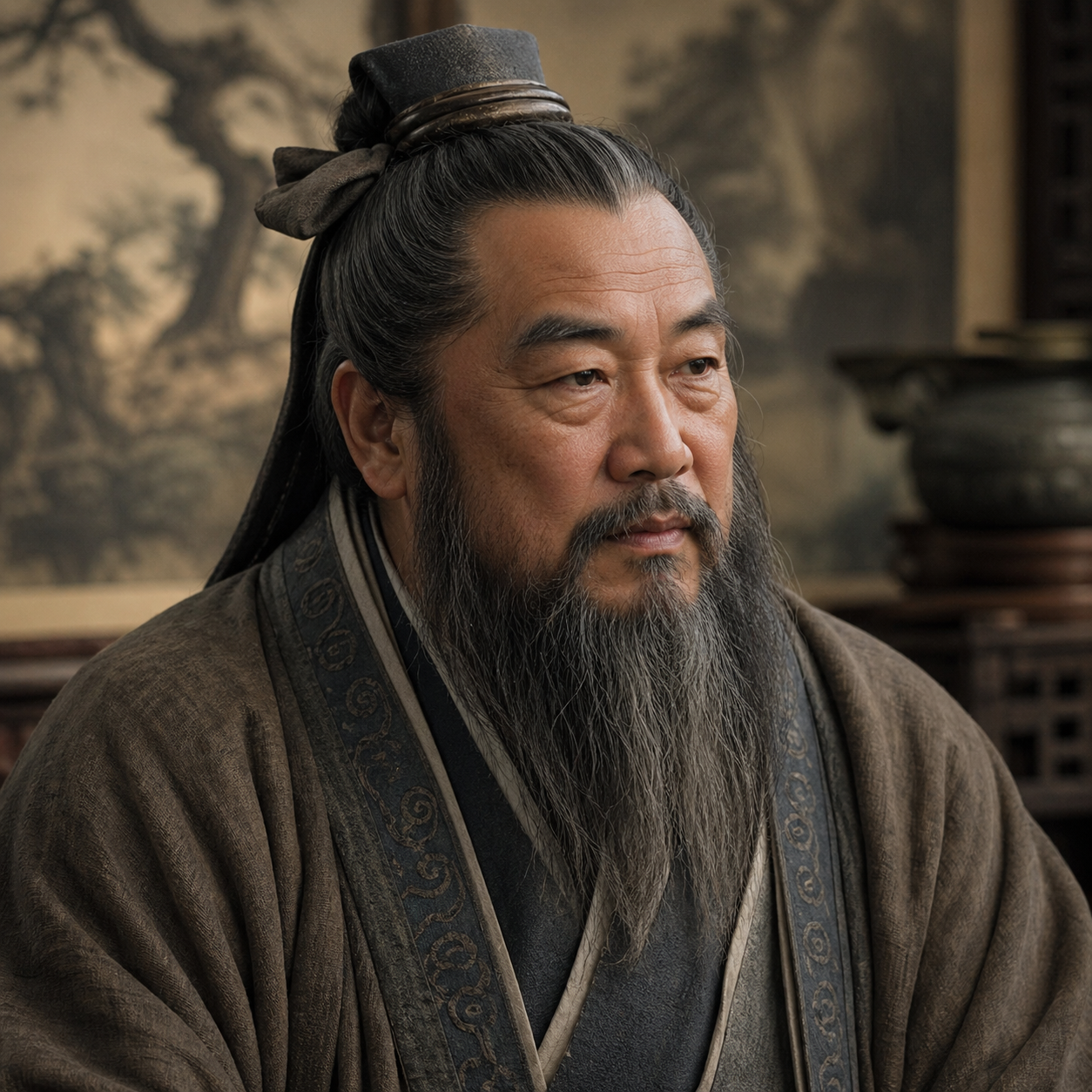
Confucius — "The man who moves a mountain begins by carrying away small stones."
The man who moves a mountain begins by carrying away small stones.
The man who moves a mountain begins by carrying away small stones.
Click any product to generate a realistic preview. Up to 3 at a time.
* Initial load can take up to 90 seconds — revising the preview in another color is nearly instant.
"The gentleman reveres three things. He reveres the mandate of Heaven; he reveres great people; and he reveres the words of sages."
"In a state governed by the Way, poverty and low station are cause for shame; in a state bereft of the Way, wealth and high rank are cause for shame."
"Attack the evil that is within yourself, rather than attacking the evil that is in others."
"He who is not concerned about the distant future will find sorrow near at hand."
"I will not be afflicted that men do not know me; I will be afflicted that I do not know men."
Chinese philosopher and teacher whose teachings (compiled by his students in the Analects) became the foundational ethical framework of East Asian civilization for 2,500 years. Closely associated with Mencius (his most-influential follower a century later). For an intellectual contrast, see Laozi, near-contemporary Chinese sage and Tao Te Ching author — Confucius systematized social order through ritual and family hierarchy; Laozi's Taoist effortless-action philosophy argued such systems were the disease, not the cure. The two founding poles of Chinese moral philosophy — every East Asian moral tradition since has positioned itself between them.
The standard scholarly entry points to Confucius's work: Philip J. Ivanhoe (Georgetown, Chinese philosophy) — Confucian Moral Self Cultivation (2000); Edward Slingerland (UBC, Asian Studies) — Effortless Action: Wu-wei as Conceptual Metaphor (2003); Tu Weiming (Harvard, Confucian scholar) — Confucian Thought: Selfhood as Creative Transformation (1985). These are the works graduate seminars cite when teaching Confucius.
Found in 1 providers: gemini
1 source checked
Big goals get accomplished through small, consistent actions rather than one heroic effort. If a task looks impossibly large, you do not need a giant breakthrough to start; you simply pick up the first manageable piece and keep going. Progress compounds. The mountain does not move because someone is strong enough to lift it, but because someone was patient enough to keep removing stones, day after day, until the work was done.
Confucius spent decades trying to reform corrupt feudal governments and was repeatedly rejected by rulers, yet he kept teaching disciples one at a time. His entire project, building a moral society through the steady cultivation of personal virtue, ren, and ritual propriety, embodied incremental effort. He believed the junzi, or noble person, was forged through daily self-correction and study, not sudden enlightenment, mirroring this saying's patient, accumulative philosophy.
Confucius lived during the late Spring and Autumn period (551-479 BCE), an age of collapsing Zhou authority, constant warfare between rival states, and breakdown of traditional ritual order. Rulers chased quick military victories and shifting alliances while social hierarchies fractured. In that climate of impatience and opportunism, Confucius's insistence on slow moral cultivation and the gradual rebuilding of virtuous government through small, disciplined acts was a radical counterargument to the era's appetite for fast, forceful solutions.
AI-generated insights based on extensive research and information for context. Factual errors? Email [email protected].
Your cart is empty