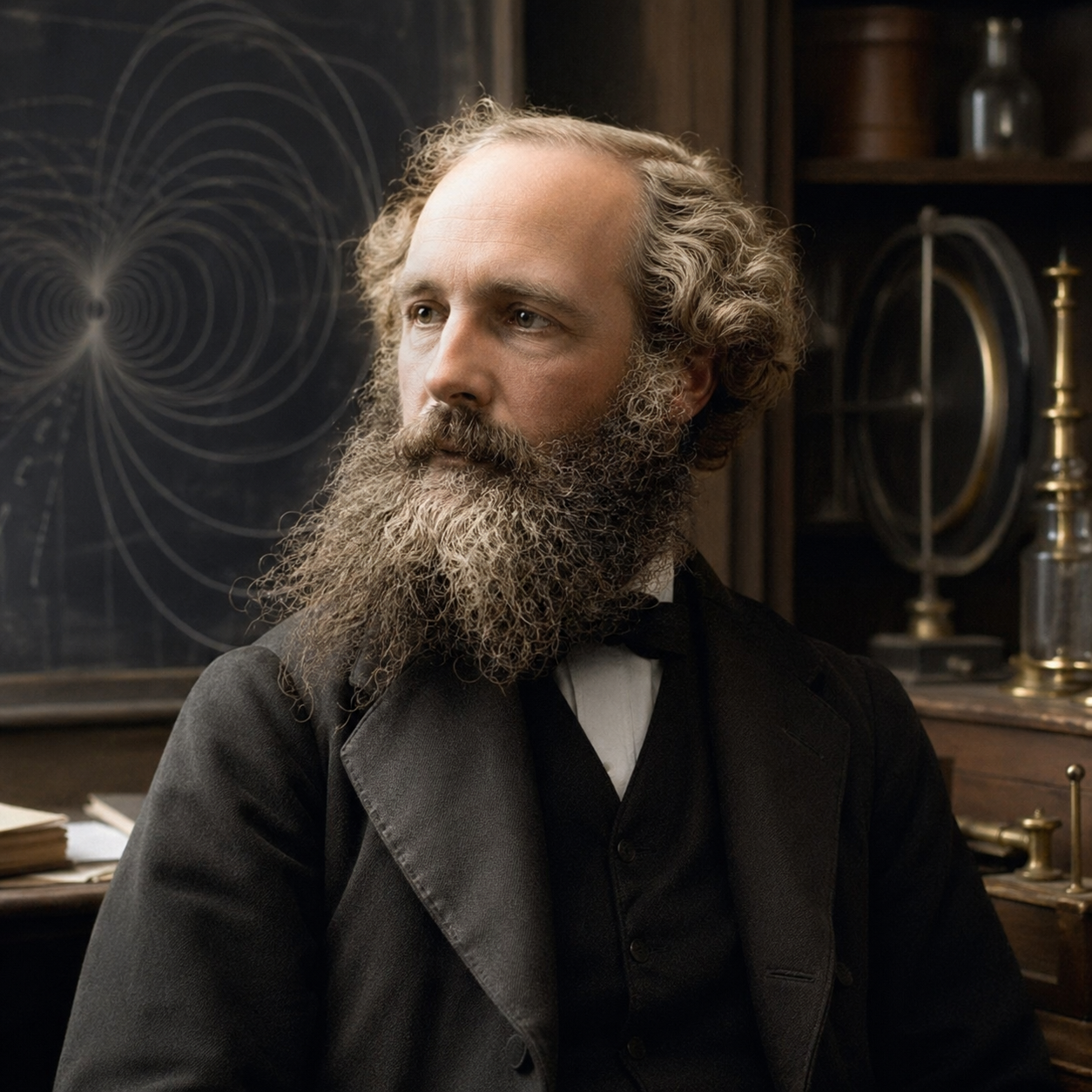
James Clerk Maxwell — "The mind can only attend to one thing at a time."
The mind can only attend to one thing at a time.
The mind can only attend to one thing at a time.
Click any product to generate a realistic preview. Up to 3 at a time.
* Initial load can take up to 90 seconds — revising the preview in another color is nearly instant.
"In the present state of science, it would be a rash thing to assert that any one physical constant is absolutely constant."
"The true beginning of all knowledge is the discovery of something we do not know."
"The present state of science is such that we cannot hope to explain all the phenomena of nature by means of a few simple laws."
"The greatest discovery ever made was the discovery of ignorance."
"I have also a paper afloat, with an electromagnetic theory of light, which, till I am convinced to the contrary, I hold to be great guns."
Found in 1 providers: grok
1 source checked
Human attention is singular, not parallel. When you try to focus on multiple things simultaneously, you are actually switching rapidly between them, and quality suffers in each. True concentration requires narrowing your awareness to a single subject, problem, or task. Multitasking is an illusion; the mind processes one item at a focal point, while everything else recedes into background awareness or gets dropped entirely.
Maxwell worked by immersing himself completely in one problem, famously spending years developing his equations unifying electricity, magnetism, and light. His breakthroughs required sustained single-minded focus on abstract mathematical structures. A devout Presbyterian who memorized long passages of scripture and poetry, Maxwell valued disciplined mental attention. His ability to hold complex field concepts in mind while others saw only disparate phenomena reflected exactly the focused cognition this observation describes.
Maxwell lived 1831-1879 during the Victorian scientific revolution, when natural philosophy was fragmenting into specialized disciplines. Faraday, Helmholtz, and Kelvin were pushing physics forward through deep, narrow investigation. Industrial-era thinkers increasingly debated mental discipline, faculty psychology, and the nature of consciousness. William James would soon formalize attention studies. Maxwell's remark anticipates modern cognitive science findings on working memory limits and the myth of multitasking by over a century.
AI-generated insights based on extensive research and information for context. Factual errors? Email [email protected].
Your cart is empty