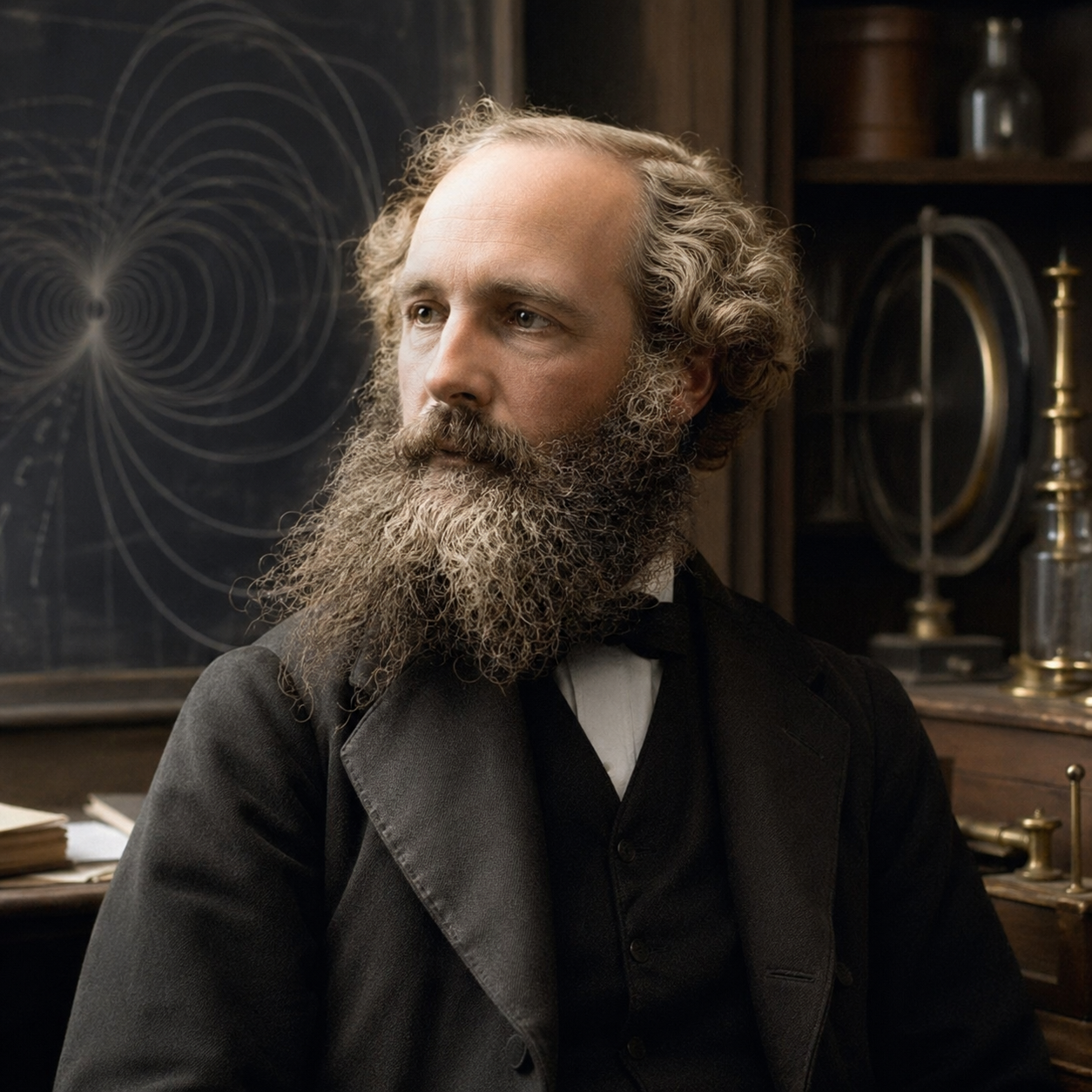
James Clerk Maxwell — "The mind of man is like a mirror, which reflects the images of things, but does …"
The mind of man is like a mirror, which reflects the images of things, but does not always reflect them truly.
The mind of man is like a mirror, which reflects the images of things, but does not always reflect them truly.
Click any product to generate a realistic preview. Up to 3 at a time.
* Initial load can take up to 90 seconds — revising the preview in another color is nearly instant.
"Every existence above a certain rank has its singular points; the higher the rank the more of them. At these points, influences whose physical magnitude is too small to be taken account of by a finite…"
"Mathematicians my flatter themselves that they possess new ideas which mere human language is as yet unable to express."
"The present state of science is such that we cannot hope to explain all the phenomena of nature by means of a few simple laws."
"I saw a rat today in the college garden, and I thought how much more pleasant it would be to be a rat than a professor."
"I have also a paper afloat, with an electromagnetic theory of light, which, till I am convinced to the contrary, I hold to be great guns."
Found in 1 providers: grok
1 source checked
Our minds work like mirrors, taking in the world around us and forming impressions of what we see and experience. But these mental reflections are not always accurate. Perception gets distorted by bias, emotion, prior beliefs, and the limits of our senses. What we think we know about reality is often a warped version of it, and we should stay humble about the reliability of our own thinking and observations.
Maxwell built his career on precise mathematical descriptions of invisible phenomena like electromagnetic fields, where human intuition constantly misleads. A devout Presbyterian with deep philosophical interests, he wrestled with the limits of human knowledge throughout his work. His famous demon thought experiment and color vision research both probed how minds misinterpret physical reality. This quote reflects a scientist acutely aware that instruments and equations were needed precisely because raw perception cannot be trusted to reveal nature truthfully.
Maxwell worked during the Victorian era (1831-1879), a period of massive upheaval in how humans understood reality. Darwin had destabilized biology, photography was challenging notions of objective truth, and physics was revealing invisible forces like electromagnetism that contradicted everyday intuition. Philosophers like John Stuart Mill debated empiricism and the reliability of observation. Maxwell lived at the intersection of deep religious faith and radical scientific discovery, when thinkers urgently questioned whether the human mind could accurately grasp a universe far stranger than common sense suggested.
AI-generated insights based on extensive research and information for context. Factual errors? Email [email protected].
Your cart is empty