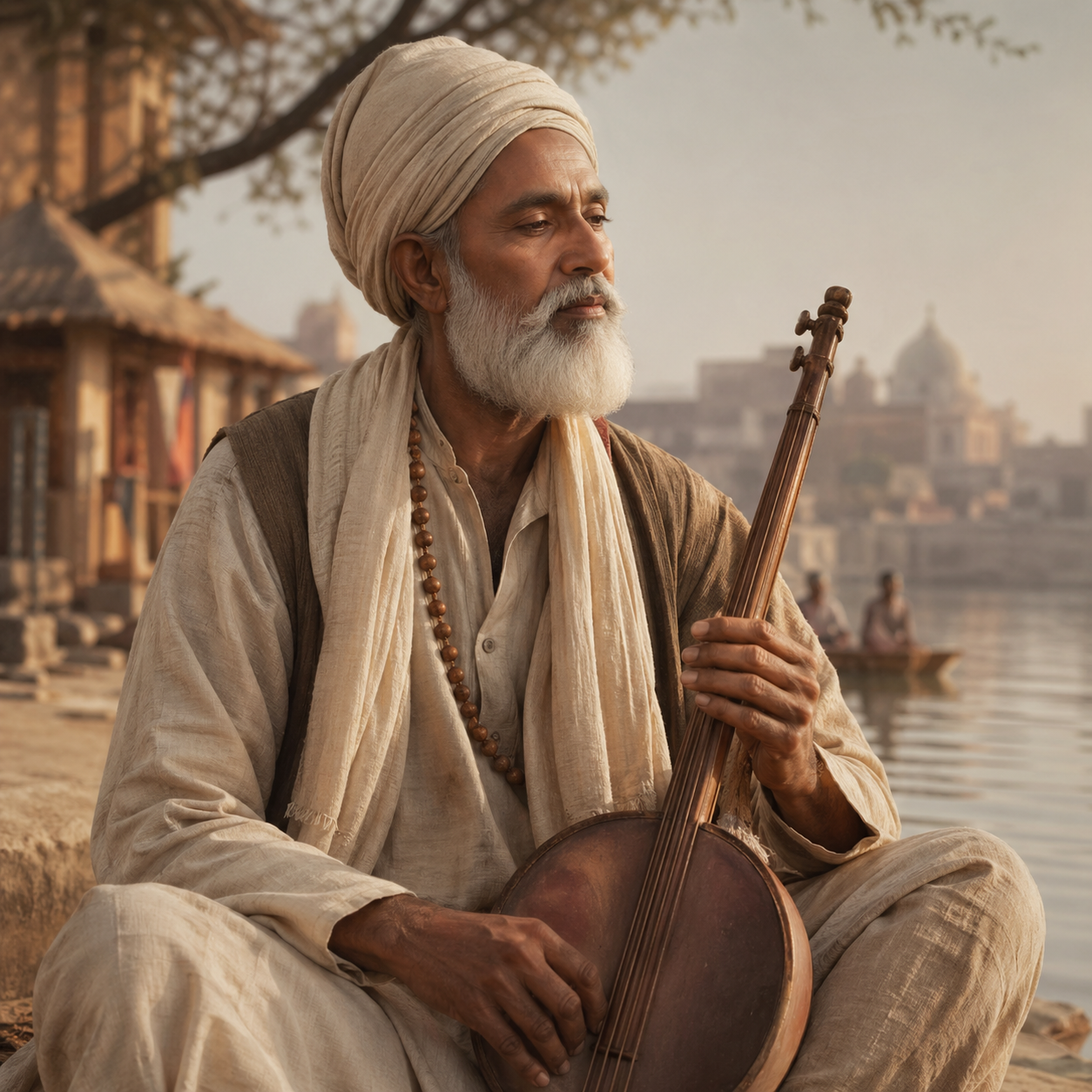
Kabir — "The mirror teaches: what we see is often what we bring."
The mirror teaches: what we see is often what we bring.
The mirror teaches: what we see is often what we bring.
Click any product to generate a realistic preview. Up to 3 at a time.
* Initial load can take up to 90 seconds — revising the preview in another color is nearly instant.
"Bada hua to kya hua, jaise ped khajoor. Panthi ko chhaya nahin, phal lage atidoor. (What good is it to be big like a date palm tree? It gives no shade to travelers, and its fruit is far out of reach.)"
"Kabir stands in the market, wishing all well. Friends with none, enemies with none."
"The fish swims in water but never gets wet."
"Seeing the grinding mill, Kabir wept. Between stones, nothing stays whole."
"I shut not my eyes, I close not my ears, I do not mortify my body; I see with eyes open and smile, and behold His beauty everywhere: I utter His Name, and whatever I see, it reminds me of Him; whateve…"
Indian mystic poet whose verses (preserved in the Sikh Guru Granth Sahib and the Hindu Bhakti tradition) attacked both Hindu and Islamic orthodoxy. Closely associated with Guru Nanak (founder of Sikhism, who incorporated Kabir's verses). For an intellectual contrast, see Brahmanical priesthood, the ritualistic Hindu establishment of his era — Kabir's poetry is the founding text of bhakti devotional rebellion against ritualistic Hinduism — his verses ridicule caste, ritual purity, and priestly mediation as religious theatre.
Emphasizing projection and subjective reality, from his poetry (Dohas).
Date: 15th Century
EducationalFound in 1 providers: gemini
1 source checked
Your cart is empty