James Clerk Maxwell — "The molecules of a gas are like angry bees in a jar, but far more mathematical."
The molecules of a gas are like angry bees in a jar, but far more mathematical.
The molecules of a gas are like angry bees in a jar, but far more mathematical.
Click any product to generate a realistic preview. Up to 3 at a time.
* Initial load can take up to 90 seconds — revising the preview in another color is nearly instant.
"The chief philosophical difficulty in the present state of electrical science is to form a distinct conception of the mode in which electrical action is propagated through space."
"I think men of science as well as other men need to learn from Christ, and I think Christians whose minds are scientific are bound to study science that their view of the glory of God may be as extens…"
"The velocity of light is a quantity of which we have now a more accurate knowledge than of any other physical constant."
"I am not a great mathematician, but I can do a little."
"The value of a scientific theory depends on its power of predicting future events."
Found in 1 providers: deepseek
1 source checked
Gas molecules zip around chaotically, bouncing off each other and their container in ways that look wild and unpredictable, like bees swarming inside a jar. But unlike bees, their motion follows strict statistical rules. Average speeds, collision rates, and pressure can all be calculated precisely. The chaos is only apparent; underneath lies clean mathematics that predicts how billions of particles behave together, even when any single one is impossible to track.
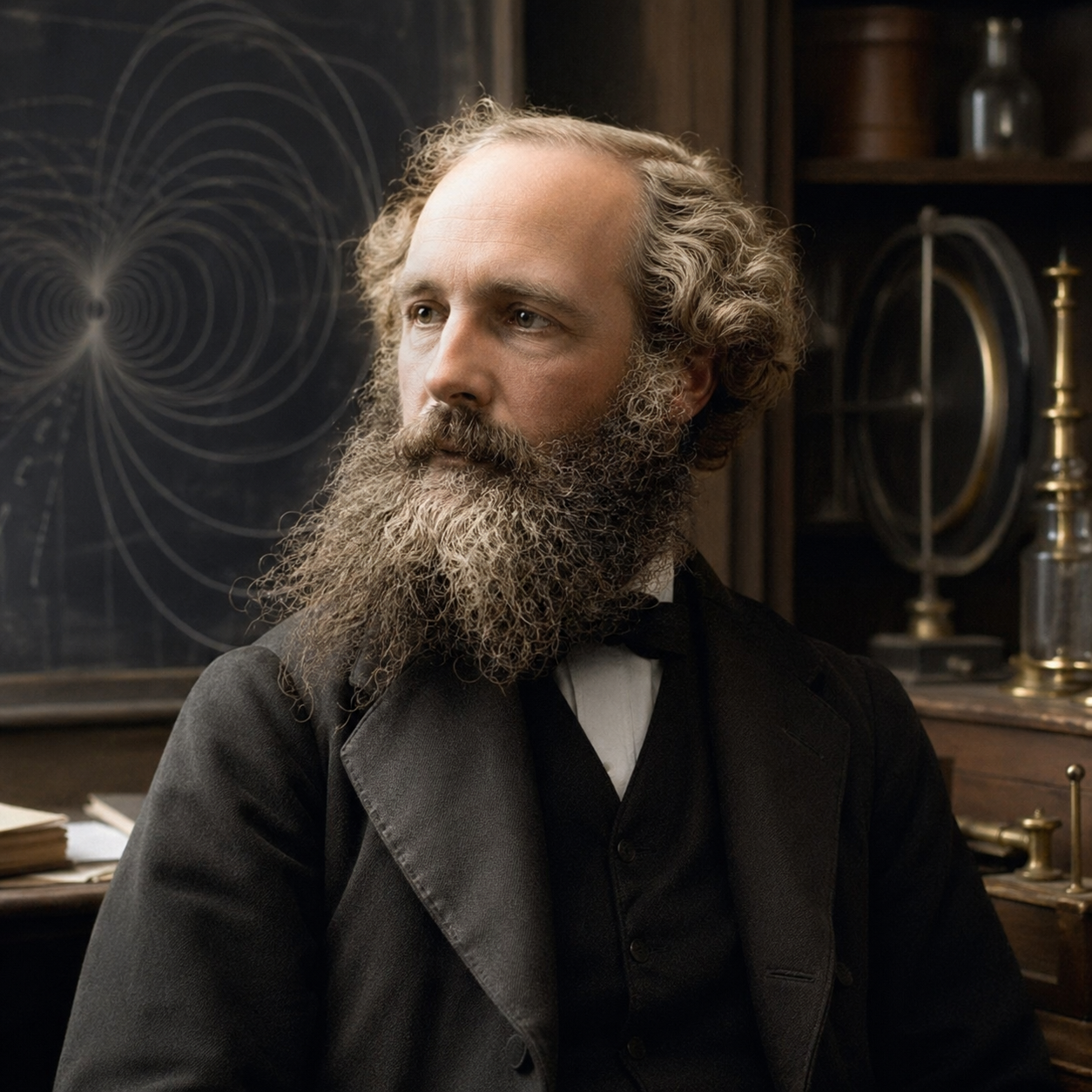
Maxwell built the kinetic theory of gases, deriving the Maxwell-Boltzmann distribution that describes molecular speeds statistically. He was famous for vivid physical intuition paired with rigorous math, exactly what this quip captures. Beyond electromagnetism, he pioneered statistical mechanics, treating invisible molecules as a population governed by probability. His Scottish wit and love of homely analogies, from spinning tops to fish-eye lenses, made him a natural at turning abstract equations into pictures anyone could grasp.
Maxwell worked in the mid-1800s, when atoms were still contested and many physicists doubted molecules existed at all. Thermodynamics was being built from scratch, and Clausius, Boltzmann, and Maxwell were racing to explain heat, pressure, and entropy as products of unseen particles in motion. Industrial steam engines made gas behavior economically urgent, while Victorian science prized mechanical models. Against that backdrop, likening molecules to bees was both a teaching device and a quiet argument that the atomic worldview deserved to be taken seriously.
AI-generated insights based on extensive research and information for context. Factual errors? Email [email protected].
Your cart is empty