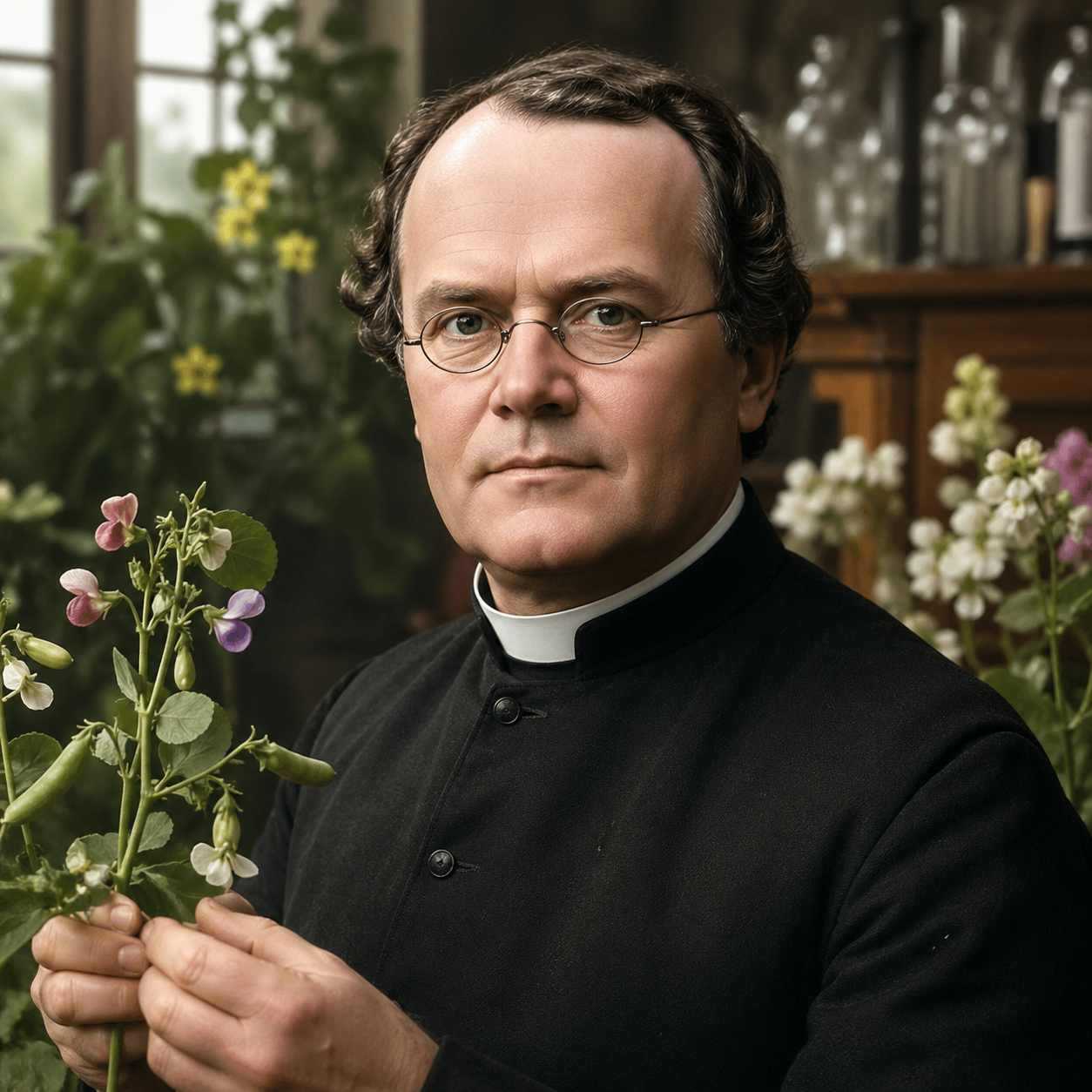
Gregor Mendel — "The monastery garden is my laboratory, and the pea plants are my teachers."
The monastery garden is my laboratory, and the pea plants are my teachers.
The monastery garden is my laboratory, and the pea plants are my teachers.
Click any product to generate a realistic preview. Up to 3 at a time.
* Initial load can take up to 90 seconds — revising the preview in another color is nearly instant.
"I am convinced that it will not be long before the whole world acknowledges the results of my work."
"The most important result of hybridization is beyond doubt the production of new constant forms."
"You should regard the numerical expressions as being only empirical, because they can not be proved rational."
"It is indeed a pity that the results of the experiments cannot yet be published, as I have not yet succeeded in obtaining the desired number of generations."
"The numerical ratios I have observed cannot be dismissed as mere coincidence."
Found in 1 providers: deepseek
1 source checked
Patience and careful observation in ordinary surroundings can reveal universal truths. Mendel expresses that his scientific knowledge came not from textbooks or formal instruction but from directly watching nature work — tracking how traits passed from plant to plant across generations. It valorizes humility in learning: the natural world itself is the ultimate teacher. Any space, even a monastery garden, can become a laboratory when approached with curiosity, rigor, and systematic attention.
Mendel literally conducted his landmark heredity experiments in the monastery garden at St. Thomas's Abbey in Brno, cultivating roughly 29,000 pea plants over eight years. As an Augustinian friar without a formal university research position, he transformed his humble surroundings into a scientific workspace. His patient, systematic tracking of inherited traits — seed color, plant height, pod shape — embodied his belief that nature's hidden laws could be decoded through disciplined, empirical observation rather than speculation.
During Mendel's 1850s–1860s experiments, Darwin had just upended biology with evolution theory, yet heredity mechanisms remained entirely unknown. No chromosome theory existed; DNA was undiscovered. Formal scientific laboratories were rare outside elite universities, and much natural science was conducted by clergy or gentleman-scholars. Mendel's garden approach was both practical necessity and philosophical statement — proving that rigorous botanical experiments, not expensive equipment or institutional prestige, could crack one of biology's deepest mysteries.
AI-generated insights based on extensive research and information for context. Factual errors? Email [email protected].
Your cart is empty