Werner Heisenberg — "The more profound the knowledge, the more clear is the awareness of the limits o…"
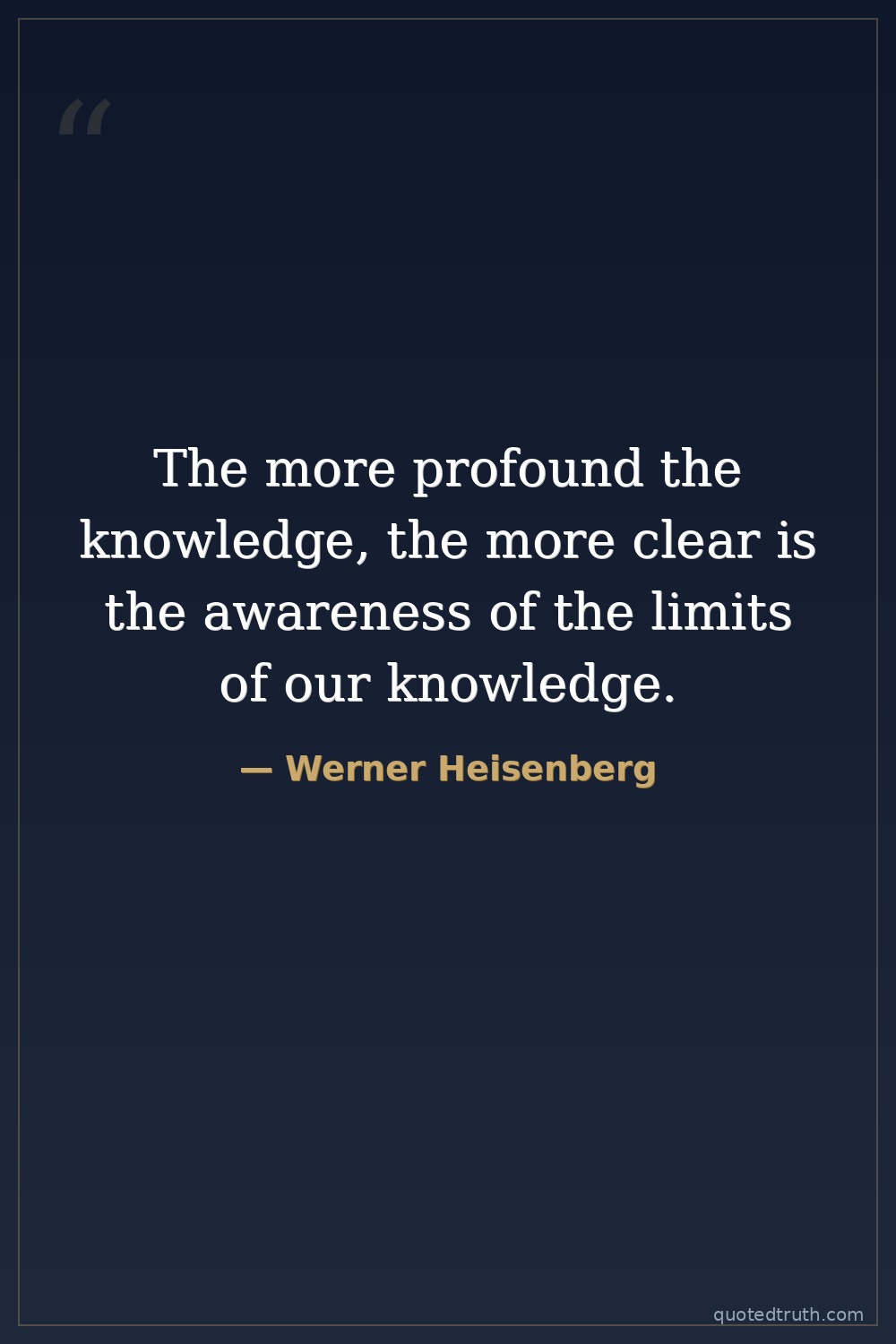
The more profound the knowledge, the more clear is the awareness of the limits of our knowledge.
The more profound the knowledge, the more clear is the awareness of the limits of our knowledge.
Click any product to generate a realistic preview. Up to 3 at a time.
* Initial load can take up to 90 seconds — revising the preview in another color is nearly instant.
"Where there is no uncertainty, there is no quantum mechanics."
"I am firmly convinced that we must never judge political movements by their aims, no matter how loudly proclaimed or how sincerely upheld, but only by the means they use to realize these aims."
"The problems of language here are really serious. We wish to speak in some way about the structure of the atoms. But we cannot speak about atoms in ordinary language."
"The more precise the measurement of position, the more imprecise the measurement of momentum, and vice versa."
"The world of atoms is a world of possibilities and not a world of things."
Found in 1 providers: grok
1 source checked
Real expertise brings humility. As you learn more deeply about any subject, you discover how much you still don't understand and where certainty breaks down. Shallow learners feel confident because they haven't yet encountered the hard edges; deep learners see the boundaries clearly. Knowing more means knowing, precisely, what you don't know and perhaps what cannot be known at all.
Heisenberg literally formalized a limit on knowledge with his 1927 uncertainty principle, proving position and momentum cannot both be known exactly. His life's work in quantum mechanics forced him to accept that nature itself bars certain measurements. A devout reader of Plato and philosophy, he often reflected on epistemic humility, treating the boundaries of physics as a feature of reality, not a failure of instruments or intellect.
Heisenberg worked in 1920s-30s Germany as classical physics cracked open. Einstein's relativity had unseated Newton, and Bohr's Copenhagen circle was rebuilding reality on probability. Two world wars and the atomic bomb made scientists publicly reckon with what science could and should know. Against Enlightenment confidence in total understanding, quantum theory forced a generation to concede that observation itself disturbs truth, reshaping philosophy, theology, and postwar culture.
AI-generated insights based on extensive research and information for context. Factual errors? Email [email protected].
Your cart is empty