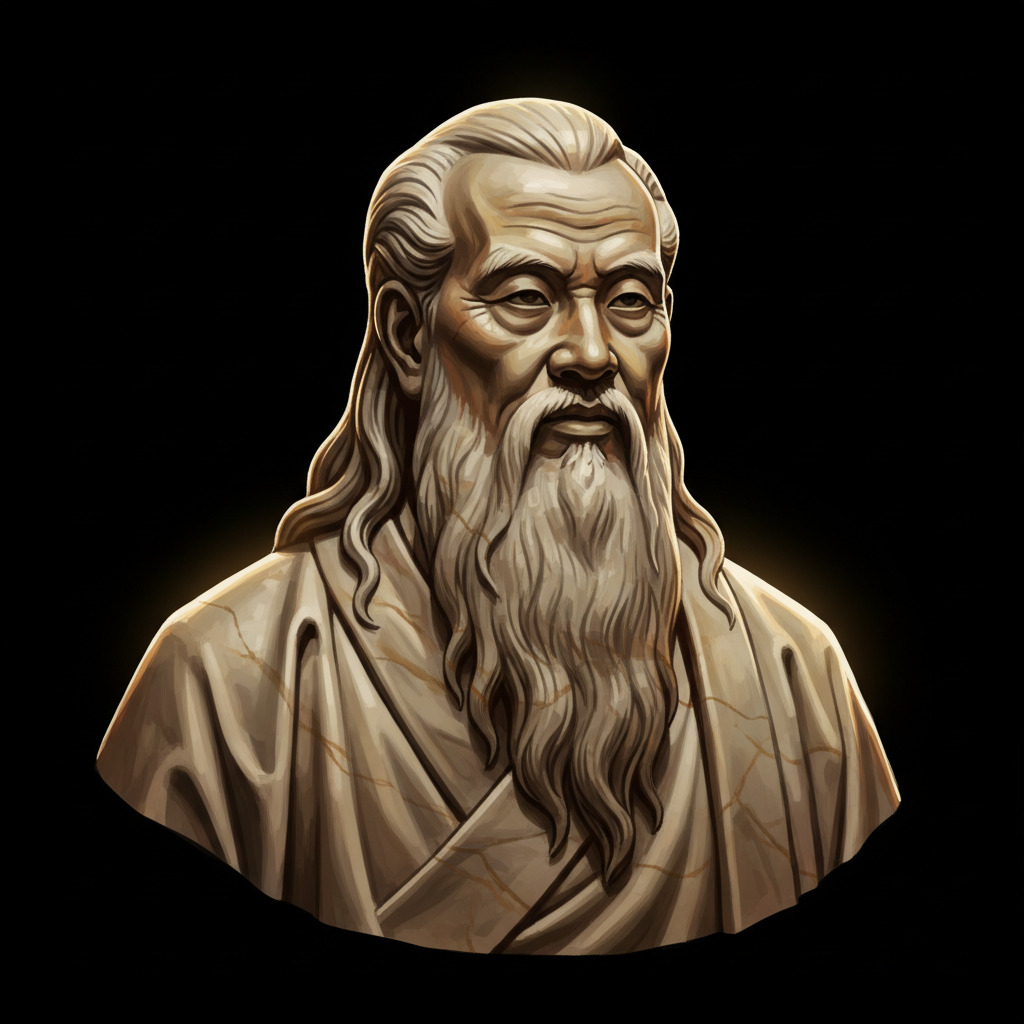
Laozi — "The more you know, the less you understand."
The more you know, the less you understand.
The more you know, the less you understand.
Click any product to generate a realistic preview. Up to 3 at a time.
* Initial load can take up to 90 seconds — revising the preview in another color is nearly instant.
"The sage does not act and therefore does not fail, does not seize and therefore does not lose."
"The highest good is like water. It nourishes all things without trying to."
"When the great Tao is lost, there is 'benevolence' and 'righteousness'."
"He who knows does not speak. He who speaks does not know."
"The value of teaching without words and accomplishing without action is understood by few in the world."
Reputed founder of Taoism and author of the Tao Te Ching, whose wu wei (effortless action) shaped East Asian philosophy. Closely associated with Zhuangzi (later Taoist who extended Laozi's framework). For an intellectual contrast, see Confucius, near-contemporary Chinese sage of social ritual and duty — Confucius systematized social order through ritual and hierarchy; Laozi argued that all such systems were the disease, not the cure — the two founding poles of Chinese moral philosophy.
Found in 2 providers: gemini,grok
2 sources checked
Accumulating facts and information is not the same as real understanding. As you pile up knowledge, you often see more contradictions, exceptions, and complications, which can cloud judgment rather than clarify it. True comprehension comes from grasping underlying patterns, not from hoarding data. The more a person chases details, the further they drift from the simple, intuitive wisdom that actually guides good living and clear thinking.
Laozi, the traditional founder of Taoism, taught that wisdom comes from aligning with the Tao, the natural way, rather than from scholarly study or political schemes. He prized wu wei, effortless action, and distrusted the rigid learning promoted by rival Confucian scholars. As a reputed archivist in the Zhou court, he saw firsthand how accumulated knowledge bred ambition and rules, which he believed pulled people away from simplicity and virtue.
Laozi is traditionally placed in the 6th century BCE, during the late Zhou dynasty as China slid toward the Warring States period. Feudal lords fought constantly, and competing schools like Confucianism, Legalism, and Mohism offered elaborate doctrines to restore order. Against that backdrop of scholarly argument and political maneuvering, his praise of quiet intuition over heaped-up learning was a pointed rebuke of the era's faith in rules, ritual expertise, and clever statecraft.
AI-generated insights based on extensive research and information for context. Factual errors? Email [email protected].
Your cart is empty