Edward Jenner — "The most important discoveries have often been made by accident."
The most important discoveries have often been made by accident.
The most important discoveries have often been made by accident.
Click any product to generate a realistic preview. Up to 3 at a time.
* Initial load can take up to 90 seconds — revising the preview in another color is nearly instant.
"How wonderful that this horrid pestilence should at this time even have an existence in our island . . . A Physician from Copenhagen call'd on me today, and express'd his astonishment at an opposition…"
"The most beautiful part of the human frame is the eye; and yet it is the most liable to disease."
"I have never been a lover of controversy; but when truth is concerned, I am not afraid to speak out."
"The discovery of vaccination is one of the most important that has ever been made."
"It is a great satisfaction to me to reflect, that I have been instrumental in saving so many lives."
Found in 1 providers: grok
1 source checked
Groundbreaking discoveries often come not from deliberate, systematic searching but from unexpected observations and chance events. Open-mindedness and the ability to recognize significance in unplanned moments matter as much as structured research. True breakthroughs emerge when someone notices something odd or counter to expectations and chooses to investigate rather than dismiss it — transforming a random observation into a world-changing insight.
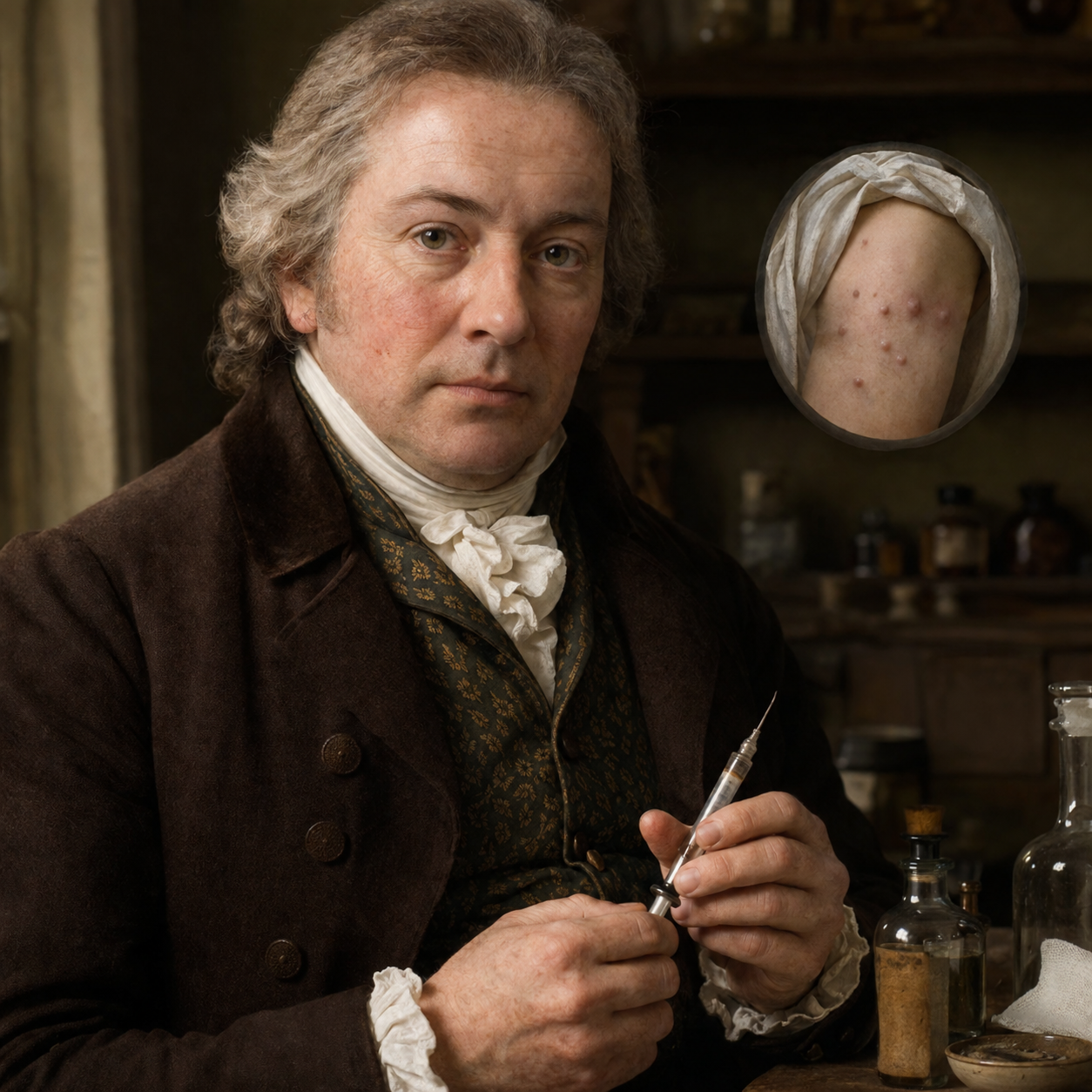
Jenner's vaccine discovery began with an accidental observation: milkmaids who contracted cowpox appeared immune to smallpox. He didn't set out to invent a vaccine — he noticed a folk belief, took it seriously, and tested it systematically. His 1796 experiment inoculating young James Phipps with cowpox material, then exposing him to smallpox, validated that accidental insight and ultimately led to eradicating a disease killing hundreds of thousands annually.
Jenner worked in the late 18th century when smallpox killed roughly 400,000 Europeans each year and left survivors scarred or blind. Formal laboratory science barely existed; natural philosophy advanced mainly through field observation. Variolation — deliberate infection with live smallpox — was practiced but risky. The Enlightenment prized empirical evidence over tradition, giving Jenner the intellectual permission to test a farmer's folk observation and overturn centuries of medical orthodoxy.
AI-generated insights based on extensive research and information for context. Factual errors? Email [email protected].
Your cart is empty