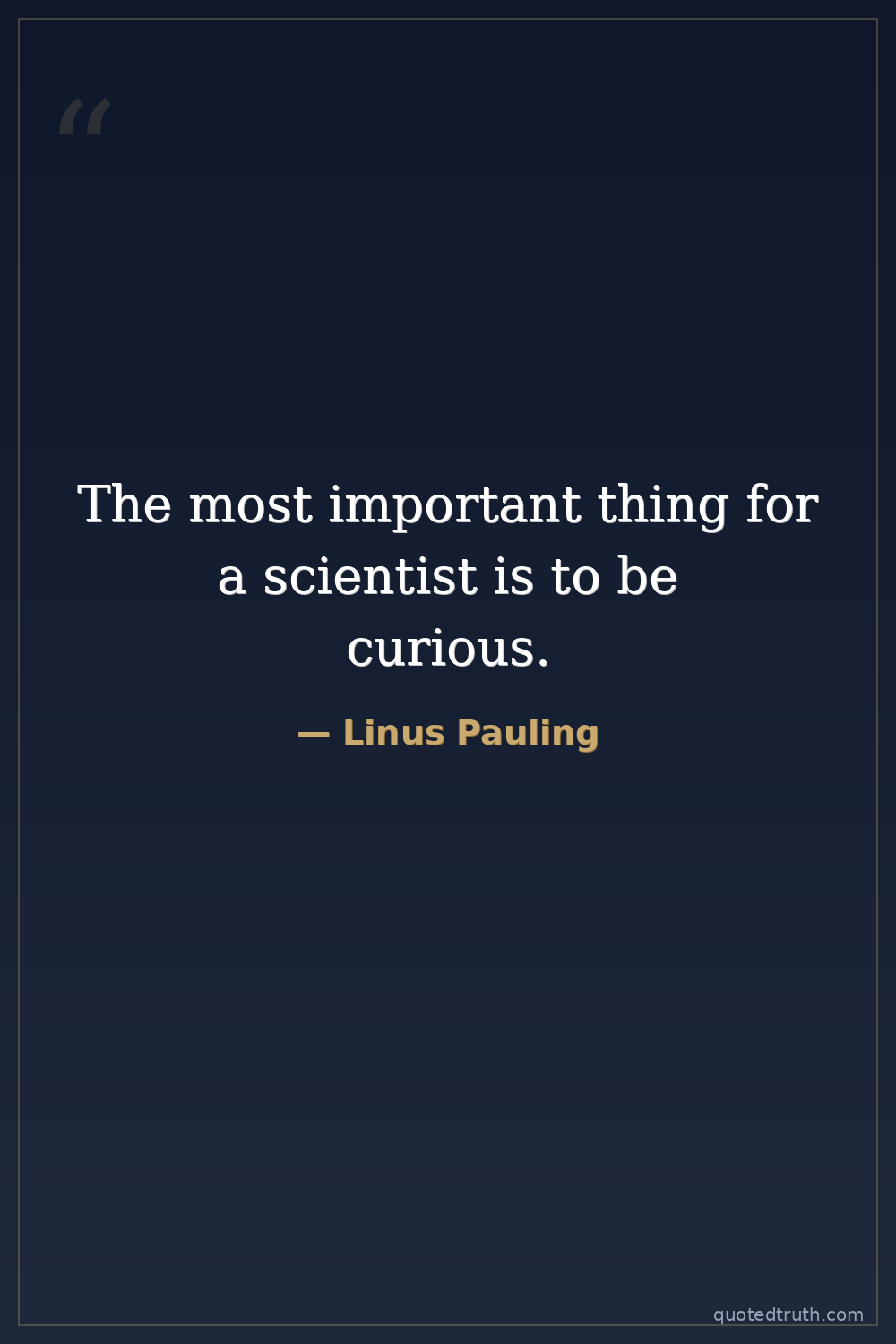
Linus Pauling — "The most important thing for a scientist is to be curious."
The most important thing for a scientist is to be curious.
The most important thing for a scientist is to be curious.
Click any product to generate a realistic preview. Up to 3 at a time.
* Initial load can take up to 90 seconds — revising the preview in another color is nearly instant.
"I have always been a teacher, and I believe that education is the key to a better future."
"I think that we should make the world safe for differences."
"I am an optimist. I believe that the human race will solve its problems."
"I believe that every problem has a solution, and that we should never give up on finding it."
"Every man of science has some favorite hypothesis which he cultivates, and with which he is so intimately bound up, that he would be glad to see it universally adopted."
Found in 1 providers: grok
1 source checked
Curiosity is the essential driving force behind scientific discovery. Without a genuine desire to ask questions and seek answers, technical skill alone produces nothing original. A scientist who stops wondering stops discovering. This is a reminder that the instinct to ask 'why' and 'how' matters more than any tool, credential, or method — it is the engine beneath all meaningful scientific work.
Pauling won two unshared Nobel Prizes — Chemistry in 1954 for chemical bond theory, Peace in 1962 for anti-nuclear activism — demonstrating curiosity that refused disciplinary boundaries. He pursued vitamin C research obsessively into old age, attracted controversy by following his curiosity wherever it led, even against mainstream consensus. His career was defined not by institutional caution but by relentless questioning across chemistry, biology, and geopolitics.
Pauling worked through the Manhattan Project era, Cold War nuclear buildup, and the postwar explosion of molecular biology. Scientists faced intense pressure to produce applied, government-funded results rather than pursue open-ended inquiry. McCarthyism subjected curious, independent thinkers like Pauling to political suspicion. His insistence on curiosity as the core scientific virtue pushed back against an era demanding scientists be instruments of state power rather than free inquirers.
AI-generated insights based on extensive research and information for context. Factual errors? Email [email protected].
Your cart is empty