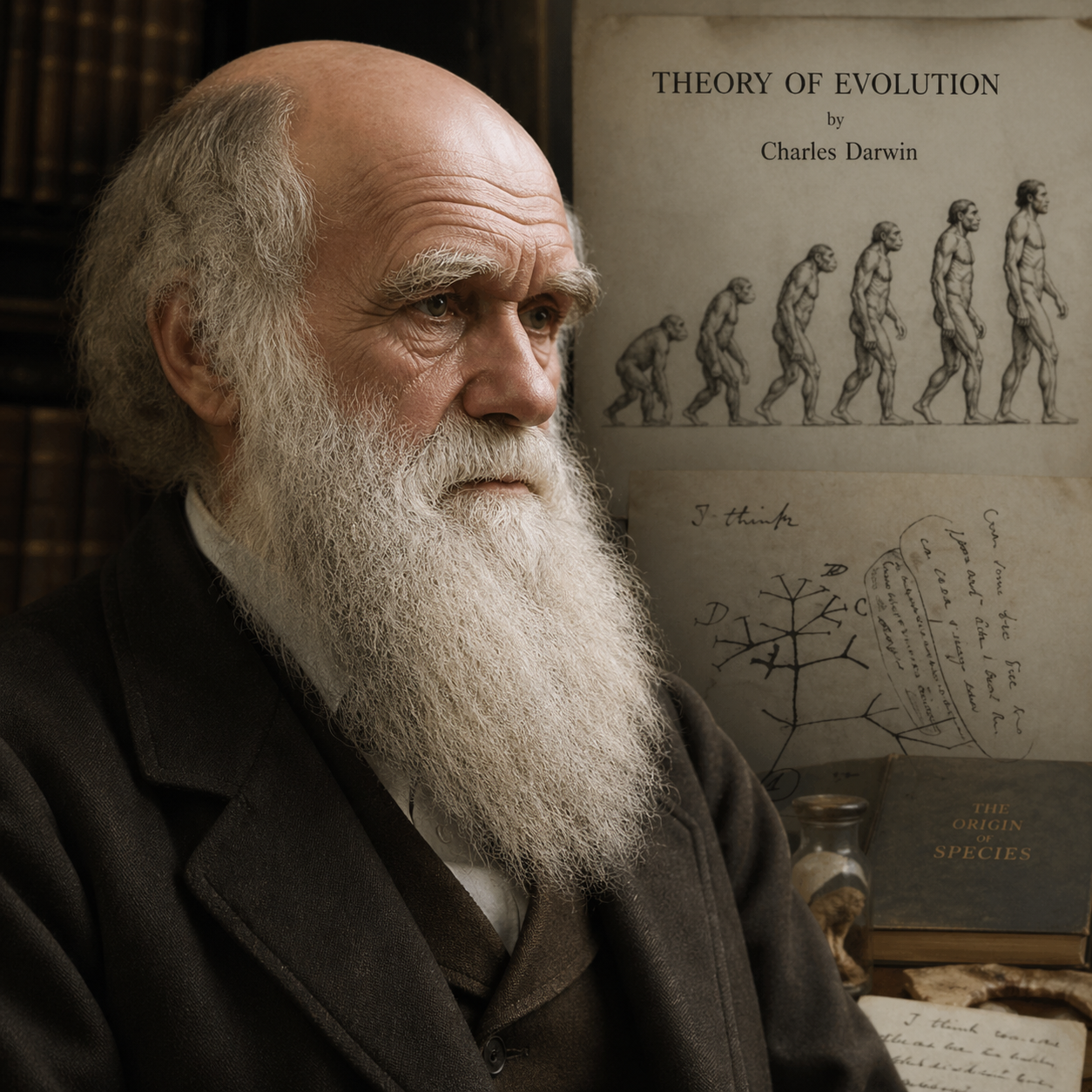
Charles Darwin — "The mystery of the beginning of all things is insoluble by us; and I for one mus…"
The mystery of the beginning of all things is insoluble by us; and I for one must be content to remain an agnostic.
The mystery of the beginning of all things is insoluble by us; and I for one must be content to remain an agnostic.
Click any product to generate a realistic preview. Up to 3 at a time.
* Initial load can take up to 90 seconds — revising the preview in another color is nearly instant.
"At some future period, not very distant as measured by centuries, the civilized races of man will almost certainly exterminate and replace the savage races throughout the world."
"I am almost convinced that species are not (it is like confessing a murder) immutable."
"As a proof of the admirable power of the mind, I may mention that I have been for some years training my mind to reject the evidence of my senses when they do not square with my preconceived notions."
"The difference in mind between man and the higher animals, great as it is, certainly is one of degree and not of kind."
"The world will not be inherited by the strongest, it will be inherited by those most able to change."
British naturalist whose On the Origin of Species (1859) established evolution by natural selection — the unifying theory of modern biology. Closely associated with Thomas Henry Huxley (his 'bulldog' public defender) and Alfred Russel Wallace (independent co-discoverer of natural selection). For an intellectual contrast, see William Paley, Anglican theologian and Natural Theology author (1743-1805) — Origin of Species is structurally a 400-page reply to Paley — Darwin admired Paley's watchmaker-argument as an undergraduate at Cambridge and then spent 20 years building the empirical machinery to displace him. The cleanest 'design argument vs natural selection' founding rebuttal in science.
The standard scholarly entry points to Charles Darwin's work: Janet Browne (Harvard, history of science) — Charles Darwin: Voyaging (1995) and The Power of Place (2002); Adrian Desmond (UCL, biographer) — Darwin: The Life of a Tormented Evolutionist (1991, with James Moore). These are the works graduate seminars cite when teaching Charles Darwin.
A personal statement on his agnostic stance regarding ultimate origins.
Date: Approximate
WisdomFound in 2 providers: gemini,grok
2 sources checked
Some questions — like what caused existence itself to begin — are simply beyond what humans can figure out. Rather than forcing a confident answer about God, creation, or the cosmos, Darwin says it's intellectually honest to admit uncertainty. Being agnostic means not knowing, and he's at peace with that. Humility about the unknowable is not weakness; it's the only defensible position when evidence runs out.
Darwin trained briefly for the clergy before science consumed him. His evolutionary work dismantled special creation, yet he never claimed atheism — he called himself agnostic, a word coined by close friend Thomas Huxley in 1869. His daughter Annie's death in 1851 deepened his estrangement from faith. This quote reflects his lifelong empiricist discipline: never assert what evidence cannot confirm, even on the most consequential questions.
Victorian England treated Christianity as civilization's bedrock — doubting God was socially dangerous, even for celebrated scientists. Darwin published On the Origin of Species in 1859, triggering furious religious backlash. The word agnostic itself was brand new, coined by Huxley in 1869. Darwin's measured refusal to claim either faith or atheism was a careful diplomatic stance in a culture where open unbelief could permanently destroy a public reputation.
AI-generated insights based on extensive research and information for context. Factual errors? Email [email protected].
Your cart is empty