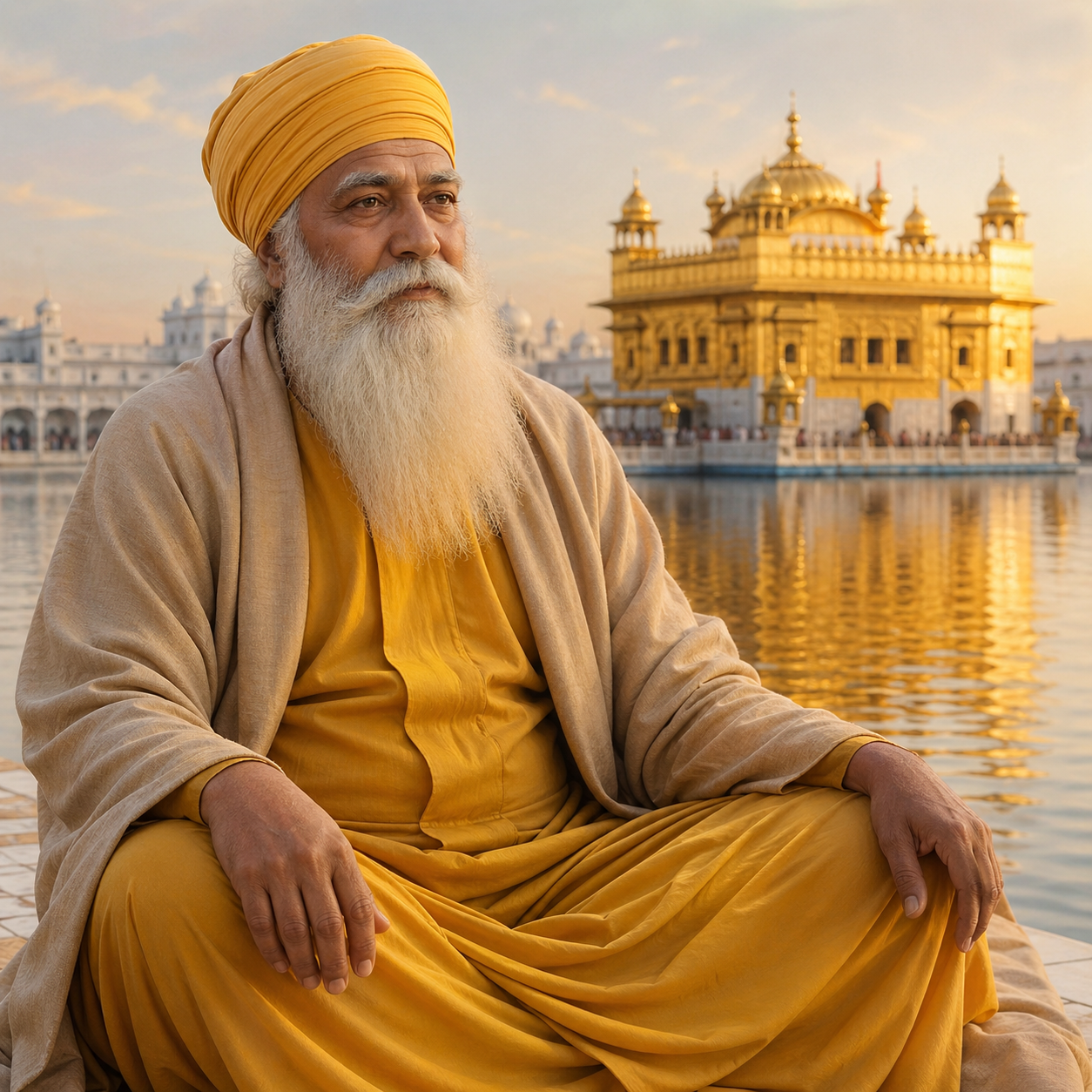
Guru Nanak — "The one who serves others, serves God."
The one who serves others, serves God.
The one who serves others, serves God.
Click any product to generate a realistic preview. Up to 3 at a time.
* Initial load can take up to 90 seconds — revising the preview in another color is nearly instant.
"God is one, but he has innumerable forms. He is the creator of all and He himself takes the human form."
"The world is suffering in falsehood, and only truth can save it."
"The world is a drama, staged in a dream."
"The Guru is the ladder, the boat, the raft, the ferryman, the ship, and the captain."
"Why do you not love the one who created you?"
Founder of Sikhism and the first of the Ten Sikh Gurus, whose teachings of one universal God and rejection of caste shaped Punjab. Closely associated with Kabir (mystical poet whose verses appear in the Sikh Guru Granth Sahib). For an intellectual contrast, see Brahmanical orthodoxy, the Hindu caste-and-ritual establishment of his era — Sikhism was founded as a deliberate alternative to both Hindu ritual hierarchy and Islamic exclusivism — Nanak's universalism was a structural rejection of caste and priestly mediation.
Found in 1 providers: grok
1 source checked
Genuine service to other people is itself a form of worship. You don't reach the divine through private rituals, temple fees, or pilgrimages while ignoring the person in front of you. Feeding the hungry, helping the weak, and treating strangers with dignity is how devotion actually shows up in the world. If your spirituality leaves others unhelped, it isn't spirituality at all, but performance that misses the point entirely.
Guru Nanak built this idea into Sikhism's foundations. He instituted langar, the free community kitchen where every visitor, regardless of caste, religion, or wealth, sits on the floor and eats together. His life of travel (udasis) across South Asia, Tibet, and the Middle East centered on confronting empty ritualism and uplifting laborers, women, and outcastes. Seva (selfless service) became a pillar of Sikh practice directly from convictions like this one.
Nanak lived 1469 to 1539 in Punjab under the late Delhi Sultanate and early Mughal rule, a period of rigid Hindu caste hierarchy, Brahmin ritual gatekeeping, and Hindu-Muslim tension sharpened by Babur's 1526 invasion. Religious identity meant fees, purity rules, and exclusion. Declaring that serving ordinary people equaled serving God was a direct rebuke of priestly monopolies and caste separation, and it gave common farmers and artisans a dignified spiritual path.
AI-generated insights based on extensive research and information for context. Factual errors? Email [email protected].
Your cart is empty