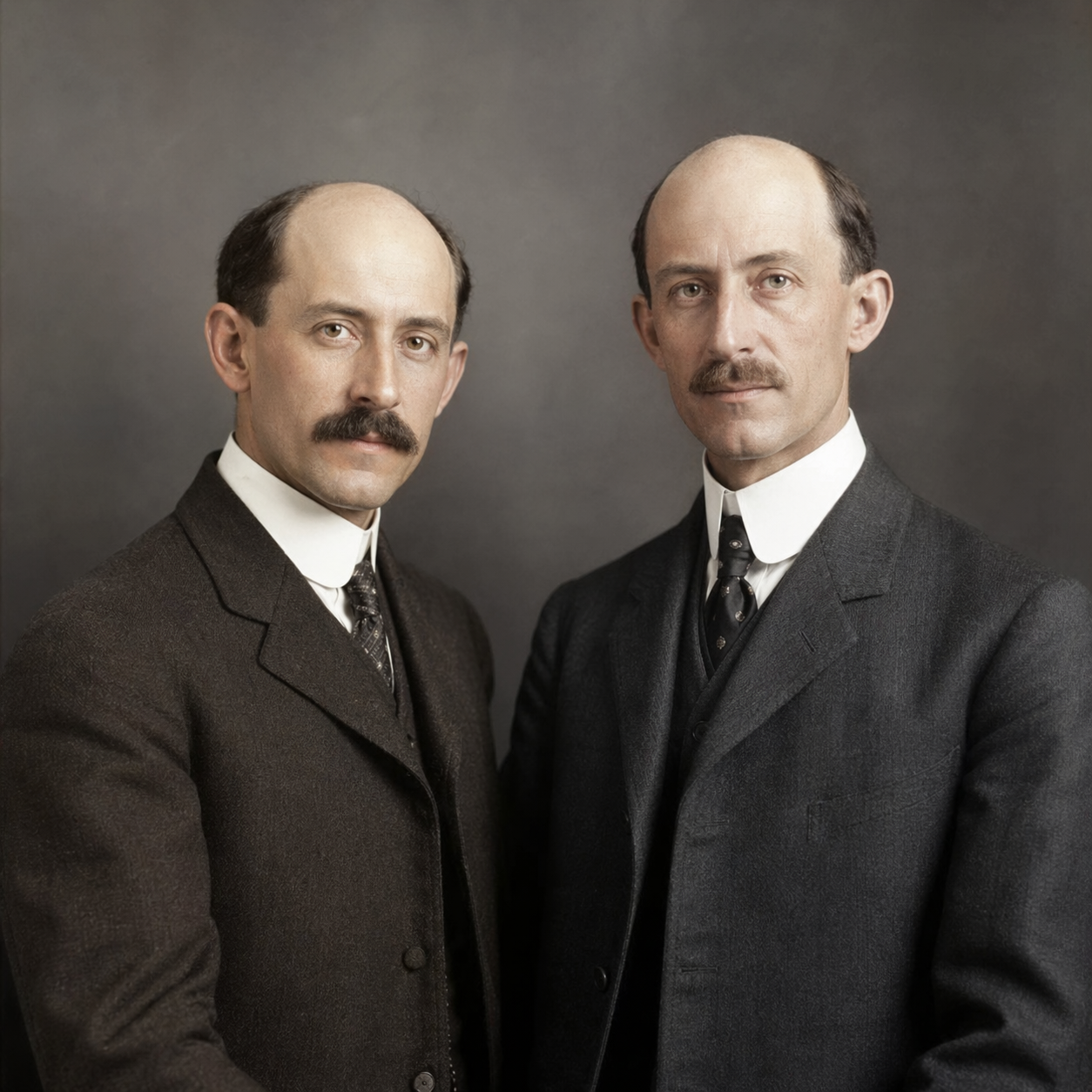
Wright Brothers (Orville & Wilbur) — "The only birds that speak are parrots, and they don’t fly very high."
The only birds that speak are parrots, and they don’t fly very high.
The only birds that speak are parrots, and they don’t fly very high.
Click any product to generate a realistic preview. Up to 3 at a time.
* Initial load can take up to 90 seconds — revising the preview in another color is nearly instant.
"If we worked on the assumption that what is currently accepted as true really is true, then there would be little hope for advance."
"It is a question of whether the machine was designed to be beautiful, or beautiful because it was well designed."
"We are not content to walk upon the ground."
"We could not but feel that the time was at hand for man to make a practical flight."
"We do not intend to make a fortune out of this, but to make a machine that will fly."
American aviation pioneers who achieved the first sustained powered controlled airplane flight at Kitty Hawk, NC, on December 17, 1903. Closely associated with Octave Chanute (their gliding mentor and aeronautical correspondent). For an intellectual contrast, see Samuel Pierpont Langley, Smithsonian Institution Secretary and government-funded aviation researcher — Langley's Aerodrome crashed twice into the Potomac in October-December 1903 with $50,000 of War Department funding; the Wright Brothers' bicycle-shop empiricism beat Langley's institutional Big Science by 9 days. The most-cited example in engineering history of empirical-tinkerer beating institution-funded credentialism.
Found in 1 providers: deepseek
1 source checked
Talkers rarely achieve greatness. Parrots can mimic speech but stay close to the ground; eagles say nothing yet climb to heights parrots never reach. This quote argues that endless talk, criticism, and proclamation are inversely related to real achievement. Those who accomplish difficult things are usually too busy working to make noise about it. Silence and focused effort consistently outperform loud ambition.
The Wright Brothers were famously quiet, private workers who toiled in their Dayton bicycle shop while prominent scientists loudly declared powered flight impossible. Samuel Langley, backed by government funding and public fanfare, crashed spectacularly. Orville and Wilbur, with no formal engineering degrees and minimal resources, said little and did everything. Their 12-second flight at Kitty Hawk in 1903 spoke louder than any manifesto. They embodied the principle: work, don't talk.
At the turn of the 20th century, the race for powered flight attracted well-funded academics, military contractors, and self-promoters who wrote papers, gave speeches, and made bold predictions. The press covered their theories extensively while flight remained elusive. Two bicycle mechanics from Ohio, working quietly outside the academic establishment, solved what experts said was impossible. The Gilded Age rewarded showmanship, but the Wright Brothers proved quiet competence could outrun any amount of noise.
AI-generated insights based on extensive research and information for context. Factual errors? Email [email protected].
Your cart is empty