James Clerk Maxwell — "The only laws of matter are those which our minds must fabricate, and the only l…"
The only laws of matter are those which our minds must fabricate, and the only laws of mind are fabricated for it by matter.
The only laws of matter are those which our minds must fabricate, and the only laws of mind are fabricated for it by matter.
Click any product to generate a realistic preview. Up to 3 at a time.
* Initial load can take up to 90 seconds — revising the preview in another color is nearly instant.
"Science is incompetent to reason upon the creation of matter itself out of nothing. We have reached the utmost limit of our thinking faculties when we have admitted that because matter cannot be etern…"
"The true Logic for this world is the Calculus of Probabilities, which takes account of the magnitude of the probability."
"The first thing that I always do is to try to understand the problem."
"I have been trying to think what is the difference between an experiment and an experience."
"The human mind is in a state of perpetual oscillation between the actual and the possible."
Found in 2 providers: deepseek,gemini
2 sources checked
Everything we call a law of nature is something our minds construct to make sense of the physical world. At the same time, our minds themselves are shaped by the physical matter of the brain. So the rules we think govern reality and the rules that govern our thinking are locked in a feedback loop, each producing the other rather than either existing as an absolute independent truth.
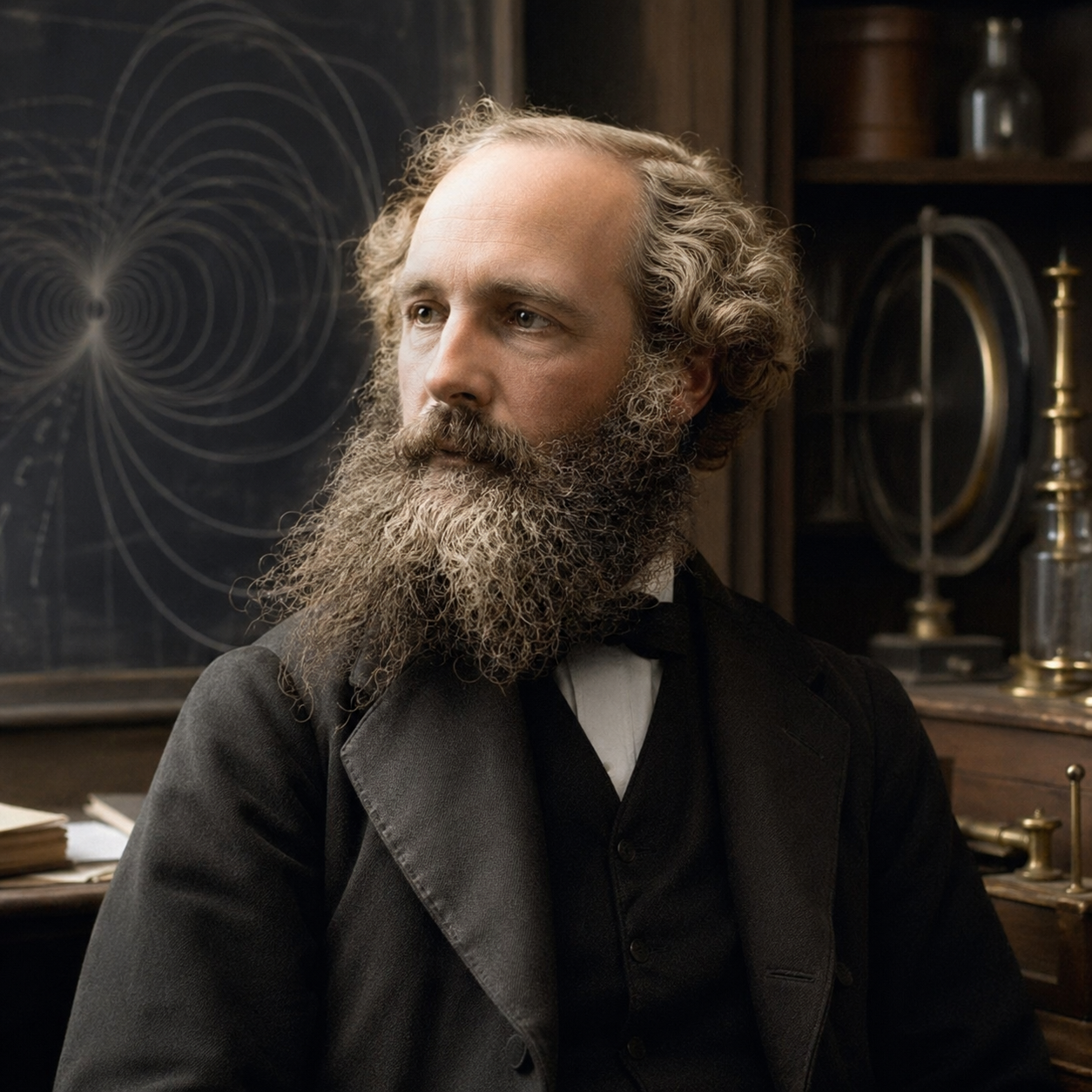
Maxwell unified electricity, magnetism, and light into a handful of equations, so he knew firsthand that physical laws are human formulations fitted to observations. A devout Presbyterian with a philosophical streak, he read Kant and Hamilton and often mused on the limits of scientific knowledge. This remark captures his humility: even the author of the most elegant equations in physics saw them as mental constructions, not divine inscriptions on nature.
Maxwell wrote during the Victorian era, when confidence in mechanistic science was peaking yet being quietly undermined. Darwin had just rooted mind in biology, Helmholtz was measuring nerve impulses, and German idealism still shaped British thought. Debates raged over whether scientific laws were discovered truths or convenient descriptions. Maxwell's statement sits exactly in that tension, anticipating twentieth-century views from Mach, Poincaré, and eventually quantum physics that laws are models, not metaphysical facts.
AI-generated insights based on extensive research and information for context. Factual errors? Email [email protected].
Your cart is empty