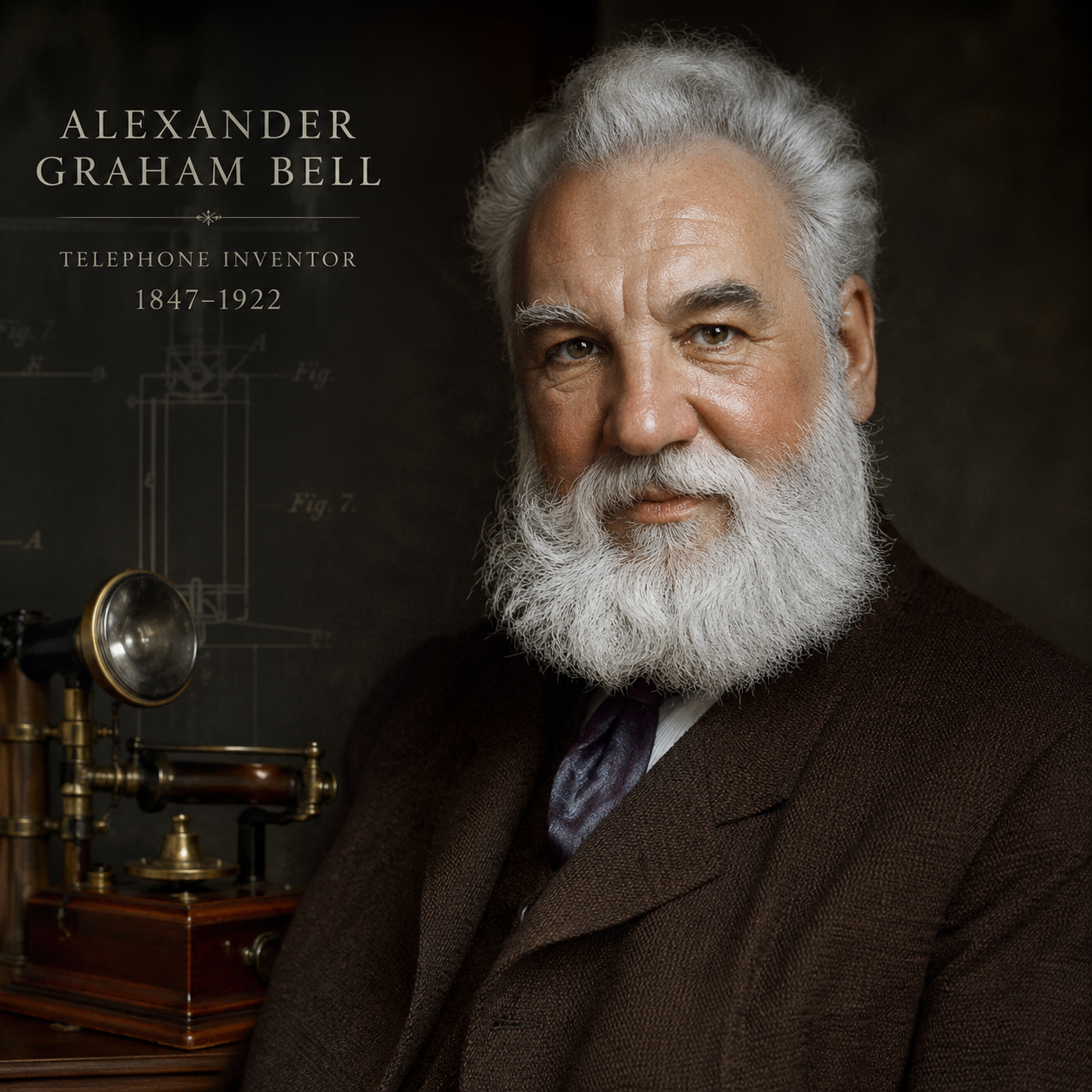
Alexander Graham Bell — "The only way to achieve the impossible is to believe it is possible."
The only way to achieve the impossible is to believe it is possible.
The only way to achieve the impossible is to believe it is possible.
Click any product to generate a realistic preview. Up to 3 at a time.
* Initial load can take up to 90 seconds — revising the preview in another color is nearly instant.
"The deaf should not intermarry."
"You cannot force ideas. Successful ideas are the result of slow growth."
"What this power is I cannot say; all I know is that it exists and it becomes available only when a man is in that state of mind in which he knows exactly what he wants and is fully determined not to g…"
"When one door closes another door opens; but we so often look so long and so regretfully upon the closed door, that we do not see the ones which open for us."
"The greatest minds are those who are not afraid to be wrong."
Found in 1 providers: grok
1 source checked
Belief isn't just optimism—it's the practical starting point for action. When you consider something impossible, you won't attempt it, won't invest effort, and won't push past failure. But if you genuinely believe something can be done, you'll find the path, persist through obstacles, and recruit others to help. Belief reframes 'impossible' as a temporary technical problem rather than a permanent wall.
Bell spent years trying to transmit human voice over electrical wire—something contemporaries dismissed as fantasy. His mother and wife were both deaf, driving his obsession with audio communication. He filed the telephone patent in 1876 against fierce competition, winning by a razor-thin margin. He never stopped inventing—working on hydrofoils, early aircraft, and metal detectors—each project treating 'impossible' as an invitation rather than a verdict.
Bell worked during the post-Civil War industrial boom, when electricity was just becoming practical and the telegraph was transforming communication. The 1870s–1890s saw a race to harness invisible forces—sound, electricity, light—that prior generations considered magical. Edison, Tesla, and Bell competed in an era where impossible inventions became daily headlines. Public faith in science and engineering was surging, making Bell's philosophy a cultural zeitgeist, not merely personal conviction.
AI-generated insights based on extensive research and information for context. Factual errors? Email [email protected].
Your cart is empty