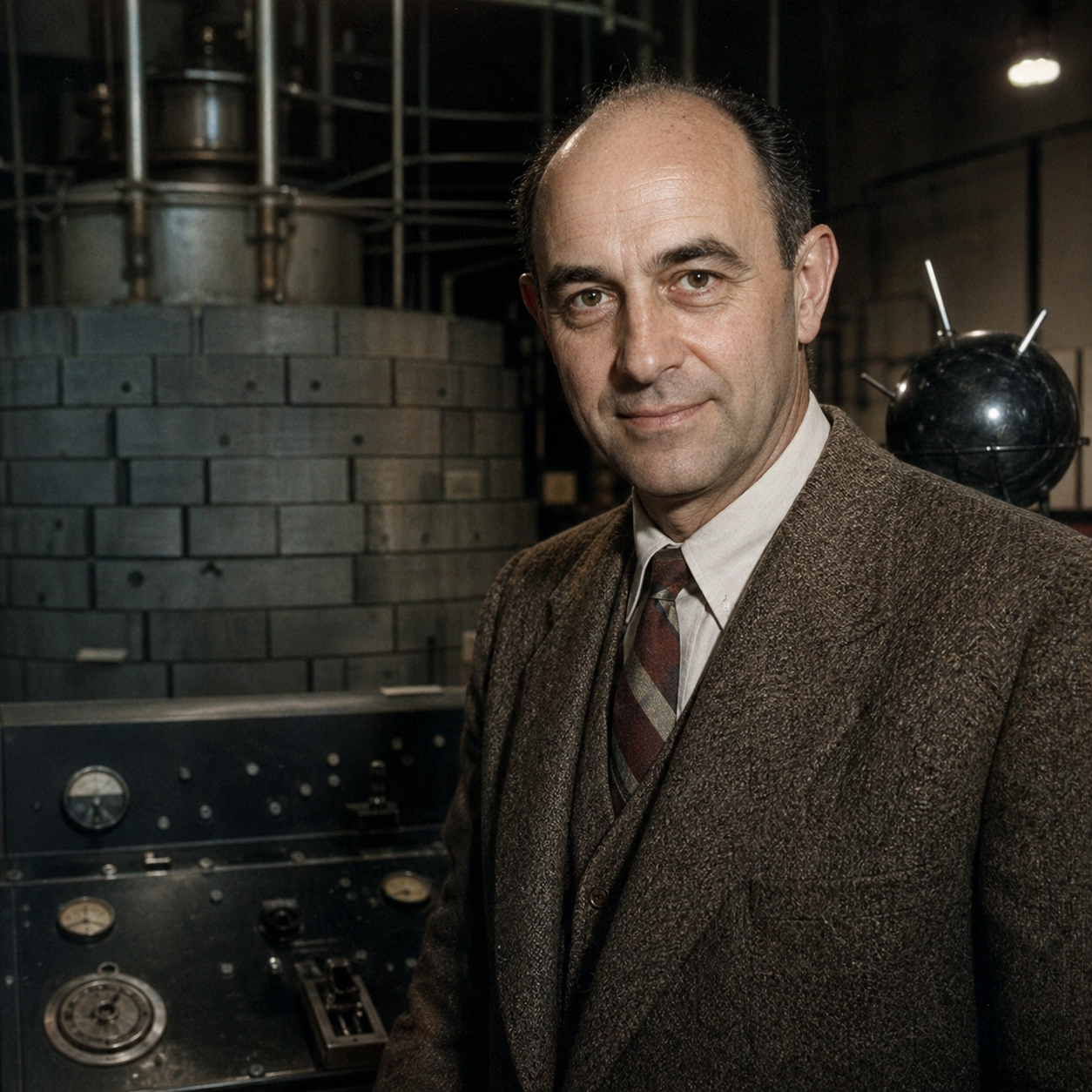
Enrico Fermi — "The only way to do great work is to love what you do."
The only way to do great work is to love what you do.
The only way to do great work is to love what you do.
Click any product to generate a realistic preview. Up to 3 at a time.
* Initial load can take up to 90 seconds — revising the preview in another color is nearly instant.
"The only constant in life is change."
"When asked what characteristics Nobel prize winning physicists had in common I cannot think of a single one not even intelligence."
"The universe is a vast and mysterious place, and we are just beginning to scratch the surface of its secrets."
"I am grateful for the opportunity to have contributed to the advancement of science, and to have witnessed the birth of the atomic age."
"The greatest tragedy of science is the slaying of a beautiful hypothesis by an ugly fact."
Found in 1 providers: grok
1 source checked
Passion is the prerequisite for excellence. When you genuinely care about your craft, you push past ordinary limits—tolerating setbacks, pursuing mastery beyond obligation, finding creative solutions others abandon. Work becomes exploration rather than burden. Without intrinsic drive, you produce competent output at best; genuine breakthroughs require authentic enthusiasm as fuel. Loving what you do transforms effort from a cost into a compulsion, sustaining the long, grinding work that separates the adequate from the truly great.
Fermi embodied this conviction viscerally. After his brother Giulio died when Enrico was fourteen, he threw himself into physics with consuming intensity, self-teaching from Latin textbooks. That passion drove him to revolutionize nuclear physics, build the world's first self-sustaining nuclear reactor beneath a Chicago squash court, and master both theoretical and experimental physics simultaneously—a rarity. Colleagues described him as visibly joyful when solving problems, treating physics less as profession than personal obsession.
Fermi worked during the mid-20th century, when physics was reshaping civilization. The 1930s–1950s saw quantum mechanics mature, nuclear fission discovered, and the atomic age ignite. World War II compressed decades of theoretical work into urgent applied science under the Manhattan Project. Scientists faced profound moral weight alongside intellectual excitement—their love of physics produced both transformative energy technology and weapons of mass destruction, making the ethics of passionate, unchecked scientific pursuit an urgent public question.
AI-generated insights based on extensive research and information for context. Factual errors? Email [email protected].
Your cart is empty