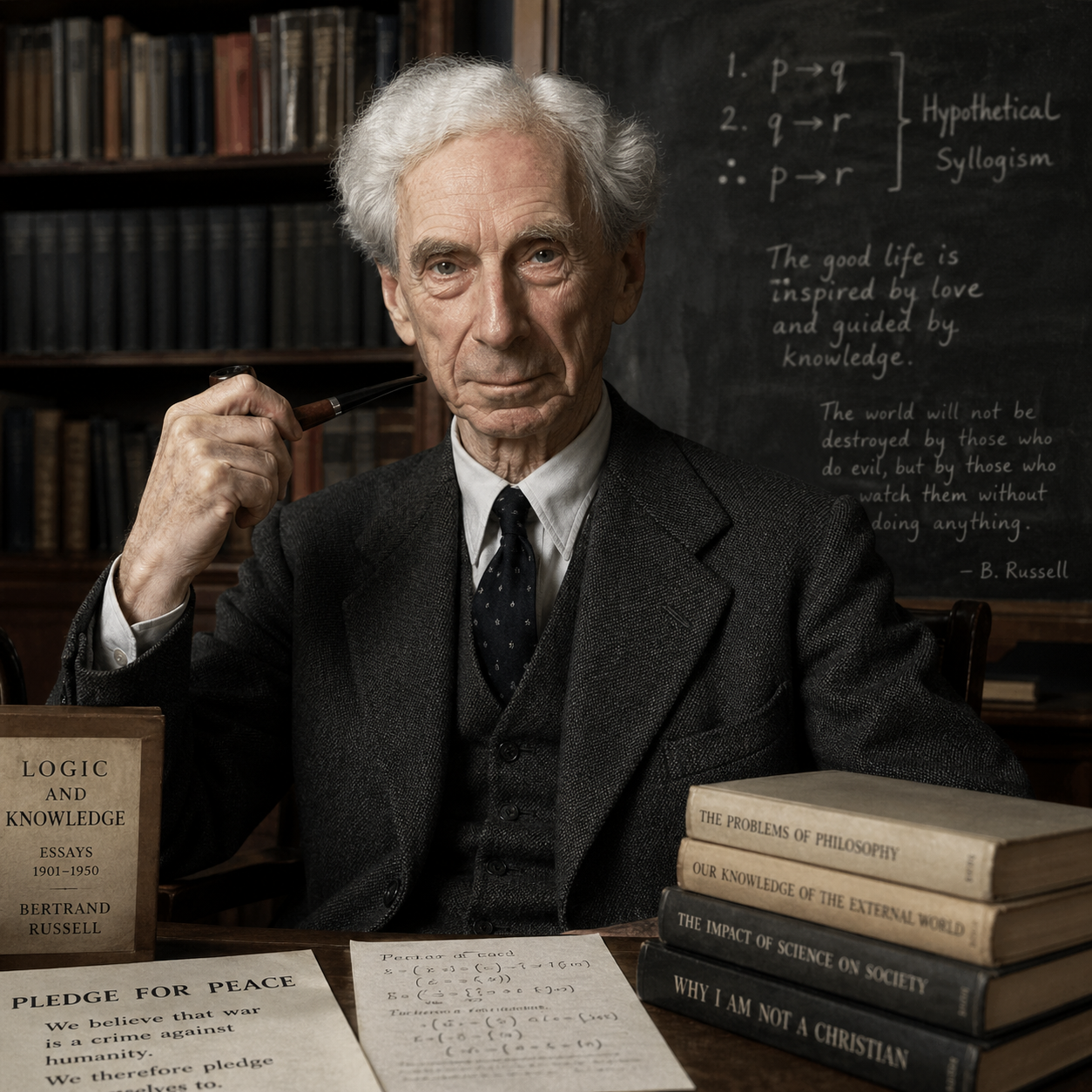
Bertrand Russell — "The only way to get rid of a temptation is to yield to it."
The only way to get rid of a temptation is to yield to it.
The only way to get rid of a temptation is to yield to it.
Click any product to generate a realistic preview. Up to 3 at a time.
* Initial load can take up to 90 seconds — revising the preview in another color is nearly instant.
"Anything you're good at, you should do."
"If a majority in every civilized country so desired, we could, within twenty years, abolish all abject poverty, quite half the illness in the world, the whole economic slavery which binds down nine te…"
"I would never die for my beliefs because I might be wrong."
"I am not interested in the universe as a whole, but in certain parts of it."
"One of the painful things about our time is that those who feel certainty are stupid, and those with any imagination and understanding are filled with doubt and indecision."
British philosopher, logician, and Nobel literature laureate (1950) who co-authored Principia Mathematica with Whitehead and led 20th-century pacifist and nuclear-disarmament campaigns. Closely associated with Alfred North Whitehead (Principia Mathematica co-author) and Ludwig Wittgenstein (his student-then-rival). For an intellectual contrast, see F.H. Bradley, British Idealist philosopher — Russell's 1898 break with Bradley's neo-Hegelian Idealism — and his subsequent logical-atomism — is the founding moment of the Anglo-American analytic philosophy tradition that displaced Idealism for a century. Russell's entire early career is structured against Bradley's metaphysics of internal relations.
The standard scholarly entry points to Bertrand Russell's work: Ray Monk (Southampton, philosophy biographer) — Bertrand Russell: The Spirit of Solitude 1872-1921 (1996); A.C. Grayling (New College of the Humanities) — Russell: A Very Short Introduction (1996). These are the works graduate seminars cite when teaching Bertrand Russell.
Your cart is empty