Enrico Fermi — "The only way to learn physics is to do physics."
The only way to learn physics is to do physics.
The only way to learn physics is to do physics.
Click any product to generate a realistic preview. Up to 3 at a time.
* Initial load can take up to 90 seconds — revising the preview in another color is nearly instant.
"Whatever you do, don't let them make you a manager."
"Before I came here I was confused about this subject. Having listened to your lecture I am still confused. But on a higher level."
"I am a physicist, and I believe that the laws of physics are universal."
"The world is full of wonders, and it is our job to explore them."
"There are two possible outcomes: if the result confirms the hypothesis, then you've made a measurement. If the result is contrary to the hypothesis, then you've made a discovery."
Found in 1 providers: grok
1 source checked
Physics knowledge cannot be absorbed passively through reading or lectures alone. Real understanding comes from working through problems, running experiments, and grappling with data directly. Theoretical concepts only crystallize when you apply them hands-on — building, measuring, calculating, failing, and iterating. Competence in physics is built through active practice, not observation. The discipline rewards those who engage with it directly rather than those who merely study descriptions of it.
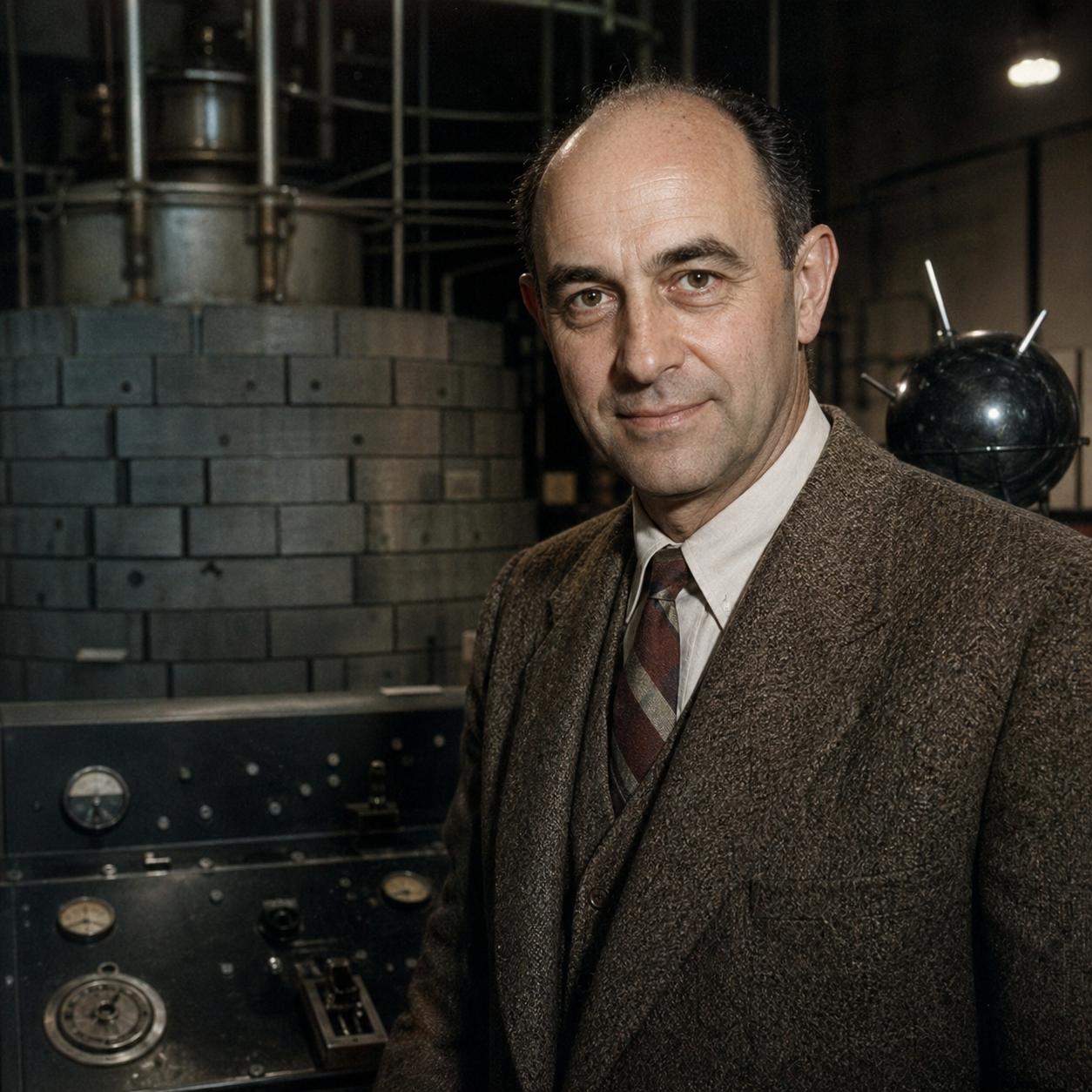
Fermi was legendary for his ability to move fluidly between theory and experiment — rare in 20th-century physics. He built the world's first nuclear reactor, Chicago Pile-1, by hand with his team in a squash court. He mentored students by throwing them into unsolved problems rather than lectures. His famous Fermi estimation technique trained physicists to reason from first principles with minimal data, embodying exactly this philosophy.
Fermi worked during the 1930s–1950s, when physics underwent its most radical transformation. The Manhattan Project compressed years of theoretical work into urgent wartime experimentation under extreme pressure. Universities were simultaneously shifting from lecture-only pedagogy to research-active training. The Cold War then demanded rapid production of capable physicists for nuclear and defense programs, making the learn-by-doing approach not just philosophically sound but strategically essential for national survival.
AI-generated insights based on extensive research and information for context. Factual errors? Email [email protected].
Your cart is empty