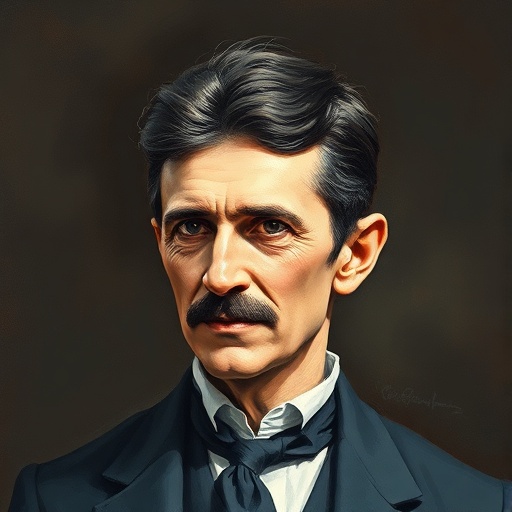
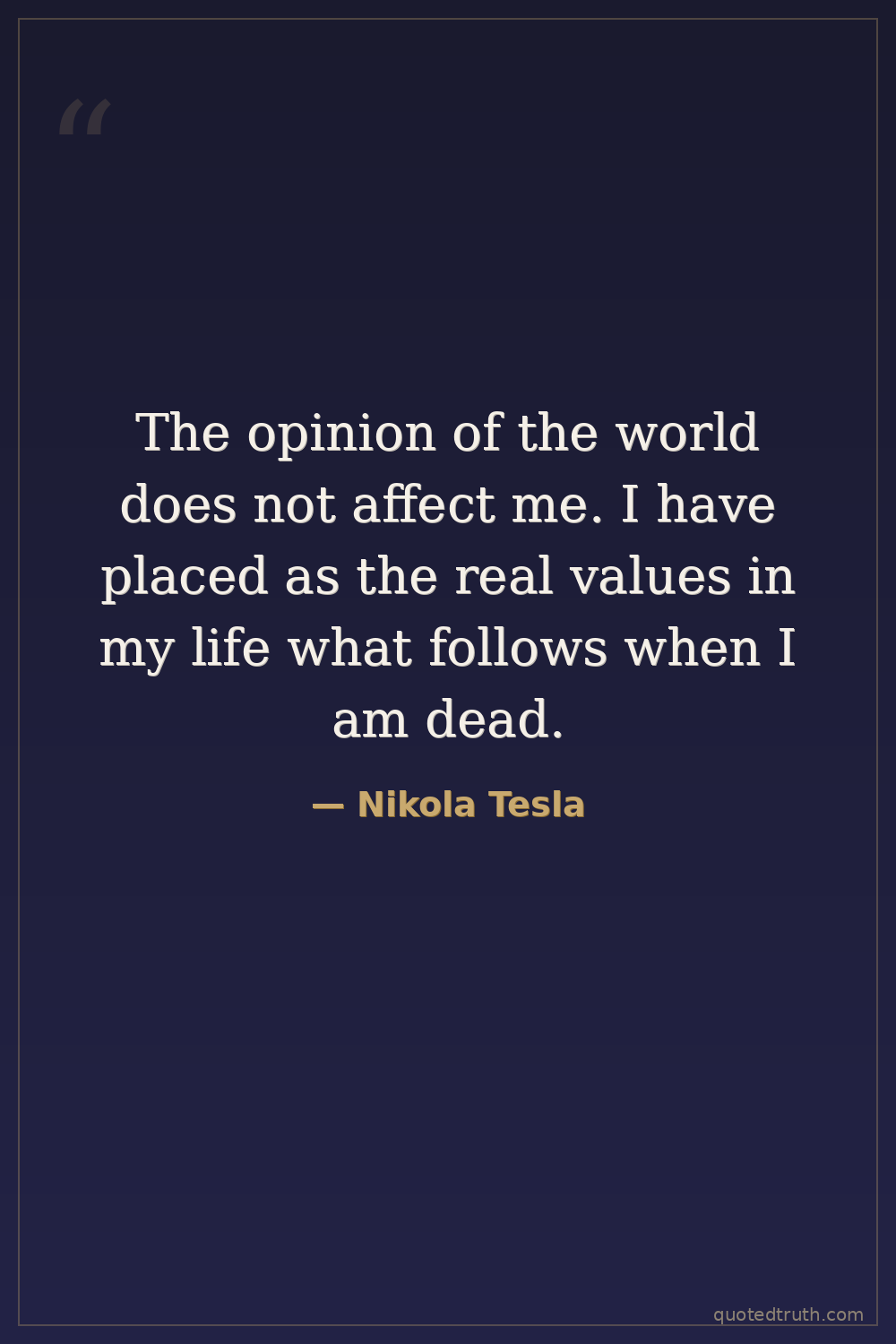
Nikola Tesla — "The opinion of the world does not affect me. I have placed as the real values in…"
The opinion of the world does not affect me. I have placed as the real values in my life what follows when I am dead.
The opinion of the world does not affect me. I have placed as the real values in my life what follows when I am dead.
Click any product to generate a realistic preview. Up to 3 at a time.
* Initial load can take up to 90 seconds — revising the preview in another color is nearly instant.
"There is no conflict between the ideal of religion and the ideal of science, but science is opposed to theological dogmas because science is founded on fact. To me, the universe is simply a great mach…"
"Nothing enters our minds or determines our actions, and what we call soul or spirit, is nothing more than the sum of the functionings of the body. When this functioning ceases, the soul or the spirit …"
"I see no reason why a man should not be able to transmit his thoughts to another across the ocean."
"Einstein's relativity work is a magnificent mathematical garb which fascinates, dazzles and makes people blind to the underlying errors. The theory is like a beggar clothed in purple whom ignorant peo…"
"My method is different. I do not rush into actual work. When I get an idea I start at once building it up in my imagination. I change the construction, make improvements, and operate the device entire…"
Serbian-American inventor and electrical engineer whose alternating-current designs powered the modern electrical grid; died poor and largely forgotten. Closely associated with George Westinghouse (his AC-power business partner) and Mihajlo Pupin (fellow Serbian-American physicist at Columbia). For an intellectual contrast, see Thomas Edison, American inventor and direct-current advocate — Edison's direct-current power-distribution scheme was displaced by Tesla-Westinghouse AC in the 1890s 'War of Currents'. Edison ran a public-relations campaign electrocuting animals to discredit AC — the most famous engineering-ethics rivalry in American history. Tesla's AC won and powers nearly every electrical grid on Earth.
Profound statement on personal values, legacy, and indifference to contemporary opinion.
Date: Approximate
PhilosophicalFound in 1 providers: gemini
1 source checked
Tesla is asserting complete detachment from contemporary judgment. He doesn't build his identity around praise, criticism, or popularity. Instead, he measures his life's worth by what it contributes to humanity after he's gone — what survives him. The real scorecard isn't current reputation but lasting impact. In modern terms: stop chasing approval and build something that matters long after you're gone.
Tesla died in 1943 in a New York hotel room, nearly penniless and largely forgotten by the public he had electrified. Edison outmaneuvered him in the War of Currents PR battle despite Tesla's AC system being superior. His Wardenclyffe Tower project was abandoned after funding collapsed. Yet his patents on AC motors and radio transmission became the bedrock of modern civilization — exactly the posthumous legacy he described.
Tesla's active years spanned the Gilded Age and early 20th century, when inventors like Edison commanded massive public adoration and corporate backing. The press shaped public perception of genius. Tesla lost the War of Currents narrative to Edison's well-funded PR machine and watched Marconi claim radio credit. In an era that worshipped celebrity inventors, Tesla's studied indifference to opinion was both countercultural and personally costly.
AI-generated insights based on extensive research and information for context. Factual errors? Email [email protected].
Your cart is empty