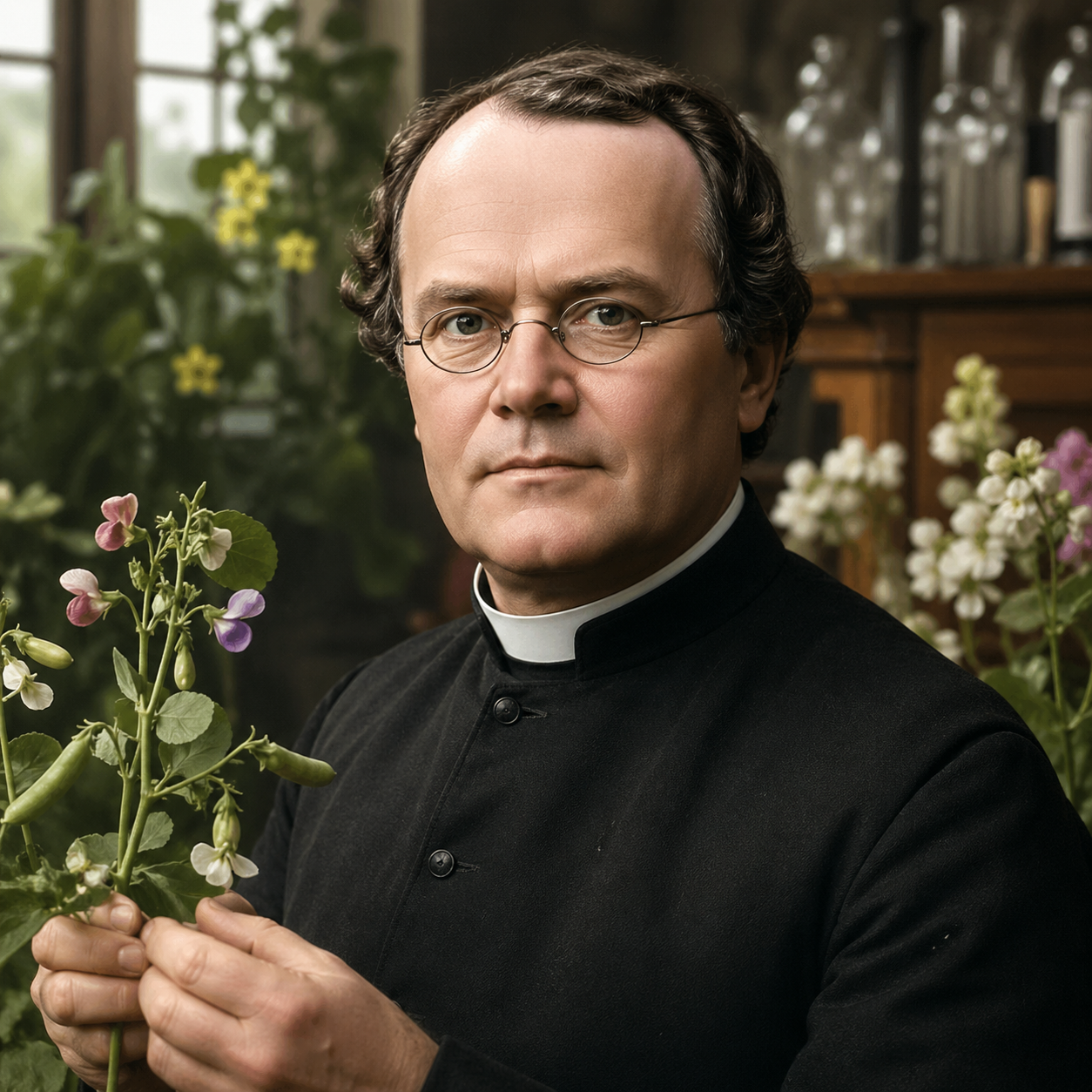
Gregor Mendel — "The pea does not lie."
The pea does not lie.
The pea does not lie.
Click any product to generate a realistic preview. Up to 3 at a time.
* Initial load can take up to 90 seconds — revising the preview in another color is nearly instant.
"I measure, I count, I compare—this is the way of science."
"I am neither a botanist nor a physicist, but a humble servant of God who seeks to understand His laws."
"I have been called a dreamer, but the numbers do not dream."
"The most important result of hybridization is beyond doubt the production of new constant forms."
"I have sown many seeds, but only a few have borne fruit."
Found in 1 providers: deepseek
1 source checked
Empirical data from nature is honest — it doesn't deceive, flatter, or conform to preconceptions. When you observe what actually happens in an experiment, reality speaks for itself. The pea plant's inheritance patterns produced consistent, mathematical ratios regardless of what anyone expected. Data cannot lie; only human interpretation can. Trust the results over the theory, and let observable evidence settle what argument and authority cannot.
Mendel spent eight years growing over 29,000 pea plants in a monastery garden, meticulously counting traits. A monk working outside mainstream science, he trusted his data over the dominant theory of blending inheritance. When results showed discrete 3:1 ratios, he published despite being ignored for decades. His entire career demonstrated faith in careful observation over received wisdom — making this his personal scientific creed.
Mendel worked in the 1850s–1860s, when Darwin's evolution was reshaping biology but inheritance mechanisms remained mysterious. The dominant belief was blending inheritance — traits mixing like paint. No statistical methods existed in biology; Mendel essentially invented them. Science was transitioning from natural philosophy to rigorous experimentation, and his era distrusted quantitative approaches in biology, making his insistence on letting data speak quietly revolutionary.
AI-generated insights based on extensive research and information for context. Factual errors? Email [email protected].
Your cart is empty