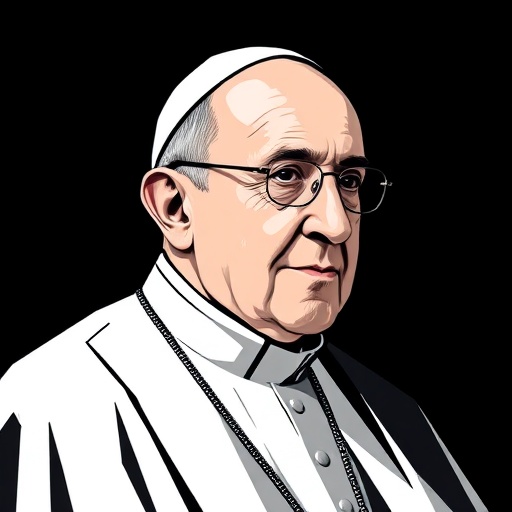
Pope Francis — "The poor are the treasure of the Church."
The poor are the treasure of the Church.
The poor are the treasure of the Church.
Click any product to generate a realistic preview. Up to 3 at a time.
* Initial load can take up to 90 seconds — revising the preview in another color is nearly instant.
"The greatest danger is spiritual worldliness."
"What are we doing with our children? We are making them into little monsters."
"The world tells us to seek success, power, and money; God tells us to seek humility, service, and love."
"I prefer a Church which is bruised, hurting and dirty because it has been out on the streets, rather than a Church which is unhealthy from being confined and from clinging to its own security."
"Hypocrisy is the devil's preferred language."
First Latin American and Jesuit pope (2013-), who has steered the Catholic Church toward pastoral inclusion on LGBTQ pastoral care, divorced Catholics, and climate. Closely associated with Pope John XXIII (the Vatican II reformer pope) and Cardinal Walter Kasper (his theological ally on pastoral reform). For an intellectual contrast, see Cardinal Raymond Burke, American traditionalist cardinal, former head of the Vatican Apostolic Signatura — Burke is the public face of Catholic traditionalism that views Francis's pastoral approach as doctrinally dangerous — he has formally challenged Amoris Laetitia and other Francis reforms.
Found in 1 providers: grok
1 source checked
Impoverished people aren't a burden or a problem to be managed — they occupy the most sacred place in the Church's identity and mission. The word 'treasure' deliberately inverts conventional measures of wealth and prestige, declaring that the marginalized are not recipients of charity but the very heart of Christian community. Serving them isn't peripheral social work; it's the defining purpose of the Church itself.
Born Jorge Mario Bergoglio in Buenos Aires, he chose Francis as his papal name after the patron saint of the poor. As Archbishop of Buenos Aires he rode public buses, cooked his own meals, and refused a chauffeured car. His Jesuit formation centered solidarity with the marginalized. His 2013 apostolic exhortation Evangelii Gaudium placed care for the poor as the defining commitment of his papacy, backing personal practice with institutional reform.
Francis became Pope in 2013 during the prolonged aftermath of the 2008 global financial crisis, which dramatically widened inequality worldwide. Austerity policies across Europe and Latin America pushed millions into poverty. The Catholic Church simultaneously faced credibility damage from abuse scandals and perceptions of institutional wealth. His declaration repositioned the Church against the era's winners and toward its casualties, making poverty both a theological and a political statement.
AI-generated insights based on extensive research and information for context. Factual errors? Email [email protected].
Your cart is empty