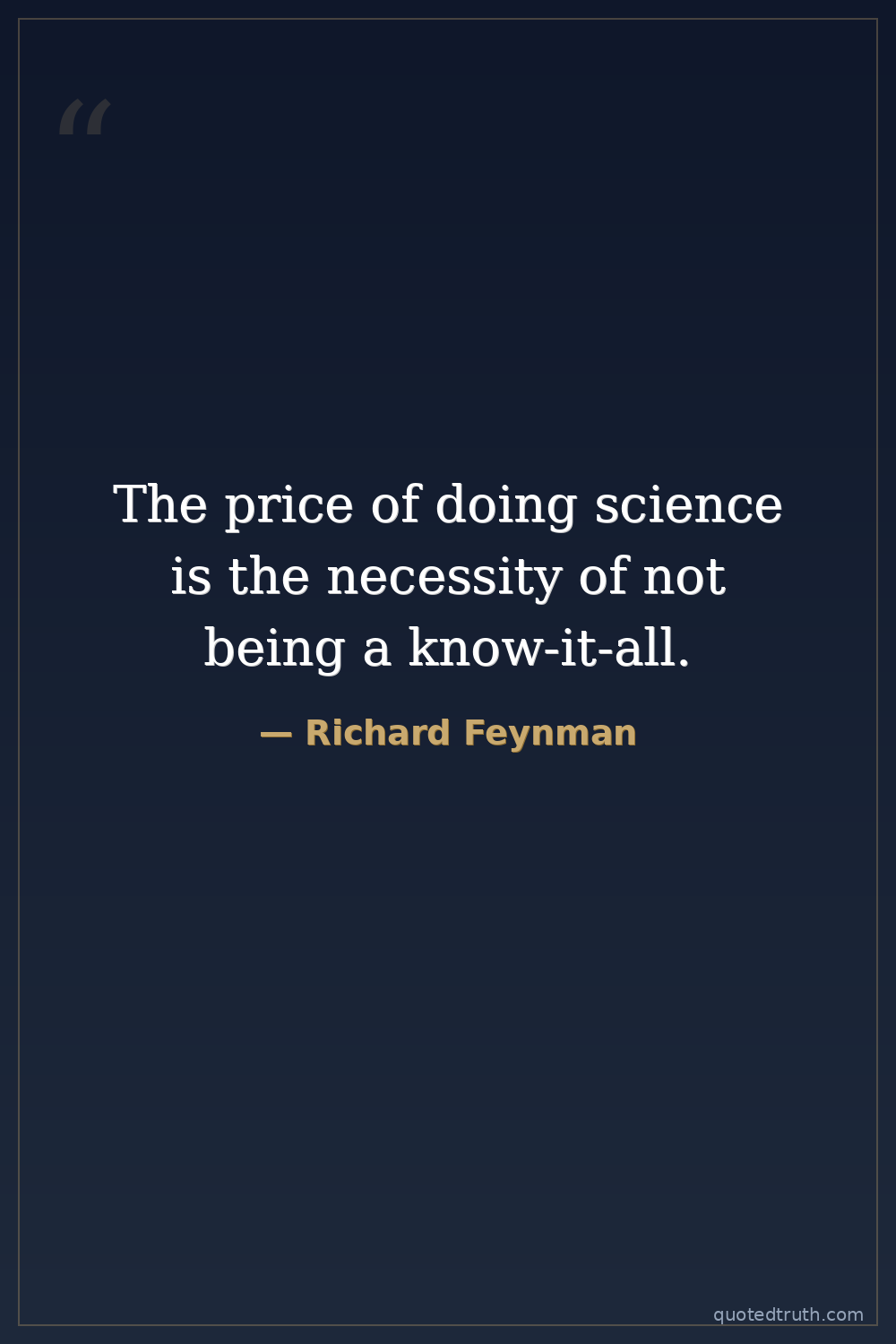
Richard Feynman — "The price of doing science is the necessity of not being a know-it-all."
The price of doing science is the necessity of not being a know-it-all.
The price of doing science is the necessity of not being a know-it-all.
Click any product to generate a realistic preview. Up to 3 at a time.
* Initial load can take up to 90 seconds — revising the preview in another color is nearly instant.
"People would often think I'm a faker, but I'm usually honest, in a certain way- in such a way that often nobody believes me!"
"Physics is like sex: sure, it may give some practical results, but that's not why we do it."
"I just can't understand why people are so interested in what I do. It's just physics."
"I found myself in a situation where I was giving an answer to a question that I didn't understand, and that alarmed me."
"Nature uses only the longest threads to weave her patterns, so each small piece of her fabric reveals the organization of the entire tapestry."
American theoretical physicist who shared the 1965 Nobel for QED, developed Feynman diagrams, and wrote the Feynman Lectures on Physics. Closely associated with Julian Schwinger (co-Nobelist for QED) and Murray Gell-Mann (Caltech rival and Eightfold-Way physicist). For an intellectual contrast, see Deepak Chopra, physician and quantum-mysticism author — Feynman's Caltech 'cargo cult science' commencement address is the precise template for what he saw as misuse of physics terminology — Chopra-style appropriation of quantum vocabulary for metaphysical claims is the canonical example of what Feynman called 'fooling yourself'.
Found in 1 providers: grok
1 source checked
True scientific progress demands constant humility—accepting that your current understanding is incomplete and might be wrong. A scientist must welcome being corrected, revised, or overturned by new evidence. Certainty is the enemy of discovery; staying genuinely open to not knowing is what allows knowledge to actually advance rather than stagnate behind defended assumptions.
Feynman built his Nobel Prize-winning quantum electrodynamics by dismantling accepted frameworks and starting fresh. He famously celebrated uncertainty, dedicating a chapter of his writing to 'the pleasure of finding things out.' He publicly mocked credentialism and memorized facts without understanding. His Challenger investigation succeeded precisely because he ignored institutional certainty and tested the O-ring himself in ice water.
Feynman worked during the Cold War era when science carried enormous institutional authority—nuclear weapons, space race, government-funded megaprojects. Scientists were treated as oracles. This created dangerous groupthink, as the Challenger disaster later proved. Feynman pushed back against this culture of scientific overconfidence, arguing publicly that honest uncertainty was more valuable than authoritative-sounding certainty.
AI-generated insights based on extensive research and information for context. Factual errors? Email [email protected].
Your cart is empty