Carl Sagan — "The price of skepticism is that you are occasionally fooled. The price of credul…"
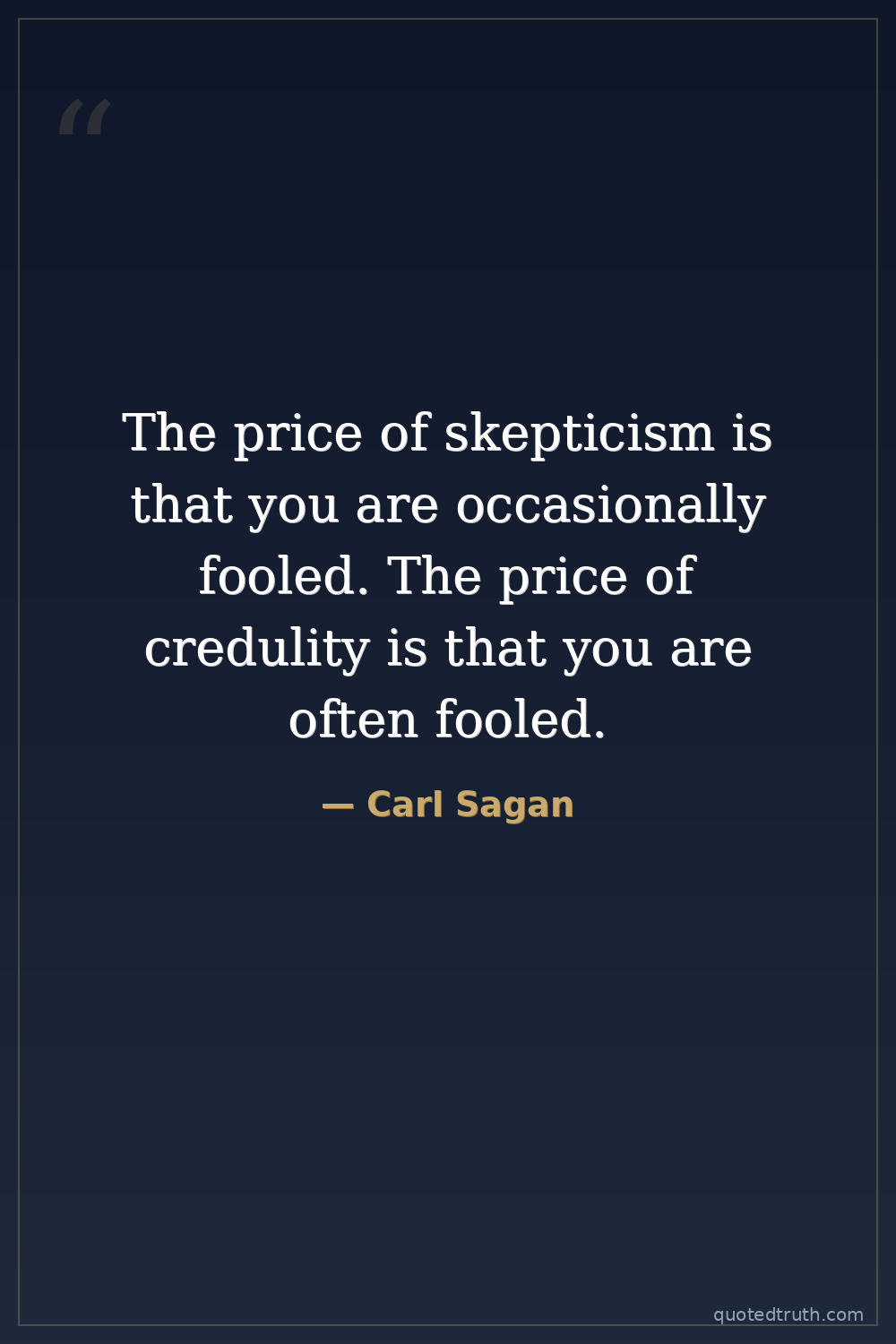
The price of skepticism is that you are occasionally fooled. The price of credulity is that you are often fooled.
The price of skepticism is that you are occasionally fooled. The price of credulity is that you are often fooled.
Click any product to generate a realistic preview. Up to 3 at a time.
* Initial load can take up to 90 seconds — revising the preview in another color is nearly instant.
"The Earth is like a tiny, fragile spaceship, and we are its crew."
"The Earth is a very small stage in a vast cosmic arena."
"If we are to survive, we must look to the stars."
"An atheist is someone who is certain that God does not exist, someone who has compelling evidence against the existence of God. I know of no such compelling evidence. Because God can be relegated to i…"
"It is far better to grasp the universe as it really is than to persist in delusion, however satisfying and reassuring."
Found in 1 providers: grok
1 source checked
Skepticism and credulity both carry costs — no epistemic position is foolproof. But the costs are wildly unequal: skeptics, who demand evidence before believing, get deceived occasionally. Credulous people, who accept claims uncritically, get deceived constantly. This frames critical thinking not as perfectionism but as pragmatic risk reduction. You will be wrong sometimes either way; the question is how often. Skepticism minimizes deception at a low, acceptable cost.
Sagan spent his career arguing that scientific thinking wasn't just for scientists — it was essential self-defense for everyone. His 1995 book The Demon-Haunted World built an entire "baloney detection kit" around exactly this logic. He co-founded CSICOP to investigate paranormal claims rigorously. As an astronomer, he watched pseudoscience — astrology, UFO cults, creationism — erode public reasoning. This quote distills his central conviction: skepticism protects, credulity exploits.
Sagan wrote and spoke primarily from the 1960s through the mid-1990s — an era when television amplified misinformation to mass audiences, the New Age movement normalized paranormal belief, and UFO abduction claims dominated tabloids. The Cold War framed nuclear decisions around public fear rather than evidence. By 1995, he saw American culture drifting toward mysticism and conspiracy thinking, making the case for skepticism feel urgent rather than merely philosophical.
AI-generated insights based on extensive research and information for context. Factual errors? Email [email protected].
Your cart is empty