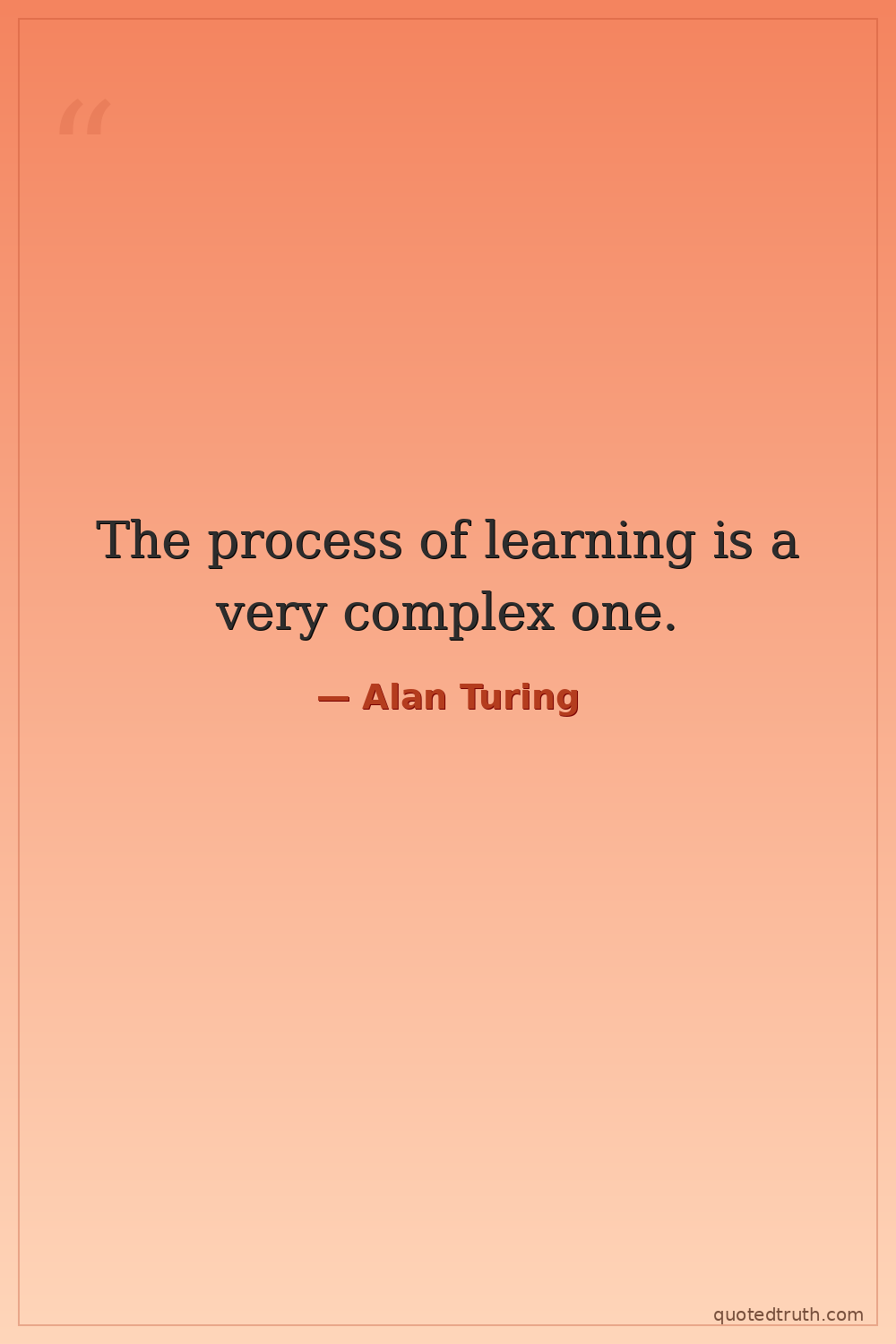
Alan Turing — "The process of learning is a very complex one."
The process of learning is a very complex one.
The process of learning is a very complex one.
Click any product to generate a realistic preview. Up to 3 at a time.
* Initial load can take up to 90 seconds — revising the preview in another color is nearly instant.
"Programming is a skill best acquired by practice and example rather than from books."
"The view that machines cannot give rise to surprises is due, I believe, to a fallacy to which philosophers and mathematicians are particularly subject."
"No doubt I shall emerge from it all a different man, but quite who I've not found out."
"The only constant in life is change."
"The possibility of a machine thinking is a disturbing thought for many people."
Found in 1 providers: grok
1 source checked
Learning isn't a simple, linear procedure — it's a layered, non-linear process involving pattern recognition, memory, feedback loops, error correction, and continuous adaptation. Complexity here isn't a flaw to engineer away but an inherent property of how minds, biological or mechanical, actually acquire new capabilities. Acknowledging that complexity honestly is the prerequisite for building any system that might genuinely replicate it.
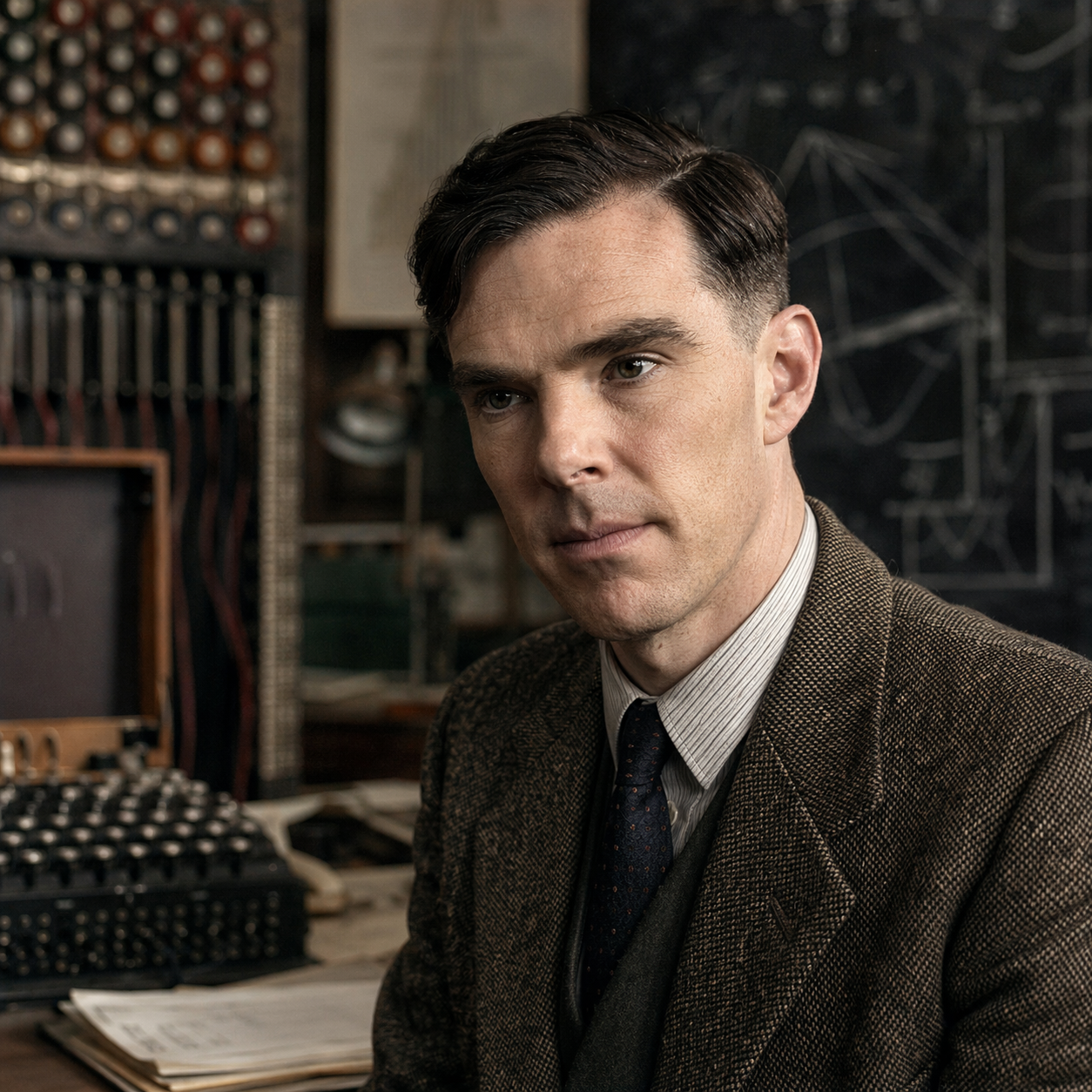
Turing's 1950 paper 'Computing Machinery and Intelligence' asked whether machines could learn and think — and his answer hinged on acknowledging learning's inherent complexity. He proposed the 'child machine' concept: rather than programming an adult mind, you'd train a machine from scratch, letting it grow. His WWII codebreaking work at Bletchley Park also required processing wildly complex, noisy patterns — no simple rule would crack Enigma.
In the late 1940s and early 1950s, computers were seen as deterministic, rule-following calculators — the opposite of learning systems. Turing was arguing that true intelligence demanded something far messier. Cognitive science barely existed; behaviorism still dominated psychology. The Cold War created pressure for fast technological solutions, yet Turing insisted that genuinely intelligent machines couldn't be shortcut — they'd need to grow through experience, not just execute fixed programs.
AI-generated insights based on extensive research and information for context. Factual errors? Email [email protected].
Your cart is empty