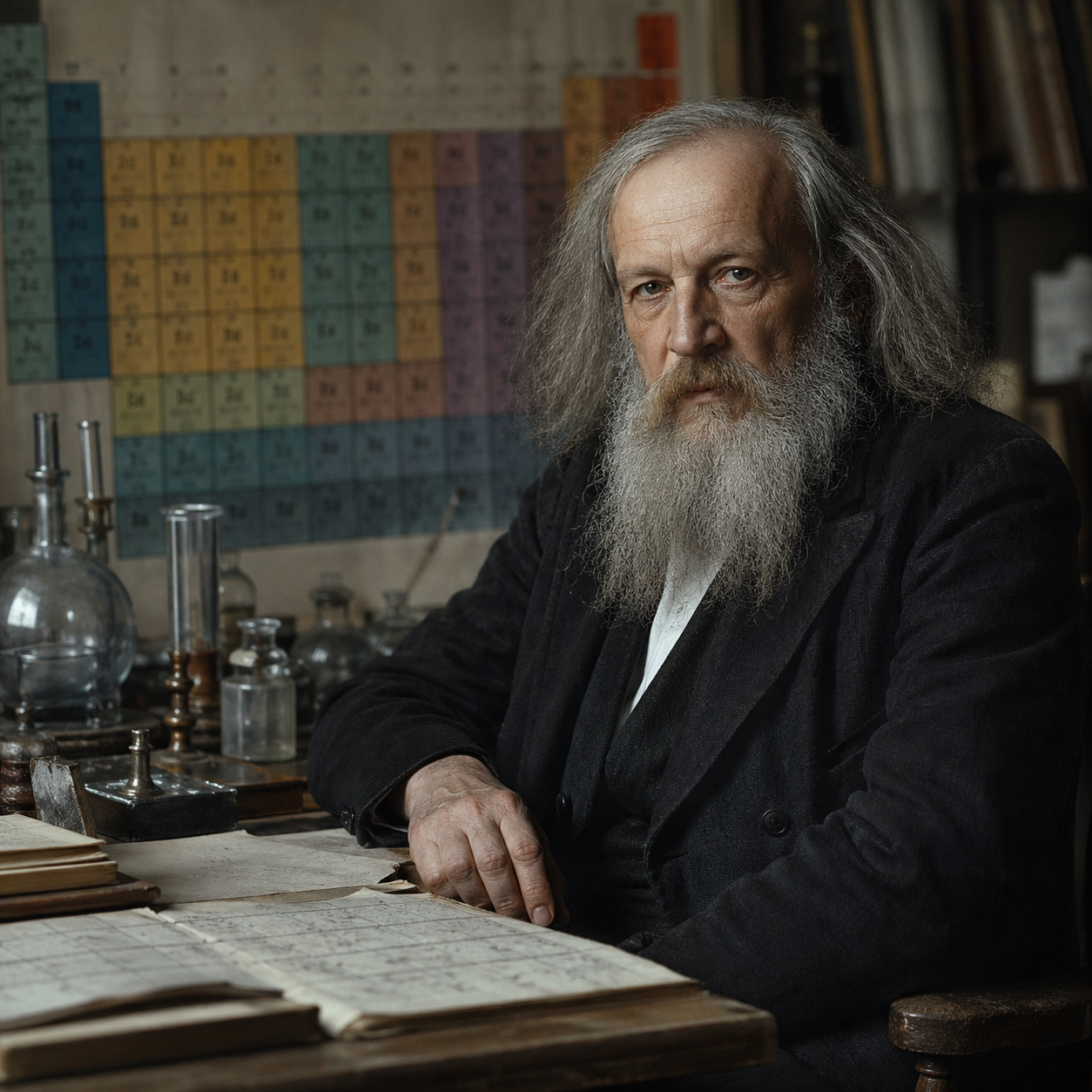
Dmitri Mendeleev — "The properties of the elements are a periodic function of their atomic weights."
The properties of the elements are a periodic function of their atomic weights.
The properties of the elements are a periodic function of their atomic weights.
Click any product to generate a realistic preview. Up to 3 at a time.
* Initial load can take up to 90 seconds — revising the preview in another color is nearly instant.
"No one nor anything can silence me."
"One day, all elements will be discovered and their properties understood."
"It is the function of the scientist to do 3 things: to observe, to generalize, and to predict."
"There is nothing in this world that I fear to say."
"To protect the Russian borders from enemies, I would surround the whole country with a continuous wall of vodka."
Found in 1 providers: grok
1 source checked
Elements don't have random properties. If you line them up by atomic weight, their characteristics repeat in a regular pattern. Light, reactive metals appear at predictable intervals, as do inert gases and halogens. This rhythm means chemistry isn't a chaotic catalog of substances but an ordered system where position predicts behavior. Knowing where an element sits in the sequence tells you roughly how it will bond, react, and combine with others.
This is Mendeleev's periodic law, the insight that made him famous. In 1869, arranging 63 known elements by weight, he spotted the recurring pattern and boldly left gaps for undiscovered elements, predicting properties of gallium, scandium, and germanium years before their discovery. A Siberian-born chemist who valued systematic thinking over memorization, he built his table partly as a teaching tool for his St. Petersburg students, embodying his belief that nature hides deep order beneath apparent variety.
The late 1800s were chemistry's cataloging era. Dozens of new elements had been isolated through electrolysis and spectroscopy, but no one understood why they behaved in families. Atomic weights were freshly measurable, industrial chemistry was booming with dyes and fertilizers, and Russia under the tsars was racing to modernize its science. Mendeleev's law arrived alongside Darwin's evolution and Maxwell's equations, part of a broader Victorian confidence that underlying natural laws could be uncovered through patient observation.
AI-generated insights based on extensive research and information for context. Factual errors? Email [email protected].
Your cart is empty