Max Planck — "The quantum of action is the universal constant that determines the size of the …"
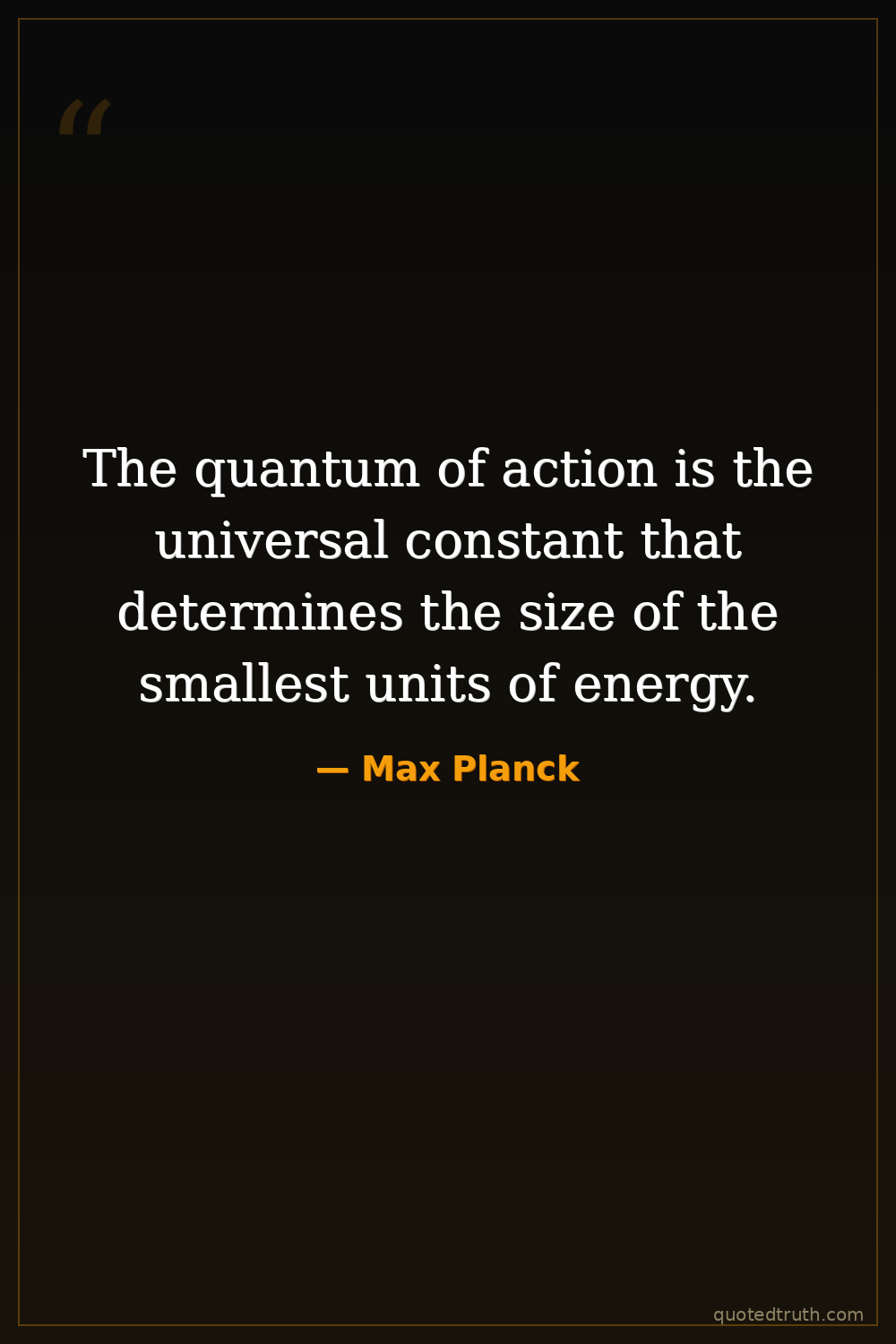
The quantum of action is the universal constant that determines the size of the smallest units of energy.
The quantum of action is the universal constant that determines the size of the smallest units of energy.
Click any product to generate a realistic preview. Up to 3 at a time.
* Initial load can take up to 90 seconds — revising the preview in another color is nearly instant.
"I learned more from my professors in one year than I have from all the books I've read."
"When you change the way you look at things, the things you look at change."
"There are no contradictions in nature. There are only contradictions in the human mind."
"Insight must precede application."
"No burden is so heavy for a man to bear as a succession of happy days."
Found in 1 providers: grok
1 source checked
Energy does not flow continuously but comes in tiny, discrete packets. There is a fundamental, fixed number built into nature that sets the minimum chunk of energy any physical interaction can involve. Below that threshold, nothing smaller exists. This constant is the same everywhere in the universe, unchanging across time and place, and it governs how atoms, light, and all microscopic processes exchange energy in measurable jumps.
Planck introduced this constant in 1900 while trying to explain blackbody radiation, and it became the foundation of quantum physics. Reluctantly, he accepted that energy is quantized, overturning the classical continuous worldview he was trained in. The constant now bears his name, h, and defined his scientific legacy. A deeply rigorous German theorist, Planck spent decades wrestling with the philosophical implications of his own discovery, which earned him the 1918 Nobel Prize in Physics.
Planck spoke during the early twentieth century, when classical Newtonian physics was cracking under experimental anomalies like blackbody radiation and the photoelectric effect. Europe's scientific establishment was being forced to abandon deterministic continuity for a strange new probabilistic framework. Einstein, Bohr, Heisenberg, and Schrödinger built quantum mechanics on Planck's foundation while Germany itself endured World War I, Weimar collapse, and Nazi rule, which personally devastated Planck's family and institutions.
AI-generated insights based on extensive research and information for context. Factual errors? Email [email protected].
Your cart is empty