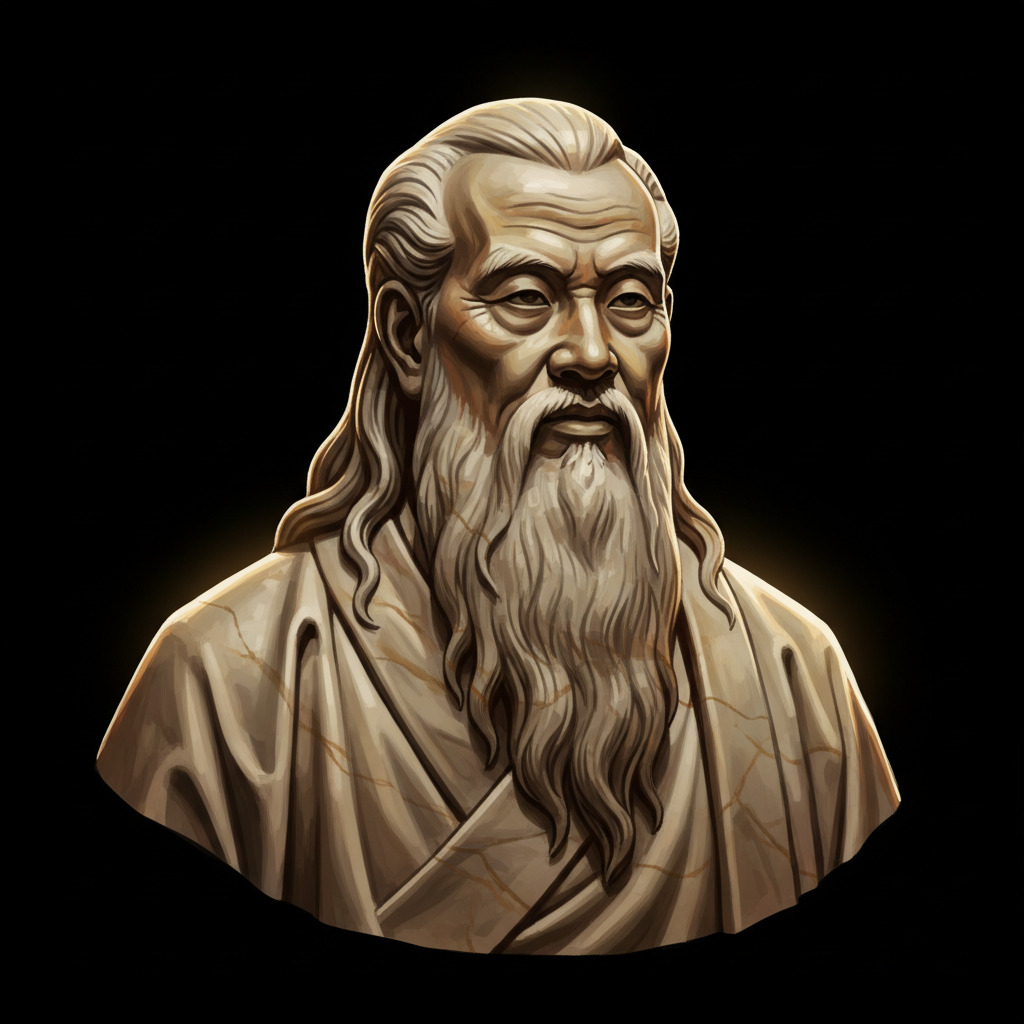
Laozi — "The sage attends to the belly, and not to what he sees."
The sage attends to the belly, and not to what he sees.
The sage attends to the belly, and not to what he sees.
Click any product to generate a realistic preview. Up to 3 at a time.
* Initial load can take up to 90 seconds — revising the preview in another color is nearly instant.
"Knowing others is intelligence; knowing yourself is true wisdom. Mastering others is strength; mastering yourself is true power."
"The Sage manages affairs without doing anything, and spreads doctrines without speaking."
"Governing a large country is like frying a small fish."
"The best rulers are those whose existence is barely known by the people."
"Truthful words are not always beautiful; beautiful words are not always truthful."
Reputed founder of Taoism and author of the Tao Te Ching, whose wu wei (effortless action) shaped East Asian philosophy. Closely associated with Zhuangzi (later Taoist who extended Laozi's framework). For an intellectual contrast, see Confucius, near-contemporary Chinese sage of social ritual and duty — Confucius systematized social order through ritual and hierarchy; Laozi argued that all such systems were the disease, not the cure — the two founding poles of Chinese moral philosophy.
Found in 1 providers: gemini
1 source checked
Focus on genuine inner needs rather than surface appearances or sensory desires. The belly represents real sustenance and essential well-being, while the eyes represent craving for spectacle, status, and accumulation. A wise person nourishes what actually sustains them and ignores distractions that inflame appetite without satisfying it. Fill yourself with substance, not stimulation, and you stay grounded instead of chasing whatever catches your eye.
Laozi, traditionally a keeper of royal archives in the Zhou court, watched rulers and courtiers destroy themselves chasing luxury, reputation, and conquest. Taoism centers on simplicity, wu wei, and returning to a natural, uncluttered state. This saying captures his core conviction that desire driven by the senses enslaves people, while attending to basic needs frees them. He reportedly left society on a water buffalo when the court's appetites grew intolerable.
Laozi lived during the late Zhou dynasty, an era of collapsing central authority sliding toward the Warring States period. Aristocrats competed through extravagant courts, elaborate rituals, and military conquest, while peasants starved. Philosophers across China debated how to restore order. Against Confucian emphasis on ceremony and hierarchy, Laozi's message of simplicity and minimal desire was a radical critique of a ruling class whose visible appetites were tearing the social fabric apart.
AI-generated insights based on extensive research and information for context. Factual errors? Email [email protected].
Your cart is empty