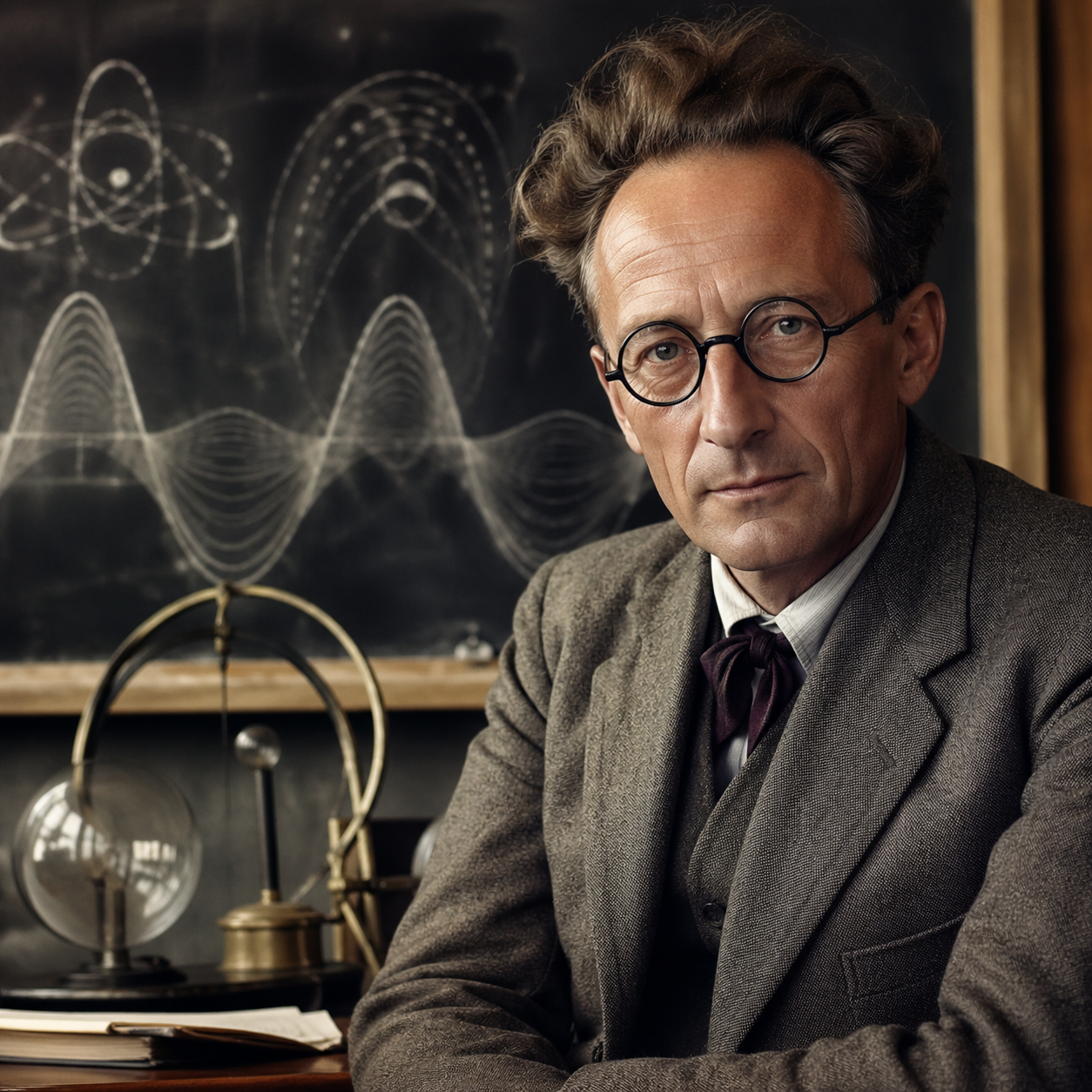
Erwin Schrodinger — "The scientific method is the best way to get at the truth, but it is not the onl…"
The scientific method is the best way to get at the truth, but it is not the only way.
The scientific method is the best way to get at the truth, but it is not the only way.
Click any product to generate a realistic preview. Up to 3 at a time.
* Initial load can take up to 90 seconds — revising the preview in another color is nearly instant.
"The greatest obstacle to discovery is not ignorance, but the illusion of knowledge."
"I am very astonished that the scientific picture of the world around me is very deficient. It gives a lot of factual information, puts all our experience in a magnificently consistent order, but it is…"
"Consciousness is a singular of which the plural is unknown."
"The greatest obstacle to progress in science is the belief that one knows something which one does not know."
"The atom consists of a nucleus and electrons. This is a very crude picture, but it is the one we have to work with."
Austrian physicist who shared the 1933 Nobel for the wave equation that bears his name and the famous cat thought-experiment. Closely associated with Werner Heisenberg (matrix-mechanics rival who reached the same physics by different math) and Albert Einstein (his pen-pal on quantum interpretation). For an intellectual contrast, see Niels Bohr, Danish physicist and architect of the Copenhagen interpretation — Schrödinger's cat thought-experiment was specifically designed to ridicule Bohr's 'observer-dependent reality' reading of quantum mechanics — Schrödinger thought the Copenhagen interpretation was absurd; the cat was meant as reductio ad absurdum.
Found in 1 providers: grok
1 source checked
Science is our most reliable tool for discovering truth, but it doesn't have a monopoly on it. Other modes of understanding—philosophy, art, intuition, personal experience—can also yield genuine insights about reality. This isn't anti-science; it's an acknowledgment that human knowledge is broader than any single methodology, and that rigidly excluding non-scientific ways of knowing impoverishes our understanding of existence.
Schrödinger was a quantum pioneer who developed wave mechanics in 1926, yet he spent decades exploring Hindu Vedanta, philosophy of mind, and consciousness. His book 'What is Life?' bridged biology and physics speculatively. He wrote 'My View of the World' on philosophical idealism. His career embodied exactly this belief—scientific rigor coexisting with metaphysical inquiry into consciousness and the nature of reality.
The early-to-mid 20th century saw quantum mechanics upend classical certainty, forcing physicists to confront observer effects and probability at reality's foundation. Simultaneously, logical positivism dominated philosophy, insisting only empirically verifiable statements were meaningful. Schrödinger pushed back against this scientism, engaging Eastern philosophy and phenomenology as Europe grappled with two world wars that shook faith in purely rationalist progress.
AI-generated insights based on extensive research and information for context. Factual errors? Email [email protected].
Your cart is empty