Erwin Schrodinger — "The scientific picture of the world is a simplification, an abstraction, and it …"
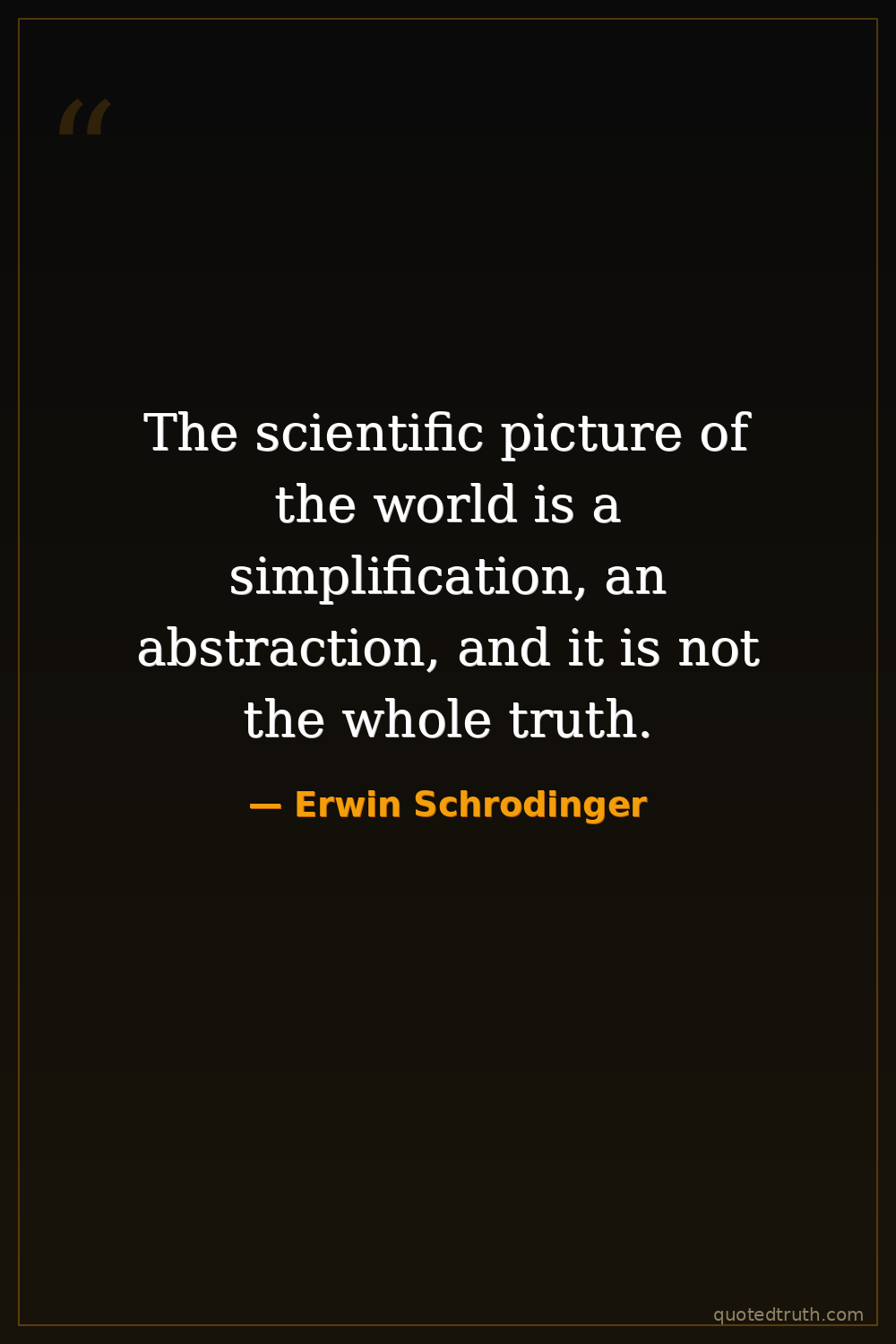
The scientific picture of the world is a simplification, an abstraction, and it is not the whole truth.
The scientific picture of the world is a simplification, an abstraction, and it is not the whole truth.
Click any product to generate a realistic preview. Up to 3 at a time.
* Initial load can take up to 90 seconds — revising the preview in another color is nearly instant.
"What we observe is not nature in itself but nature exposed to our method of questioning."
"The path to knowledge is paved with doubt."
"The world is not something that exists independently of us. It is something that we create."
"The human organism is a highly ordered and organized system, which maintains its order by continually drawing order from its environment."
"The greatest discovery of all is that the universe is alive."
Austrian physicist who shared the 1933 Nobel for the wave equation that bears his name and the famous cat thought-experiment. Closely associated with Werner Heisenberg (matrix-mechanics rival who reached the same physics by different math) and Albert Einstein (his pen-pal on quantum interpretation). For an intellectual contrast, see Niels Bohr, Danish physicist and architect of the Copenhagen interpretation — Schrödinger's cat thought-experiment was specifically designed to ridicule Bohr's 'observer-dependent reality' reading of quantum mechanics — Schrödinger thought the Copenhagen interpretation was absurd; the cat was meant as reductio ad absurdum.
Found in 1 providers: grok
1 source checked
Science constructs models by selecting measurable variables and discarding everything else — consciousness, aesthetic experience, moral meaning. These models work extraordinarily well within their domain but are maps, not the territory. Treating the scientific description of reality as complete truth is a category error. Reality is richer than any formal system designed to predict and measure it can fully capture.
Schrödinger pioneered wave mechanics but spent decades wrestling with its philosophical implications. His book What is Life bridged physics and biology, while Mind and Matter explored consciousness directly. He drew heavily on Vedantic philosophy, believing the subjective observer could never be excised from science. His cat paradox exposed quantum mechanics' incompleteness at the level of observable reality — he lived this tension professionally.
Schrödinger worked during the quantum revolution of the 1920s through 1950s, when physics dismantled Newtonian certainty. The Copenhagen interpretation held that systems have no definite properties until measured, collapsing the classical picture of an objective world. Meanwhile, existentialism challenged scientism across Europe. The atomic bomb demonstrated science's terrifying power yet moral blindness, intensifying debates about whether rationalism alone could guide civilization.
AI-generated insights based on extensive research and information for context. Factual errors? Email [email protected].
Your cart is empty