Francis Crick — "The scientist has to be a bit of an artist."
The scientist has to be a bit of an artist.
The scientist has to be a bit of an artist.
Click any product to generate a realistic preview. Up to 3 at a time.
* Initial load can take up to 90 seconds — revising the preview in another color is nearly instant.
"There is no scientific evidence for the existence of a soul."
"If you are honest, you will find that you are often wrong. But if you are not honest, you will never find out."
"I'm a reductionist."
"The scientific view of the world is a harsh one."
"Chance is the only source of true novelty."
Found in 1 providers: grok
1 source checked
Science demands more than logic and data — it requires imagination. A scientist must visualize what hasn't been seen yet, construct elegant hypotheses from incomplete information, and make creative leaps that pure analysis can't deliver. Discovery happens at the boundary between rigorous method and inspired intuition. The best scientific breakthroughs aren't just found through observation; they're shaped by the ability to imagine, model, and see patterns others miss.
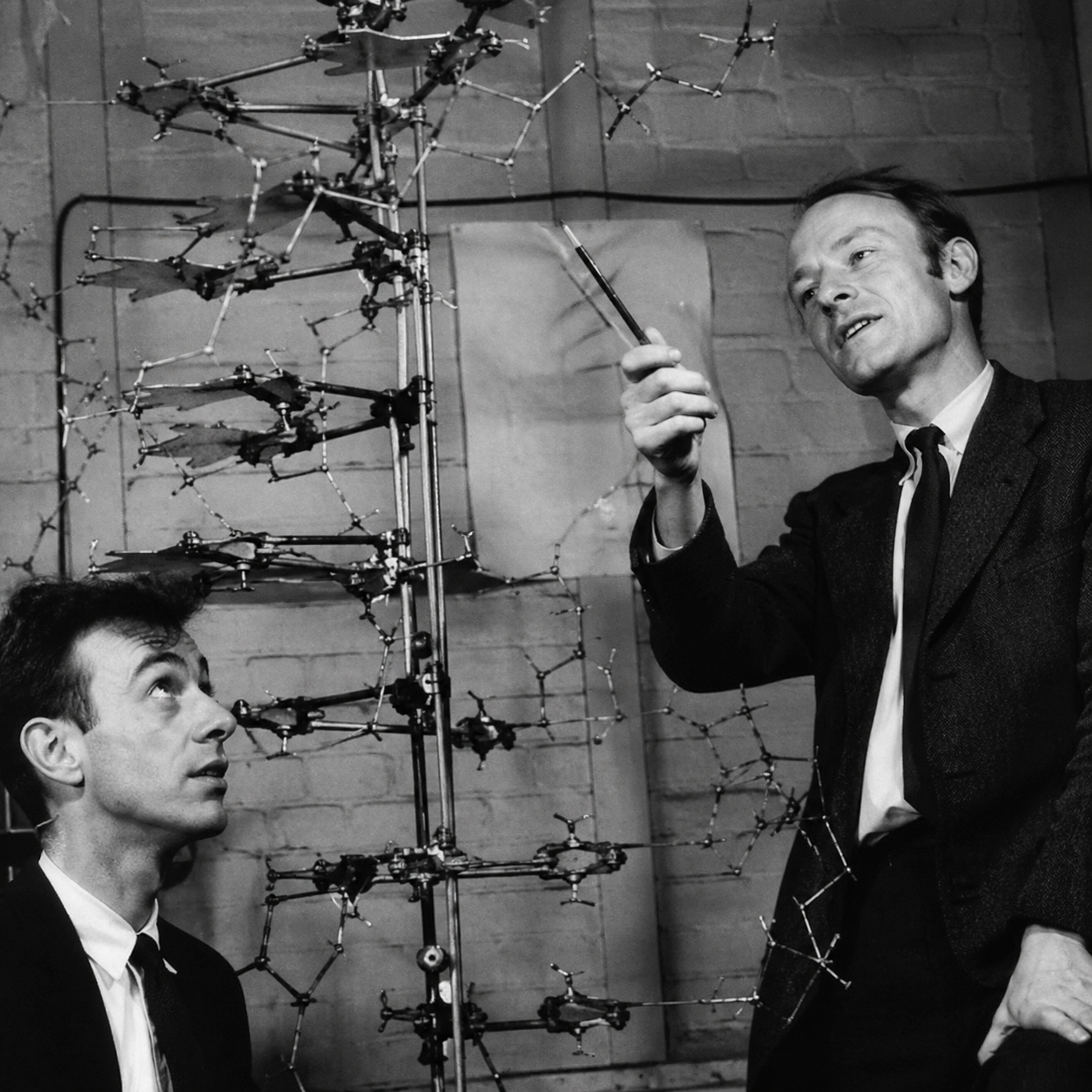
Crick exemplified this belief. A physicist turned biologist, he and Watson solved DNA's structure not by running crystallography experiments themselves but by building physical tin-and-wire models — an act of three-dimensional artistic imagination guided by others' data. Crick was famously bold, speculative, and visual in his thinking, valued elegant theory over incremental empiricism, and believed intuition and model-building were as essential to discovery as rigorous experimentation.
The mid-20th century saw science increasingly portrayed as cold, systematic, and industrial — an age of specialization, Cold War research programs, and computing. C.P. Snow's famous 1959 'Two Cultures' lecture had just declared science and the humanities irreconcilably split. Crick's view pushed back against that divide. In an era when scientific prestige came from methodological rigor, asserting that creativity and artistic intuition were essential to discovery was a meaningful, even countercultural, claim.
AI-generated insights based on extensive research and information for context. Factual errors? Email [email protected].
Your cart is empty