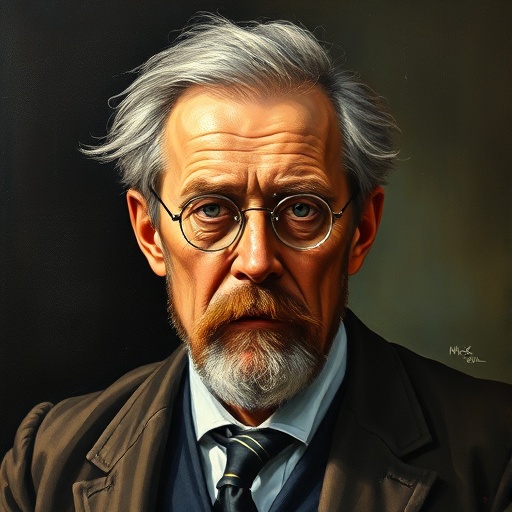
Max Planck — "The scientist must be a dreamer and a realist at the same time."
The scientist must be a dreamer and a realist at the same time.
The scientist must be a dreamer and a realist at the same time.
Click any product to generate a realistic preview. Up to 3 at a time.
* Initial load can take up to 90 seconds — revising the preview in another color is nearly instant.
"When we speak of the 'reality' of the external world, we mean that it is independent of our perception of it."
"The greatest obstacle to discovery is not ignorance, but the illusion of knowledge."
"There is no matter as such. All matter originates and exists only by virtue of a force."
"When you change the way you look at things, the things you look at change."
"The quantum of action is the universal constant that determines the size of the smallest units of energy."
Found in 1 providers: grok
1 source checked
Doing science well requires two mindsets that seem opposite. You need imagination to picture possibilities that don't yet exist, to guess at hidden rules, and to see beyond what current evidence shows. But you also need discipline to test those guesses against stubborn facts, accept inconvenient results, and discard beautiful ideas that don't match reality. Neither alone is enough; pure dreaming drifts into fantasy, pure realism never reaches new ground.
Planck embodied this duality. As a realist, he was a rigorously trained thermodynamicist who resisted speculation and initially distrusted his own quantum hypothesis of 1900, calling it an 'act of desperation' to fit blackbody data. Yet as a dreamer, he proposed that energy came in discrete packets, a radical break from classical continuity that overturned physics. He spent years trying to reconcile the leap with older theory, holding both imagination and empirical discipline in tension.
Planck worked at the turn of the twentieth century, when classical physics seemed nearly complete yet was breaking down on problems like blackbody radiation and the photoelectric effect. German universities prized rigorous experiment and mathematical formalism, while a younger generation including Einstein and Bohr pushed toward stranger interpretations. Two world wars, the rise and fall of Nazism, and the birth of quantum mechanics and relativity all unfolded during his career, demanding both visionary theorizing and grounded experimental verification.
AI-generated insights based on extensive research and information for context. Factual errors? Email [email protected].
Your cart is empty