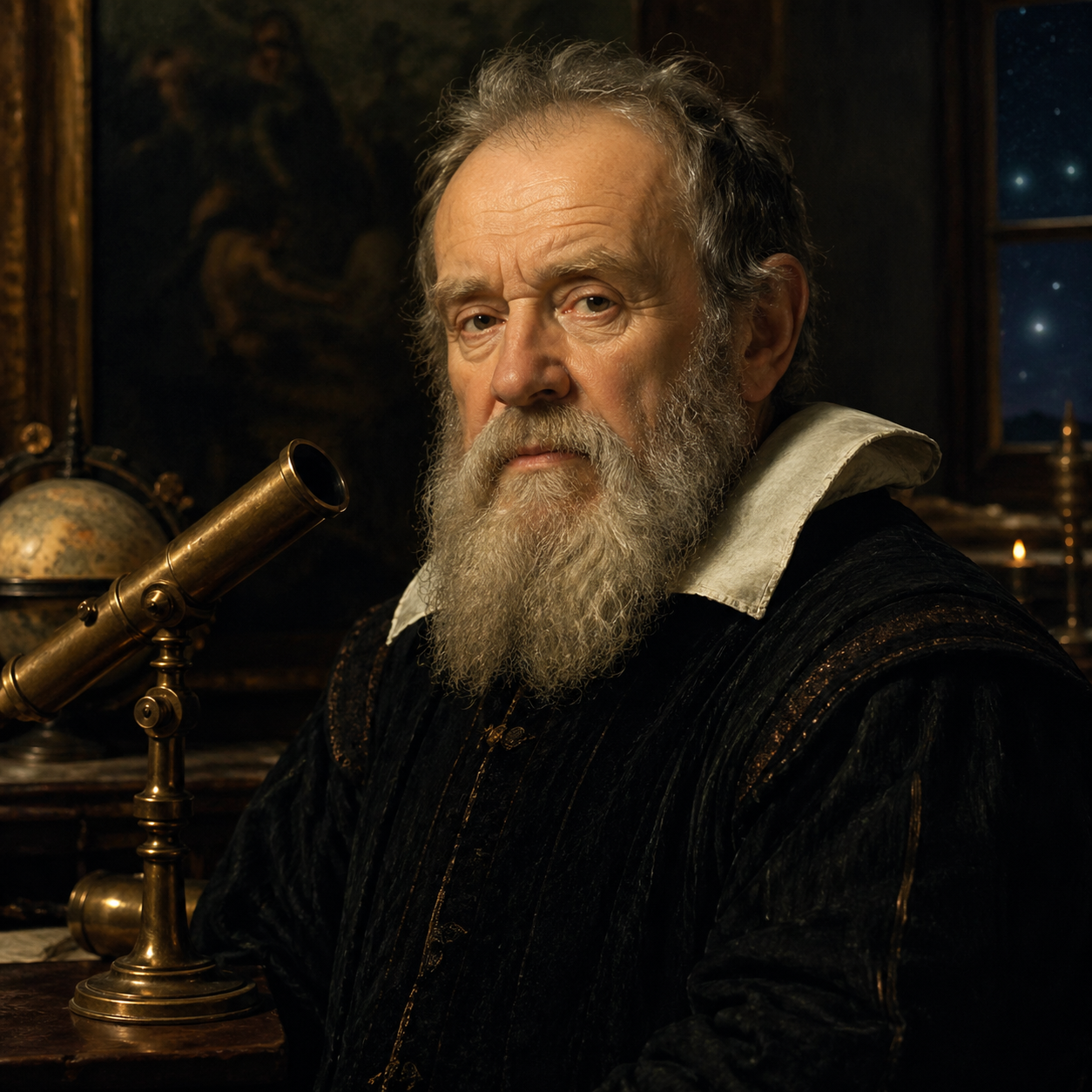
Galileo Galilei — "The senses, assisted by reason, are the source of all our knowledge."
The senses, assisted by reason, are the source of all our knowledge.
The senses, assisted by reason, are the source of all our knowledge.
Click any product to generate a realistic preview. Up to 3 at a time.
* Initial load can take up to 90 seconds — revising the preview in another color is nearly instant.
"What is important is to understand the language of nature, not to impose on it our own prejudices."
"To apply oneself to a search for the truth, without any intent to serve some predetermined end, is the true path to discovery."
"It is a great pity that there are so few who are interested in the true causes of things."
"I think that in the discussion of natural problems we ought not to begin at the authority of places of Scripture, but at sensible experiments and necessary demonstrations."
"Eppur si muove! (And yet it moves!)"
Found in 1 providers: grok
1 source checked
Knowledge comes from observing the world through our senses and then applying logical reasoning to what we perceive. We don't arrive at truth through tradition, authority, or pure speculation — we must look, measure, and think. Direct experience combined with rational analysis is the only reliable foundation for understanding how reality actually works.
Galileo built his entire career on this principle. He didn't accept Aristotle's physics on authority — he dropped objects from the Leaning Tower of Pisa, observed Jupiter's moons through his telescope, and measured pendulum swings. His conflict with the Church stemmed precisely from prioritizing empirical observation over scripture-based cosmology, costing him his freedom.
In early modern Europe, medieval scholasticism still dominated — truth was derived from Church authority and ancient Greek texts, not experiment. Galileo's era saw the Scientific Revolution challenging this order. His insistence on sensory observation over received doctrine was radical and dangerous, directly threatening the institutional power of both the Catholic Church and Aristotelian academic tradition.
AI-generated insights based on extensive research and information for context. Factual errors? Email [email protected].
Your cart is empty