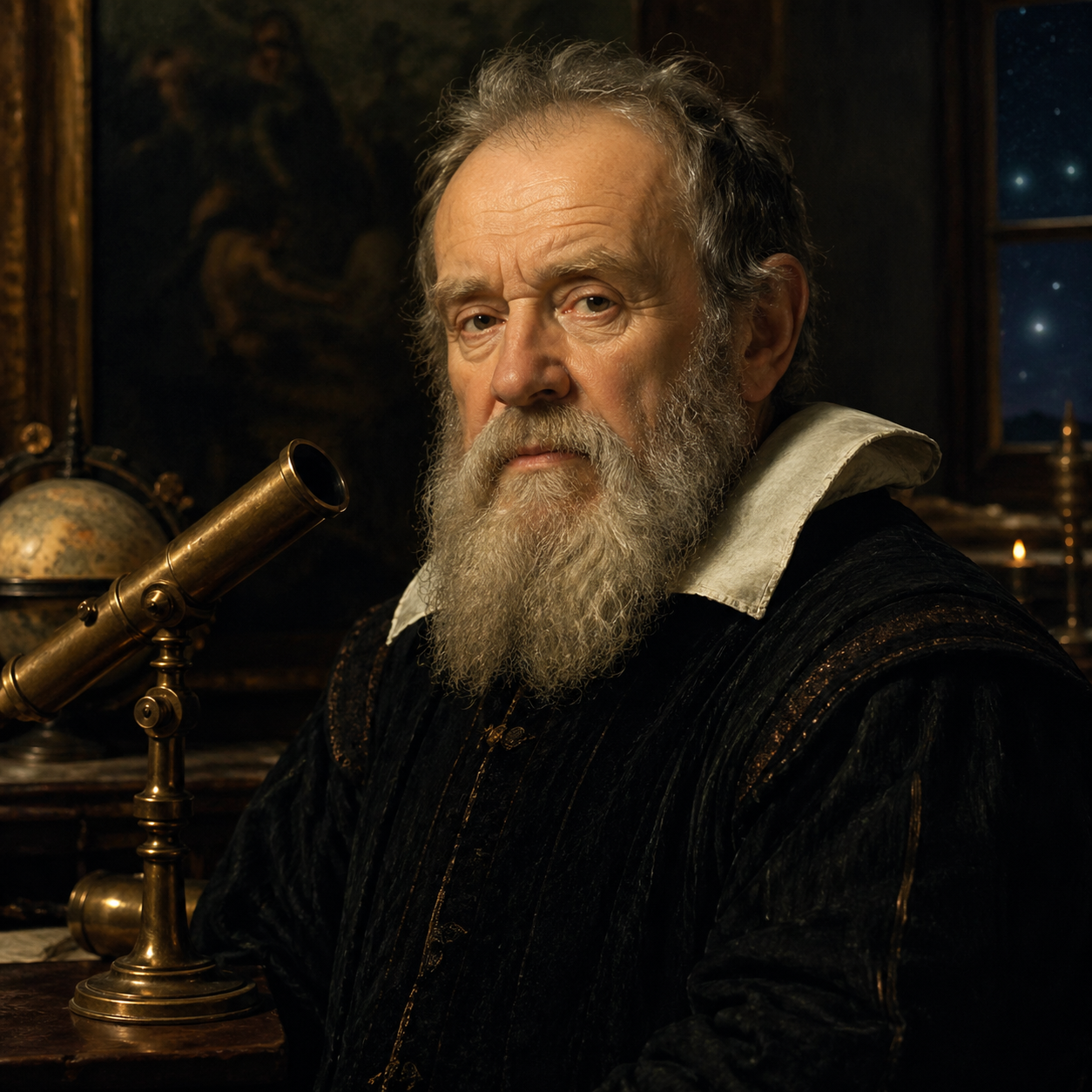
Galileo Galilei — "The senses, though they are sometimes deceived, are not always so."
The senses, though they are sometimes deceived, are not always so.
The senses, though they are sometimes deceived, are not always so.
Click any product to generate a realistic preview. Up to 3 at a time.
* Initial load can take up to 90 seconds — revising the preview in another color is nearly instant.
"Wine is sunlight, held together by water."
"I have written up many reasons and refutations on the subject, but I have not dared until now to bring them into the open, being warned by the fortunes of Copernicus himself, our master, who procured …"
"The deeper we penetrate into the universe, the more we realize that it is written in the language of mathematics."
"And finally, if the earth were to stop spinning, then the water in the oceans would fly off, and the mountains would crumble. So it must be moving."
"There are those who are so afraid of truth that they would rather deny the evidence of their own senses than admit it."
Acknowledging limitations but asserting the value of sensory experience.
Date: c. 1600s
GeneralFound in 1 providers: grok
1 source checked
Our senses can mislead us at times, but they aren't fundamentally unreliable. Careful, repeated observation corrects individual errors. Systematic sensory experience—not pure abstract reasoning alone—is a valid and essential path to understanding reality. We shouldn't dismiss empirical evidence just because perception occasionally fails us.
Galileo built his career on precise telescopic observation, discovering Jupiter's moons, lunar craters, and sunspots through disciplined sensory inquiry. Against Scholastic philosophers who distrusted the senses in favor of Aristotelian text, he insisted careful empirical observation was trustworthy. His entire method depended on rehabilitating—not abandoning—sensory evidence when rigorously applied.
In the early 1600s, dominant Aristotelian and Scholastic traditions prioritized received philosophical authority over direct observation. The Catholic Church viewed Scripture as superior to empirical findings. Galileo's defense of the senses was radical: it challenged centuries of epistemological hierarchy that placed reason and revelation above experiment, helping birth the Scientific Revolution's foundational empiricist commitment.
AI-generated insights based on extensive research and information for context. Factual errors? Email [email protected].
Your cart is empty